All species › Passerines › Antbirds › Giant Antshrike
Giant Antshrike | Batara cinerea
Reuzenmierklauwier | Batará gigante | Matracão
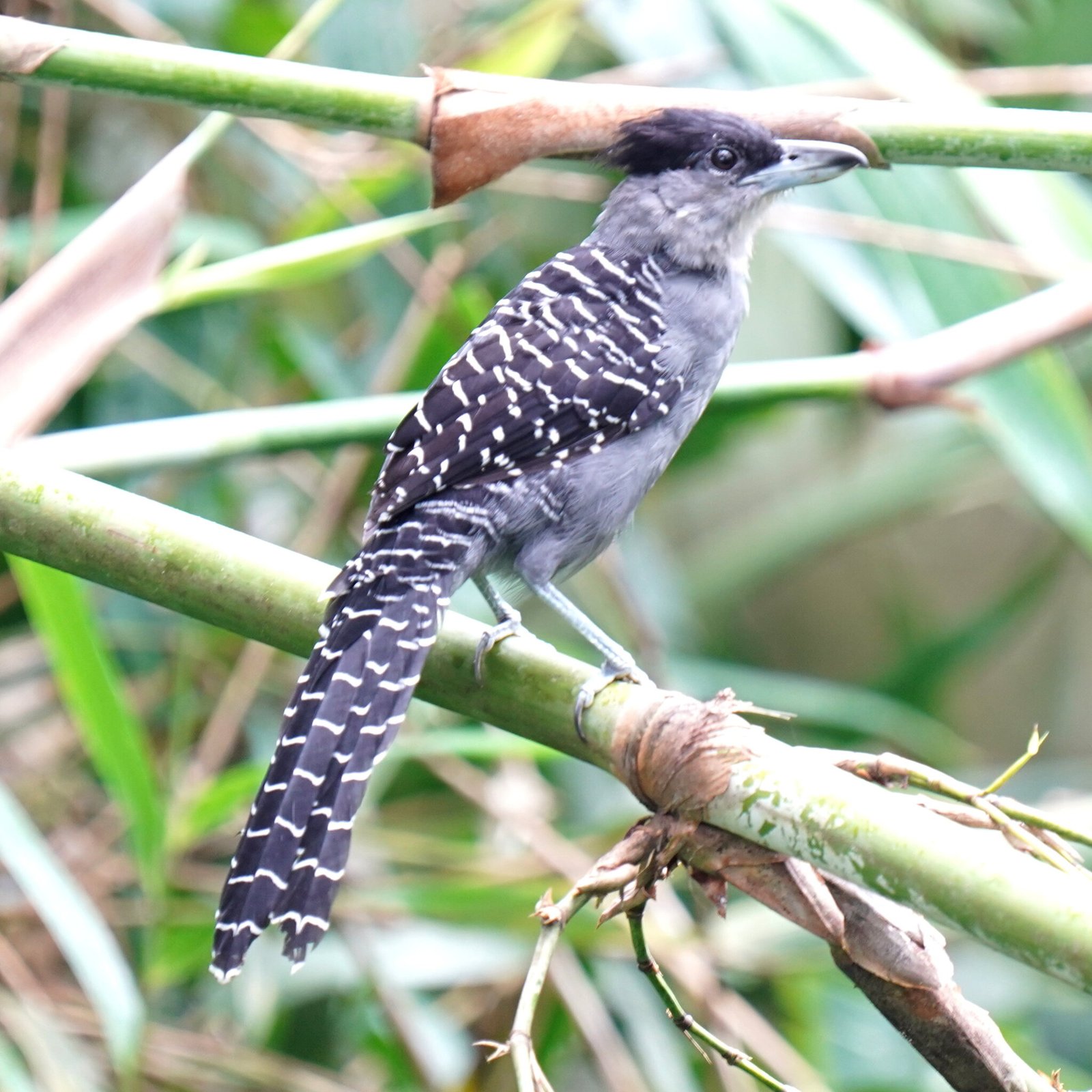
The Giant Antshrike is the largest member of the family, a bulky, crested antshrike with a heavy, strongly hooked bill. It lives hidden in dense thickets and bamboo, but is often heard. In the guide area it occurs only in Bolivia, at the northern edge of a range that extends to Argentina and south-eastern Brazil.
Voice
The song starts with a short trill and turns into fast notes that rise in strength and pitch, then level off and slow down at the end. Calls are a long, raspy, downslurred snarl, often repeated rapidly, and a short series of loud, abrupt notes.
Recording: Aluisio Ribeiro — CC BY-NC-SA 4.0 · xeno-canto
Identification
30–33 cm, large and long-tailed, with a crest and a very heavy, hook-tipped bill. The male has a black crown and crest; the back, wings and long tail are densely barred black and white, and the face and underparts are grey. The female has a rufous crest; the back, wings and tail are barred dark brown and cinnamon, and the underparts are olive-brown to yellowish. The Bolivian forms are somewhat smaller and paler than those of south-eastern Brazil.
Confusion species
Great Antshrike Taraba major is smaller, with a red iris, plain black upperparts and white underparts in the male and rufous upperparts in the female. Variable Antshrike Thamnophilus caerulescens and Rufous-capped Antshrike Thamnophilus ruficapillus are much smaller and have a less heavy bill.
Habitat
Dense understorey and mid-storey of montane forest, thickets along ravines and streams, forest edges and stands of bamboo in the Yungas, up to about 2600 m; in the south and east also in dense, thorny scrub of dry forest and Chaco. It searches dense vegetation for large insects and other invertebrates, sometimes small vertebrates. The nest is a large, untidy cup of plant fibres and leaves in a fork, 1.5–3 m above the ground.
Where the bird is most at home, classified by the vegetation units of the Andes and the west coast.


Range and movements
Bolivia: on the eastern slope of the Andes and in the adjacent valleys and foothills, in Santa Cruz, Chuquisaca and Tarija, locally farther north. There are no confirmed records from Peru. Absent from Colombia, Ecuador and the Galápagos. Outside the guide area in north-western and north-eastern Argentina, Paraguay, south-eastern Brazil and Uruguay.
- Resident
- dark = core range, pale = thinly spread
How and when to look
In the early morning, listen for the accelerating song in montane forest and streamside thickets in the valleys of Santa Cruz and Chuquisaca. The bird usually sits deep in the vegetation and sometimes comes briefly to the edge in response to sound.
Conservation status
Least Concern. Numbers are thought to be declining; the species needs large territories and disappears from small forest fragments.
Scientific name
Batara cinerea | (Vieillot, 1819)
Vieillot described the species in 1819 as Tamnophilus cinereus; because it was later moved to another genus, the author and year stand in brackets. The genus Batara was introduced in 1831 by Lesson. The genus name goes back to batará or mbatará, Guaraní names for various small black-and-white birds, used by Félix de Azara. The species name cinerea is Latin for 'ash-grey'. The specimen the first description was based on came from Rio de Janeiro, Brazil.