All species › Passerines › Antbirds › Silvered Antbird
Silvered Antbird | Sclateria naevia
Mangrovemiervogel | Hormiguero plateado | Papa-formiga-do-igarapé
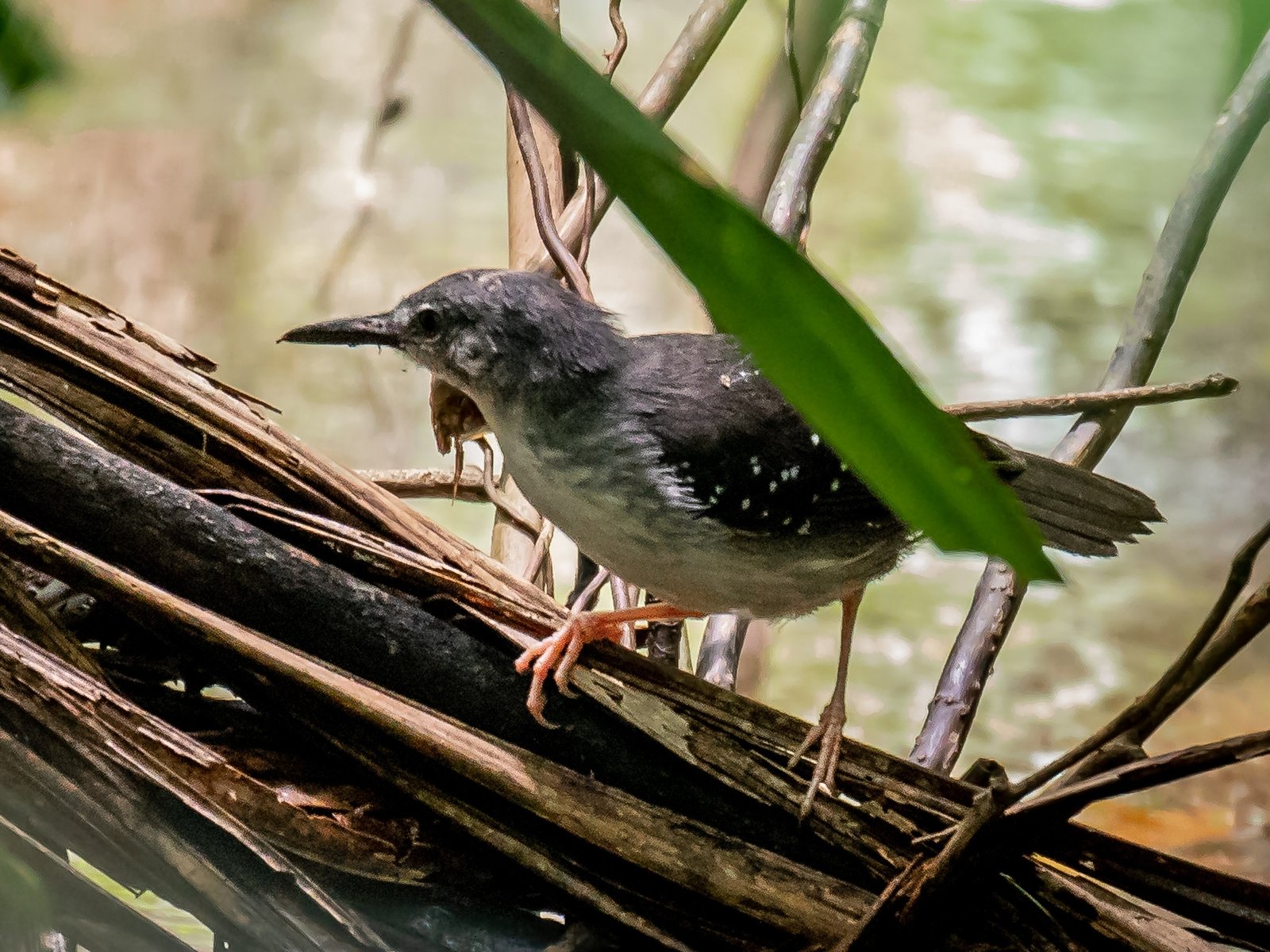
The Silvered Antbird is an antbird of stream banks and flooded forest that almost always forages just above the water or on the bank. It hops along fallen logs and roots and picks prey from the water surface. The Dutch name refers to populations along the coast of the Guianas; in the guide area it lives in the Amazonian lowlands, not in mangroves.
Voice
The song is a long, rapid trill of short, sharp notes that swells and rises in pitch, then drops steeply at the end. Calls are a short pit and a long, descending whistle.
Recording: Jelle Scharringa — CC BY-NC-SA 4.0 · xeno-canto
Identification
14–16 cm, with a long, straight bill, long pink legs and a fairly short tail. The male is dark slate-grey above, with small white dots on the wing coverts, and almost white below, with pale grey mottling on the breast and flanks. The female is greyish brown above, with pale dots on the wing, and white below, with pale brown to buff flanks and undertail coverts; in some females the entire underparts are warm buff. Young birds resemble the female.
Confusion species
Black-chinned Antbird Hypocnemoides melanopogon and Band-tailed Antbird Hypocnemoides maculicauda live in the same habitat, but are smaller, with a shorter bill, a white tail tip and, in the male, a black throat. Plumbeous Antbird Myrmelastes hyperythrus is larger, with blue bare skin around the eye; the male is also dark grey below and the female rufous below. White-browed Antbird Myrmoborus leucophrys has a white eyebrow and a black face and lives in thickets, not right at the water.
Habitat
Floor and understorey of flooded forest (várzea and igapó), banks of streams and forest lakes and swamp forest, in Ecuador and Peru also in Mauritia flexuosa palm swamps; up to about 450 m in Ecuador and 600 m in Peru. It forages alone, in pairs or in family groups within a metre of the ground or water, taking insects and spiders; it seldom follows army ants. The nest is an open cup of rootlets and moss, woven into low branches over water; the clutch is usually two eggs.
Where the bird is most at home, classified by the vegetation units of the Andes and the west coast.


Range and movements
Colombia: in the south-east, in the Amazonian lowlands and along the Orinoco tributaries. Ecuador: in the eastern lowlands. Peru: in the eastern lowlands, from north to south. Bolivia: in the north and north-east (Pando, Beni, La Paz and Santa Cruz). Absent from the Galápagos. Outside the guide area in Venezuela, the Guianas, Trinidad and much of Amazonian Brazil.
- Resident
- dark = core range, pale = thinly spread
How and when to look
In the early morning follow a forest stream or the shore of an oxbow lake by canoe or boardwalk; the song often comes from just above the water. Watch fallen logs and overhanging vines at the waterline.
Conservation status
Least Concern. Fairly common in suitable habitat in the guide area; the species depends on intact riverside forest.
Scientific name
Sclateria naevia | (Gmelin, 1788)
Gmelin described the species in 1788 as Sitta naevia; because it was later moved to another genus, the author and year stand in brackets. The genus Sclateria was introduced in 1899 by Oberholser. The genus name honours the English zoologist Philip Lutley Sclater (1829–1913), founder of The Ibis. The species name comes from Latin naevius, 'spotted'. The specimen the first description was based on came from Suriname.