All species › Passerines › Antbirds › White-cheeked Antbird
White-cheeked Antbird | Gymnopithys leucaspis
Witwangmiervogel | Hormiguero cariblanco | Mãe-de-taoca-bochechuda
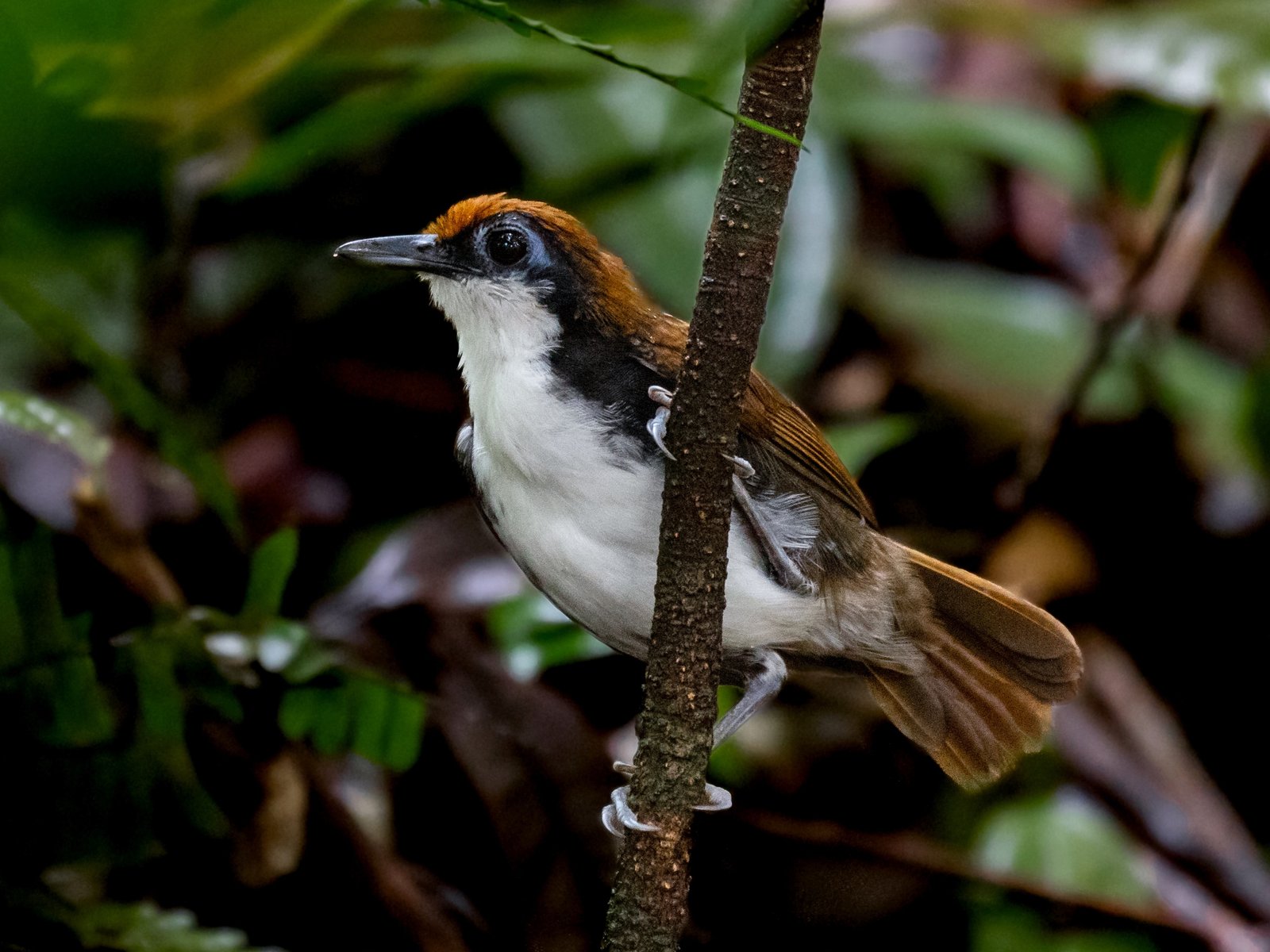
The White-cheeked Antbird is one of the most numerous ant-followers in north-western Amazonia. At army-ant swarms it is often the species present in the largest numbers. The contrast between the white throat and cheeks, the chestnut-brown upperparts and the blue skin around the eye makes it a recognisable figure in the dark understorey.
Voice
The song is a series of clear whistles that first rises, then falls and ends in a few rasping notes. At the ants a rasping, whirring chirr is often heard.
Recording: Mauricio Cuellar Ramirez (@Birding.travel) — CC BY-NC-SA 4.0 · xeno-canto
Identification
14 cm, with a short tail and a strong bill. Around the eye a patch of bare blue skin. The crown, nape and upperparts are chestnut-brown. The lores are blackish; the throat, cheeks, breast and centre of the belly are white, bordered at the sides by a narrow black edge, and the flanks and undertail coverts brown. The sexes are almost alike; in the female the wing coverts are sometimes pale-fringed. Juveniles are duller, with less white below.
Confusion species
West of the Andes lives the closely related Gymnopithys bicolor, with blackish cheeks and browner flanks; the ranges do not overlap. Lunulated Antbird Oneillornis lunulatus has a grey male with a white supercilium and throat. Hairy-crested Antbird Rhegmatorhina melanosticta has a crest, a black throat and dark underparts. Black-spotted Bare-Eye Phlegopsis nigromaculata is larger, with black spots on the upperparts and red skin around the eye.
Habitat
Understorey of humid terra firme and várzea lowland forest, also old secondary forest and forest edges, up to about 1000 m at the foot of the Andes, usually lower. It almost always follows army-ant swarms and catches flushed insects, spiders and other arthropods, also small lizards. The nest is an open cup low in a hollow stump or among palm fronds.
Where the bird is most at home, classified by the vegetation units of the Andes and the west coast.


Range and movements
Colombia: in the eastern lowlands, from Meta and Guaviare south to Putumayo and Amazonas. Ecuador: in the eastern lowlands. Peru: in the north-east, north of the Marañón and the Amazon. Bolivia: absent. Absent from the Galápagos. Outside the guide area in southern Venezuela and north-western Amazonian Brazil.
- Resident
- dark = core range, pale = thinly spread
How and when to look
In Yasuní, around Leticia or near Iquitos, search the understorey for army-ant swarms; where ant-followers gather, the White-cheeked Antbird is usually among them.
Conservation status
Least Concern. Common in undisturbed forest; as an obligate ant-follower the species disappears from small, isolated forest fragments.
Scientific name
Gymnopithys leucaspis | (Sclater, 1855)
Sclater described the species in 1855 as Myrmeciza leucaspis; because it was later moved to another genus, the author and year stand in brackets. The genus Gymnopithys was introduced in 1857 by Bonaparte. The genus name combines Greek gumnos, 'bare, naked', with the name of the antbird genus Pithys, erected by Vieillot in 1818. The species name combines Greek leukos, 'white', and aspis, 'shield', for the white patch on cheek and throat. The specimen the first description was based on came from Villavicencio, Colombia (suggested).