All species › Passerines › Antbirds › Black-spotted Bare-Eye
Black-spotted Bare-Eye | Phlegopsis nigromaculata
Roodoogmiertimalia | Carirrosa negripunteada | Mãe-de-taoca
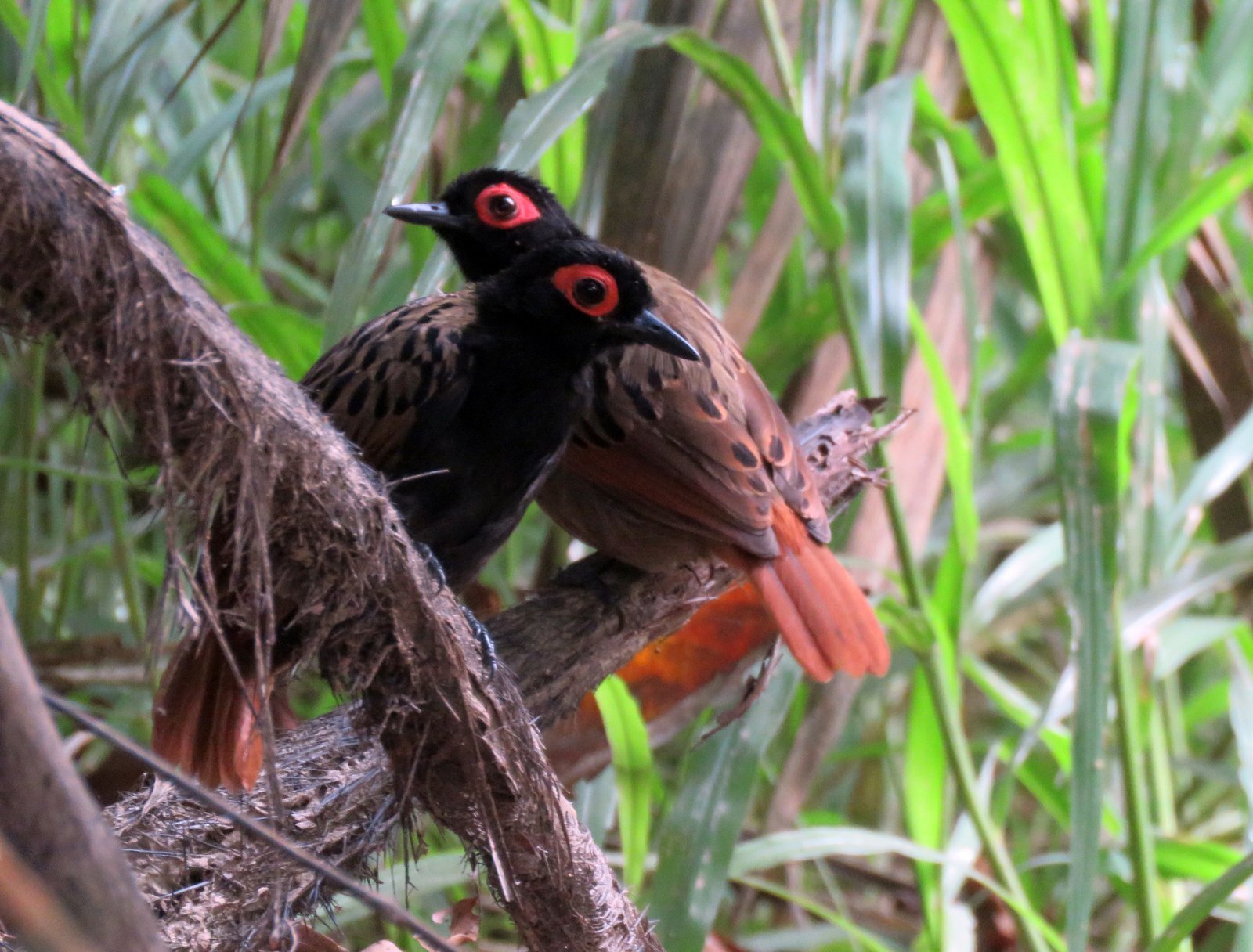
The Black-spotted Bare-eye is a large ant follower with bright red bare skin around the eye, a black head and underparts and a brown back full of black spots. It is an obligate ant follower and is among the largest and most dominant birds at army ant swarms. In the guide area it is widespread in the Amazonian lowlands.
Voice
The song is a short series of hoarse, descending whistles. At ant swarms it often gives harsh, grating calls and a churring chirrr.
Recording: JAYRSON ARAUJO DE OLIVEIRA — CC BY-NC-SA 4.0 · xeno-canto
Identification
16–18 cm, with a fairly long tail and long legs. A large patch of bright red bare skin surrounds the eye. Head, neck and underparts are black. Back, rump and wing coverts are olive-brown, with large black spots narrowly fringed pale; flight feathers and tail brown to rufous-brown. The sexes are alike; young birds are duller and browner.
Confusion species
Reddish-winged Bare-eye Phlegopsis erythroptera also has red skin around the eye, but the male has white-scaled upperparts and broad rufous wing bands, the female a brown body with rufous wing bands. Hairy-crested Antbird Rhegmatorhina melanosticta has bluish-white skin around the eye and a pale crest. Antthrushes such as Black-faced Antthrush Formicarius analis walk on the ground and lack a red eye-ring.
Habitat
Understorey of humid lowland forest, both terra firme and várzea, also tall secondary forest and forest edges, mostly below 600 m. It follows army ant swarms and from low saplings and twigs catches the arthropods fleeing the ants; usually in pairs or small groups.
Where the bird is most at home, classified by the vegetation units of the Andes and the west coast.


Range and movements
Colombia: in the south-east, from Meta and Guainía to Caquetá, Putumayo and Amazonas. Ecuador: in the eastern lowlands. Peru: throughout the Amazonian lowlands. Bolivia: in the north. Absent from the Galápagos. Outside the guide area in Amazonian Brazil, mainly south of the Amazon.
- Resident
- dark = core range, pale = thinly spread
How and when to look
In south-eastern Peru, for example around Tambopata or Manu, or in eastern Ecuador, look for an army ant swarm; at the swarm, watch for the red eye-ring in the shade of the understorey.
Conservation status
Least Concern. Widespread and locally fairly common. As an obligate ant follower it disappears from fragmented forest.
Scientific name
Phlegopsis nigromaculata | (d'Orbigny, ACVMD & de Lafresnaye, 1837)
D'Orbigny, ACVMD & de Lafresnaye described the species in 1837 as Myothera nigro-maculata; because it was later moved to another genus, the author and year stand in brackets. The genus Phlegopsis was introduced in 1850 by Reichenbach. The genus name comes from Greek phlox, 'flame' (from phlegō, 'to flame'), and opsis, 'countenance', for the bare skin around the eye. The species name comes from Latin niger, 'black', and maculatus, 'spotted'. The specimen the first description was based on came from Guayaros, Bolivia.