All species › Passerines › Antbirds › Reddish-winged Bare-Eye
Reddish-winged Bare-Eye | Phlegopsis erythroptera
Roodvleugelmiertimalia | Carirrosa alirrojiza | Mãe-de-taoca-avermelhada
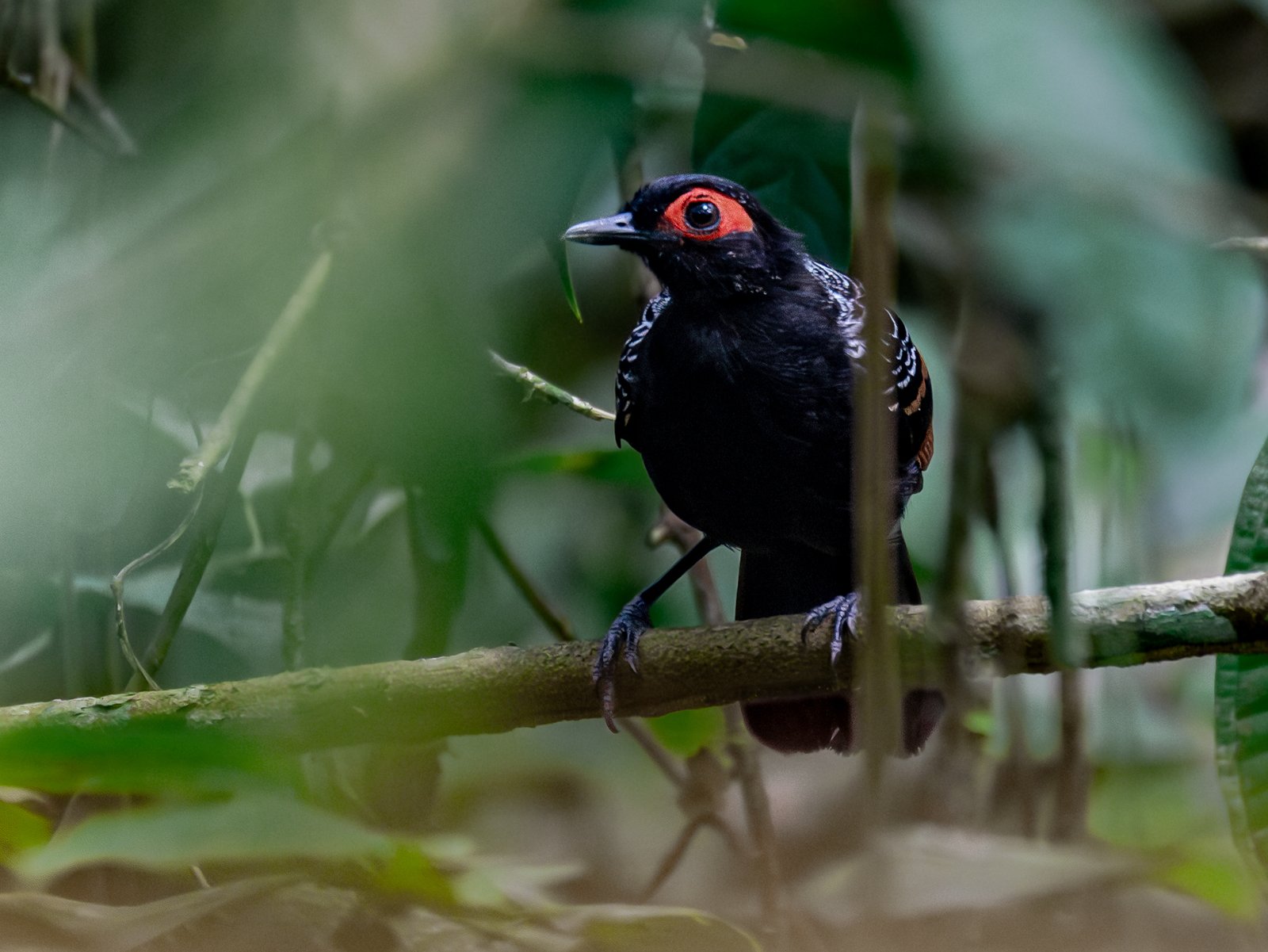
The Reddish-winged Bare-eye is the larger of the two bare-eyes in the guide area: a heavy ant follower with red bare skin around the eye and broad rufous bands across the wings. It is an obligate ant follower of terra firme forest in the north-western Amazon basin. Birds showing features of both bare-eyes are known and are regarded as hybrids.
Voice
The song is a short series of hoarse whistles. At ant swarms it gives harsh, grating calls and a churring chirrr.
Recording: Jorge Muñoz — CC BY-NC-SA 4.0 · xeno-canto
Identification
18–19 cm, with long legs. A large patch of red bare skin surrounds the eye. The male is black; the feathers of the back and wing coverts are fringed white, giving a scaled pattern, and broad rufous bands cross the wing. The female is brown, with more rufous underparts and two or three broad buff to rufous wing bands.
Confusion species
Black-spotted Bare-eye Phlegopsis nigromaculata has an olive-brown back with black spots and lacks the white scaling and the broad rufous wing bands. White-plumed Antbird Pithys albifrons attends the same swarms, but is much smaller, grey and chestnut, with white plumes on the face. The female somewhat resembles females of other antbirds with wing bands, but the red eye-ring and the size are distinctive.
Habitat
Understorey of humid terra firme lowland forest, less often várzea and tall secondary forest, mostly below 500 m. It follows army ant swarms and from low saplings catches the arthropods fleeing the ants; at a swarm usually less numerous than other ant followers.
Where the bird is most at home, classified by the vegetation units of the Andes and the west coast.


Range and movements
Colombia: in the south-east, from Guainía and Vaupés to Caquetá, Putumayo and Amazonas. Ecuador: rather scarce in the eastern lowlands. Peru: in the north, mainly in Loreto, locally further south. Bolivia: a few reports from Pando, occurrence uncertain. Absent from the Galápagos. Outside the guide area in southern Venezuela and western Brazil.
- Resident
- dark = core range, pale = thinly spread
How and when to look
Search terra firme forest in eastern Ecuador or around Iquitos for army ant swarms and stay there for a while; this species often appears only after some time at the edge of the swarm.
Conservation status
Least Concern. Widespread, but in the guide area less numerous than Black-spotted Bare-eye. As an obligate ant follower it disappears from fragmented forest.
Scientific name
Phlegopsis erythroptera | (Gould, 1855)
Gould described the species in 1855 as Formicarius erythropterus; because it was later moved to another genus, the author and year stand in brackets. The genus Phlegopsis was introduced in 1850 by Reichenbach. The genus name comes from Greek phlox, 'flame' (from phlegō, 'to flame'), and opsis, 'countenance', for the bare skin around the eye. The species name comes from Greek eruthros, 'red', and pteron, 'wing'. The specimen the first description was based on came from Rio Negro, Brazil (presumed).