All species › Passerines › Antbirds › Stripe-backed Antbird
Stripe-backed Antbird | Myrmorchilus strigilatus
Witbaardmiervogel | Hormiguero estriado | Tem-farinha-aí
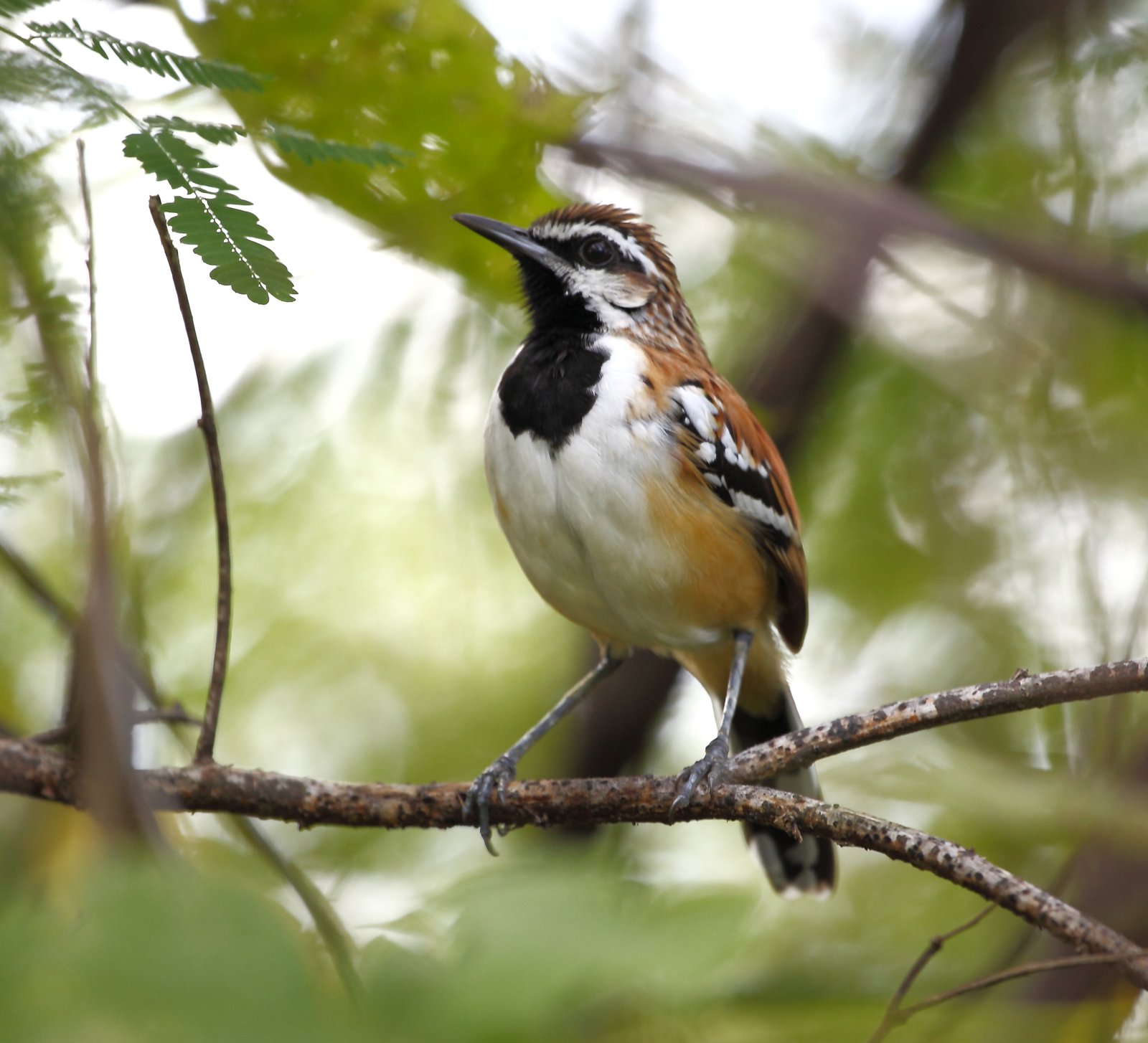
The Stripe-backed Antbird is a streaked, largely terrestrial antbird of dry Chaco woodland and the Brazilian caatinga. In the guide area only the subspecies suspicax occurs, in south-eastern Bolivia. It forages under dense scrub and is mostly detected by its long whistle.
Voice
The song is a sharp, very high phrase, sometimes followed by a few harsh, descending notes. The call is a long whistled note that slides down or rises and then falls.
Recording: Jacob Wijpkema — CC BY-NC-SA 4.0 · xeno-canto
Identification
15–16 cm, a fairly sturdy antbird with a medium-long tail. The crown, nape and back are rufous with black streaks, and the rump is plain rufous. The wings are black with white tips to the coverts. The male has a pale supercilium, a dark eyestripe, a black throat and breast and pale underparts with black spots on the flanks; in the Chaco subspecies the supercilium, flanks and undertail coverts are buff. The female lacks the black on the throat and breast; she is buff below with dark streaks on the breast and sides.
Confusion species
Great Antshrike Taraba major is larger, with a heavy hooked bill, a red iris, plain black or rufous upperparts and white underparts. The male Variable Antshrike Thamnophilus caerulescens is grey, without a streaked back or black throat. Black-capped Antwren Herpsilochmus atricapillus is much smaller, grey and white, and forages high in the trees.
Habitat
Dry Chaco woodland and thorn scrub with dense undergrowth and a litter layer, up to about 1100 m. It forages alone or in pairs on the ground under dense vegetation for insects and other arthropods, rummaging in leaf litter and in terrestrial bromeliads and sometimes jumping up to leaves above it. The nest is an open cup of dry grass on the ground, holding two eggs.
Where the bird is most at home, classified by the vegetation units of the Andes and the west coast.


Range and movements
In Bolivia in the south-east, in the Chaco of Santa Cruz, Chuquisaca and Tarija. Absent from Colombia, Ecuador, Peru and the Galápagos. Outside the guide area in western Paraguay, northern Argentina and south-western Brazil; the nominate form lives in the caatinga of north-eastern Brazil.
- Resident
- dark = core range, pale = thinly spread
How and when to look
In the early morning, listen for the long whistle in Chaco woodland south and east of Santa Cruz, for example around the Kaa-Iya area. The bird often sings from a low branch and then drops back into the undergrowth.
Conservation status
Least Concern. The population is probably declining as Chaco woodland is converted to cropland and pasture; only a small part of its habitat is protected.
Scientific name
Myrmorchilus strigilatus | (Wied-Neuwied, 1831)
Wied-Neuwied described the species in 1831 as Myiothera strigilata; because it was later moved to another genus, the author and year stand in brackets. The genus Myrmorchilus was introduced in 1909 by Ridgway. The genus name combines Greek murmos, 'ant', with orkhilos, an unknown bird, probably the wren. The species name is Modern Latin strigilatus, 'striped, barred', from Latin strix, strigis, 'furrow, groove'; probably for the streaked back. The specimen the first description was based on came from Bahia, Brazil.