All species › Passerines › New World blackbirds, troupials and allies › Giant Cowbird
Giant Cowbird | Molothrus oryzivorus
Grote koevogel | Tordo gigante | Iraúna-grande
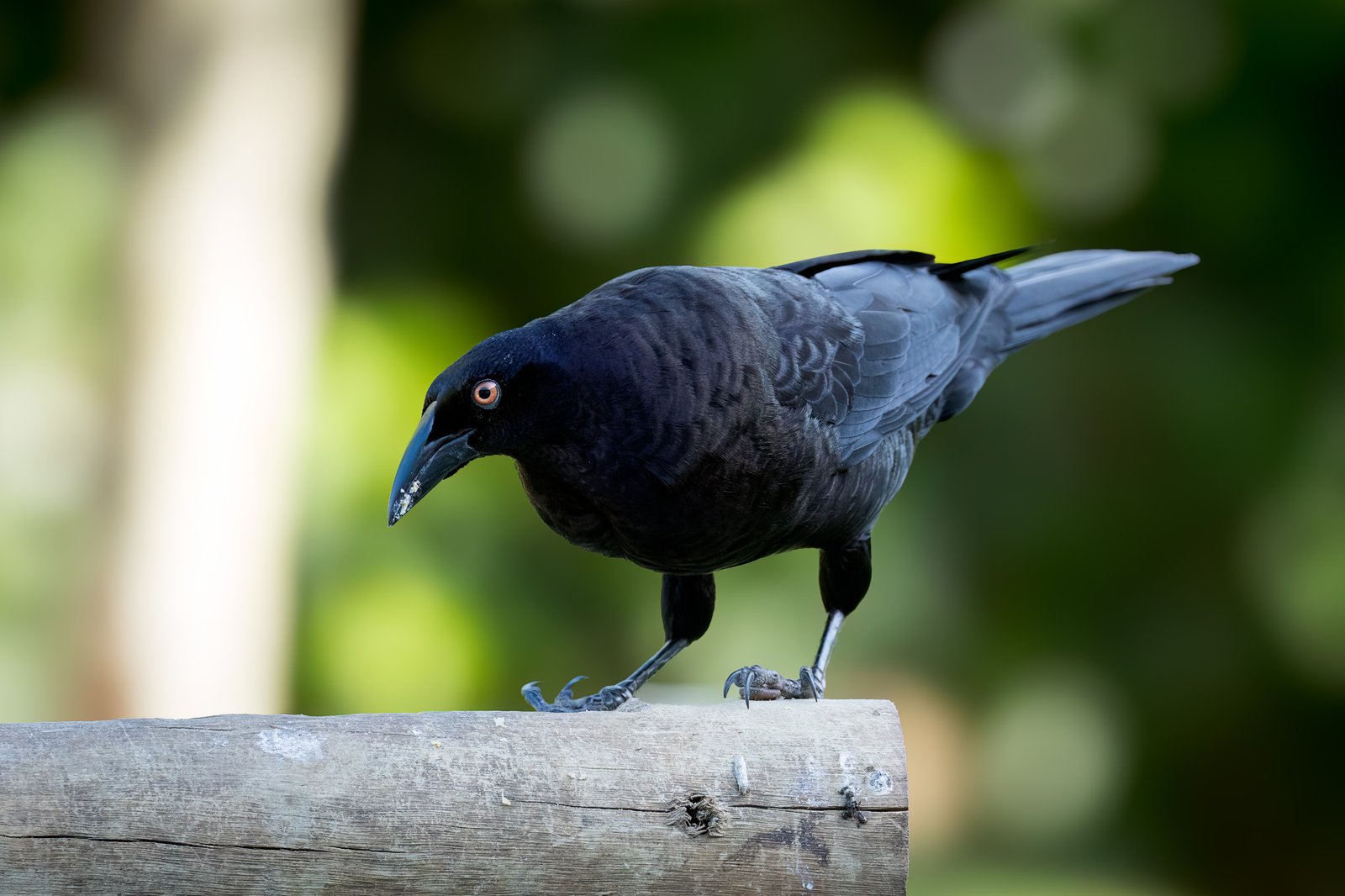
The Giant Cowbird is the largest cowbird and a brood parasite of oropendolas and caciques: the female lays her eggs in their hanging nests. Males look small-headed because of a ruff of raised neck feathers. The species is widespread in the lowlands and follows rivers, forest edges and open country.
Voice
Usually silent. In display, with ruff raised, the male gives shrill, squeaky and grating notes. In flight sometimes a dry chek.
No recording with a suitable Creative Commons licence is available for this species yet.
Identification
28–36 cm; the male is clearly larger than the female. The male is entirely glossy black with a purple to blue sheen, with a thick, straight black bill, a red to orange-red iris and a broad neck ruff that makes the head look small. The female is smaller, duller blackish brown with little gloss and a smaller ruff; her iris varies from red to yellowish. Juveniles are brownish black with a pale iris and a pale bill. Flight undulating: a series of wingbeats alternating with a short glide.
Confusion species
Shiny Cowbird Molothrus bonariensis is much smaller, with a short bill, a dark iris and no ruff. The male Great-tailed Grackle Quiscalus mexicanus has a yellow iris and a long, keeled tail. Velvet-fronted Grackle Lampropsar tanagrinus is much smaller, with a dark iris and a small bill. Solitary Cacique Cacicus solitarius has a pale bill.
Habitat
Riverbanks, sandbars, river islands, forest edges, open country with scattered trees and pastures, often near colonies of oropendolas and caciques; mainly in the lowlands up to about 1500 m, locally higher. It forages on the ground and on sandbars for insects, seeds and fruit and sometimes picks parasites off cattle and capybaras. It builds no nest of its own.
Where the bird is most at home, classified by the vegetation units of the Andes and the west coast.


Range and movements
In Colombia in the lowlands on both sides of the Andes, including the Magdalena and Cauca valleys. In Ecuador in the western lowlands and in Amazonia. In Peru mainly in the eastern lowlands and foothills. In Bolivia in the north and east. Absent from the Galápagos. Outside the guide area from southern Mexico to north-eastern Argentina.
- Resident
- dark = core range, pale = thinly spread
How and when to look
Look along rivers and at oropendola colonies, where females move about around the hanging nests. On sandbars and in pastures small groups often walk on the ground; in flight the undulating action with gliding phases stands out.
Conservation status
Least Concern. Widespread and locally common; the species benefits from cleared, open land along rivers.
Scientific name
Molothrus oryzivorus | (Gmelin, 1788)
Gmelin described the species in 1788 as O[riolus] oryzivorus; because it was later moved to another genus, the author and year stand in brackets. The genus Molothrus was introduced in 1832 by Swainson. The genus name comes from Greek mōlos, 'struggle', and thrōskō, 'to impregnate', referring to the brood parasitism of cowbirds. The species name comes from Latin oryza, 'rice', and vorare, 'to devour', meaning 'rice-eater'. The specimen the first description was based on came from Cayenne, French Guiana.