All species › Passerines › New World blackbirds, troupials and allies › Scrub Blackbird
Scrub Blackbird | Dives warczewiczi
Struiktroepiaal | Negro matorralero | Graúna-do-matagal
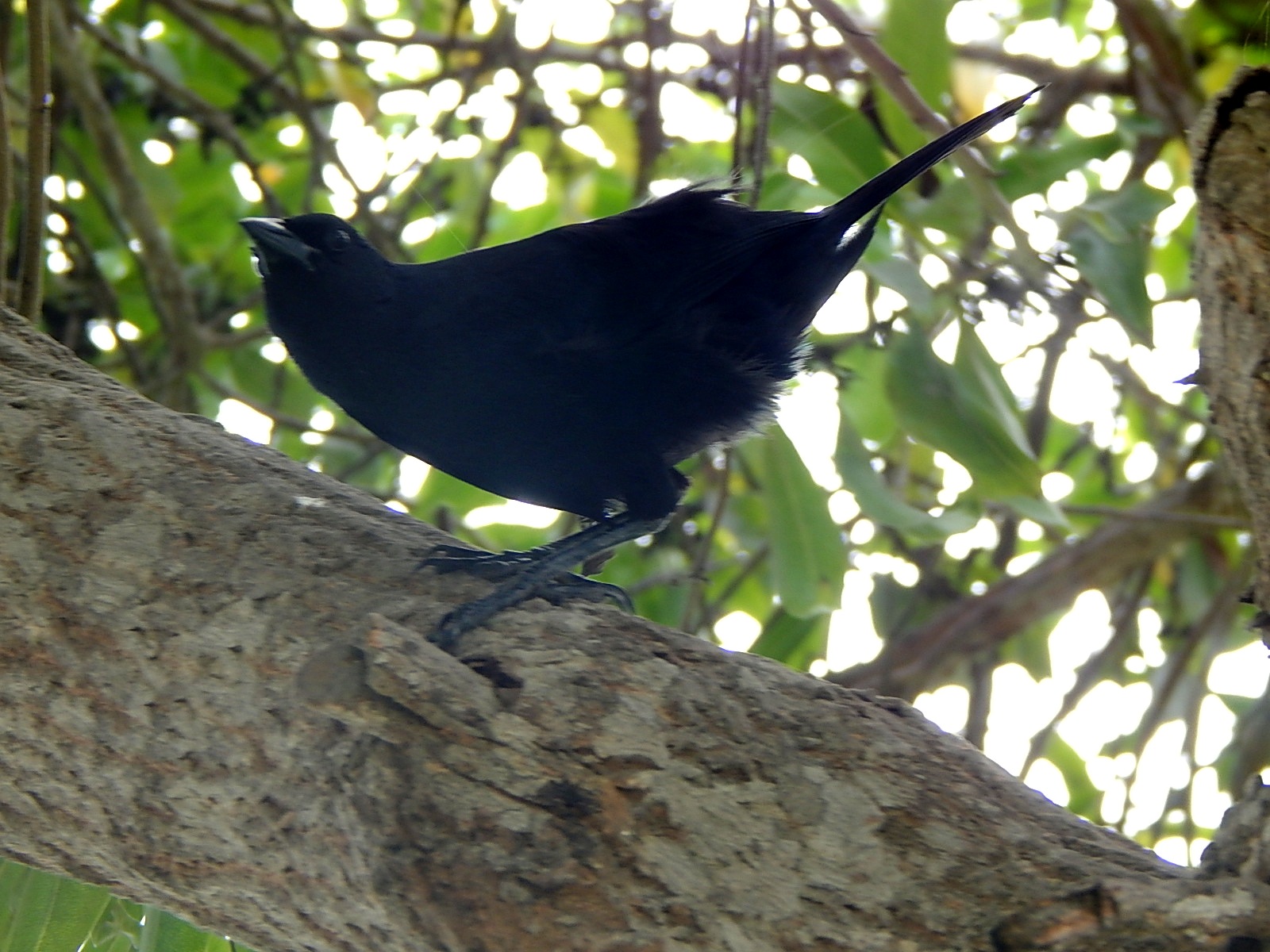
The Scrub Blackbird is an all-black icterid of the dry Pacific side of Ecuador and Peru. It lives in dry scrub, farmland, gardens and villages and draws attention with its loud, clear whistles. The other members of the genus Dives occur only in Central America.
Voice
A varied series of loud, clear and melodious whistles and short phrases, often in duet or from a high perch. Also calls a sharp chip and a dry chek.
Recording: Cristopher Rodríguez-Moreira — CC BY-NC-SA 4.0 · xeno-canto
Identification
22–26 cm; the male is larger than the female. Entirely black with a faint blue gloss, a dark iris, a fairly slender, pointed black bill and a rather long, slightly rounded tail. The female is slightly duller and smaller. Juveniles are dull blackish brown without gloss.
Confusion species
Shiny Cowbird Molothrus bonariensis is smaller, with a shorter, thicker bill, and the male has a stronger purple gloss; the female is greyish brown. The male Great-tailed Grackle Quiscalus mexicanus is larger, with a yellow iris and a long, keeled tail. Giant Cowbird Molothrus oryzivorus is larger, with a red iris and a small head.
Habitat
Dry forest, thorn scrub, fields with hedges, orchards, gardens, parks and villages, also riparian woodland in dry valleys; from sea level to about 2500 m in dry Andean valleys. It forages on the ground and in shrubs for insects, seeds and fruit. The nest is a cup in a shrub or tree.
Where the bird is most at home, classified by the vegetation units of the Andes and the west coast.


Range and movements
In Ecuador in the western lowlands and lower Andean slopes, especially in the drier parts, and in dry valleys in the south. In Peru along the west coast and on the western slope south to about the middle of the country, and in the dry Marañón valley. In Colombia at most in the extreme south-west. Absent from Bolivia and the Galápagos.
- Resident
- dark = core range, pale = thinly spread
How and when to look
Listen for the loud whistles in villages, gardens and farmland in western Ecuador and Peru; birds often sing from roofs, wires and treetops and forage in pairs or small groups on the ground.
Conservation status
Least Concern. Common within its range; the species thrives in human-modified landscapes.
Scientific name
Dives warczewiczi | (Cabanis, 1861)
Cabanis described the species in 1861 as Lampropsar Warczewiczi; because it was later moved to another genus, the author and year stand in brackets. The genus Dives was introduced in 1867 by Cassin. The genus name comes from Latin dives, 'rich'. The species name honours Józef Warszewicz (1812–1866), a Polish-Lithuanian botanist and collector in Central and South America; Cabanis misspelled the name. The specimen the first description was based on came from Peru.