All species › Passerines › New World blackbirds, troupials and allies › Great-tailed Grackle
Great-tailed Grackle | Quiscalus mexicanus
Langstaarttroepiaal | Zanate mexicano | Graúna-de-cauda-grande
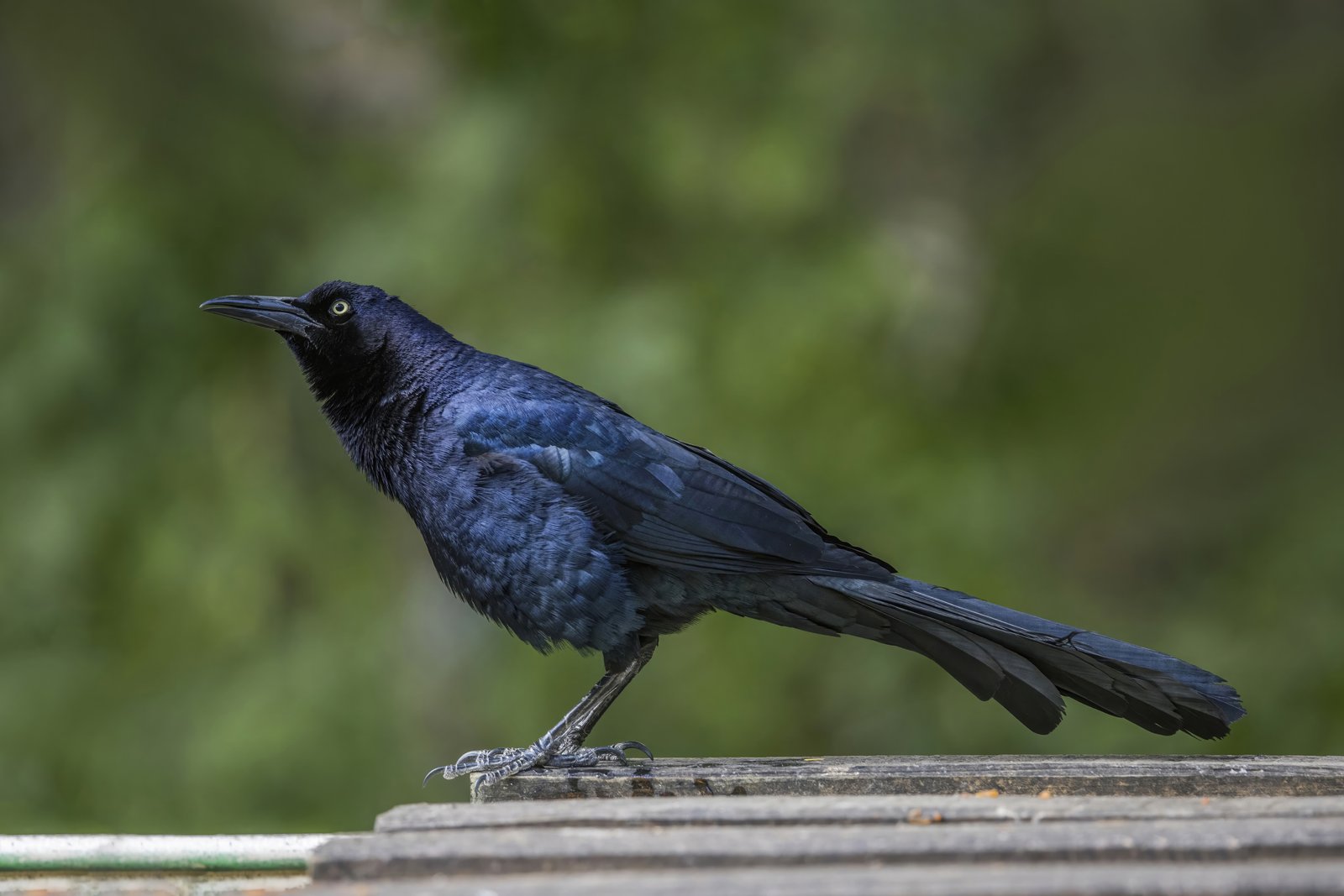
The Great-tailed Grackle is a large icterid with a long, keeled tail and marked differences between the sexes. In the guide area it lives along the Caribbean and Pacific coasts, in mangroves, harbours, villages and cities. It lives in noisy groups and roosts communally in trees in parks and squares.
Voice
Very varied: loud, rising whistles, clicking, rattling and grating sounds and a dry chak. Groups are very noisy at the roost.
Recording: AUDEVARD Aurélien — CC BY-NC-SA 4.0 · xeno-canto
Identification
33–43 cm; the male is much larger than the female. The male is glossy black with a purple-violet sheen, a bright yellow iris, a long, strong bill and a long tail that it holds V-shaped (keeled) in flight and display. The female is much smaller and brown, darker on wings and tail, with a pale buff supercilium, throat and breast and a yellow iris. Juveniles resemble the female, with a dark iris and faintly streaked underparts.
Confusion species
Carib Grackle Quiscalus lugubris is much smaller, with a shorter tail, and in the guide area lives only in eastern Colombia. Giant Cowbird Molothrus oryzivorus has a red iris, a shorter tail and a small head with a neck ruff. Scrub Blackbird Dives warczewiczi is smaller, with a dark iris and an ordinary, rounded tail.
Habitat
Mangroves, beaches, lagoons, harbours, towns and villages with parks, and farmland and pastures on the coastal plain; mostly low, locally higher inland. Omnivorous: it walks on the ground and along the waterline and eats insects, small animals, fruit, seeds and refuse. It breeds in colonies; the nest is a cup in a tree, palm or reeds.
Where the bird is most at home, classified by the vegetation units of the Andes and the west coast.


Range and movements
In Colombia along the Caribbean coast, in the lower Magdalena valley and along the Pacific coast, locally also inland. In Ecuador along the west coast. In Peru along the north coast, expanding southwards. Absent from Bolivia and the Galápagos. Outside the guide area from the southern United States through Central America to north-western Venezuela.
- Resident
- dark = core range, pale = thinly spread
How and when to look
Look in coastal towns, harbours and along mangroves; groups walk about on beaches and town squares. Towards evening large numbers fly to communal roosts in park trees.
Conservation status
Least Concern. The species benefits from cities, agriculture and deforestation and is still expanding its range in the guide area.
Scientific name
Quiscalus mexicanus | (Gmelin, 1788)
Gmelin described the species in 1788 as C[orvus] mexicanus; because it was later moved to another genus, the author and year stand in brackets. The genus Quiscalus was introduced in 1816 by Vieillot. The genus name comes from Linnaeus's species name Gracula quiscula; the origin of that word is uncertain: possibly the Carib Quisqueya, 'mother of all lands', a name for Hispaniola, or Latin quis, 'what', and qualis, 'of what kind'. The species name refers to Mexico. The specimen the first description was based on came from Veracruz, Mexico.