All species › Passerines › New World blackbirds, troupials and allies › Carib Grackle
Carib Grackle | Quiscalus lugubris
Caribische troepiaal | Zanate caribeño | Iraúna-do-norte
The Carib Grackle is a medium-sized grackle of the Lesser Antilles, northern Venezuela, the Guianas and north-eastern Brazil. In the guide area it reaches only eastern Colombia. It lives in groups in open, human-used country.
Voice
A series of rising, squeaky whistles, often from a group at once, and a dry, metallic chek. Singing males fluff their feathers and spread wings and tail.
Recording: Denis Dujardin — CC BY-NC-SA 4.0 · xeno-canto
Identification
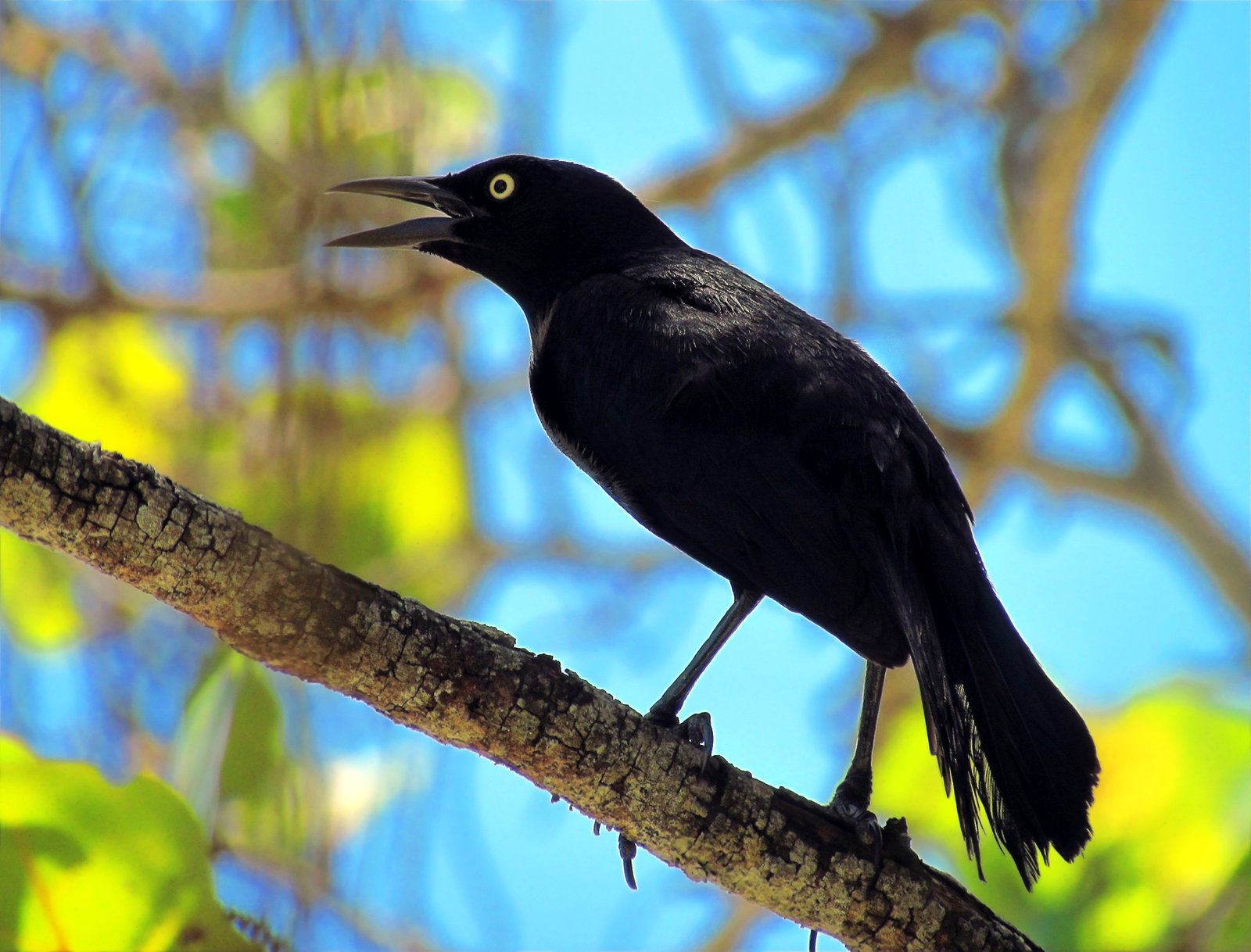
22–28 cm; the male is larger than the female. The male is glossy black with a violet to blue sheen, a yellow iris, a fairly long, slightly decurved bill and a medium-length tail that it holds slightly keeled in display. The female is smaller and dull greyish brown, paler on the throat and breast, with a yellow iris. Juveniles are brown with a dark iris.
Confusion species
Great-tailed Grackle Quiscalus mexicanus is much larger, with a much longer tail, and in the guide area lives along the coasts. Shiny Cowbird Molothrus bonariensis has a dark iris and a shorter, thicker bill. The male Giant Cowbird Molothrus oryzivorus is larger, with a red iris and a neck ruff.
Habitat
Open savanna with scattered trees, pastures, fields, marsh edges, villages and farms in the lowlands. It forages in groups on the ground for insects, seeds and refuse. It breeds in loose colonies; the nest is a cup in a tree or palm.
Where the bird is most at home, classified by the vegetation units of the Andes and the west coast.


Range and movements
In Colombia locally in the north-eastern llanos along the border with Venezuela. Absent from Ecuador, Peru, Bolivia and the Galápagos. Outside the guide area in Venezuela, the Guianas, north-eastern Brazil, Trinidad and the Lesser Antilles.
- Resident
- dark = core range, pale = thinly spread
How and when to look
Look at farms, in villages and in pastures in the eastern llanos; groups walk on the ground among cattle and sing from treetops and roofs.
Conservation status
Least Concern. Common over most of its range; in the guide area only local.
Scientific name
Quiscalus lugubris | Swainson, 1838
Swainson described the species in 1838 and placed it straight away in the genus where it still stands. The genus Quiscalus was introduced in 1816 by Vieillot. The genus name comes from Linnaeus's species name Gracula quiscula; the origin of that word is uncertain: possibly the Carib Quisqueya, 'mother of all lands', a name for Hispaniola, or Latin quis, 'what', and qualis, 'of what kind'. The species name is Latin lugubris, 'mournful', after the black plumage. The specimen the first description was based on came from Guyana.