All species › Passerines › New World blackbirds, troupials and allies › Colombian Mountain Grackle
Colombian Mountain Grackle | Macroagelaius subalaris
Bergtroepiaal | Chango de montaña | Graúna-montanhesa-da-colômbia
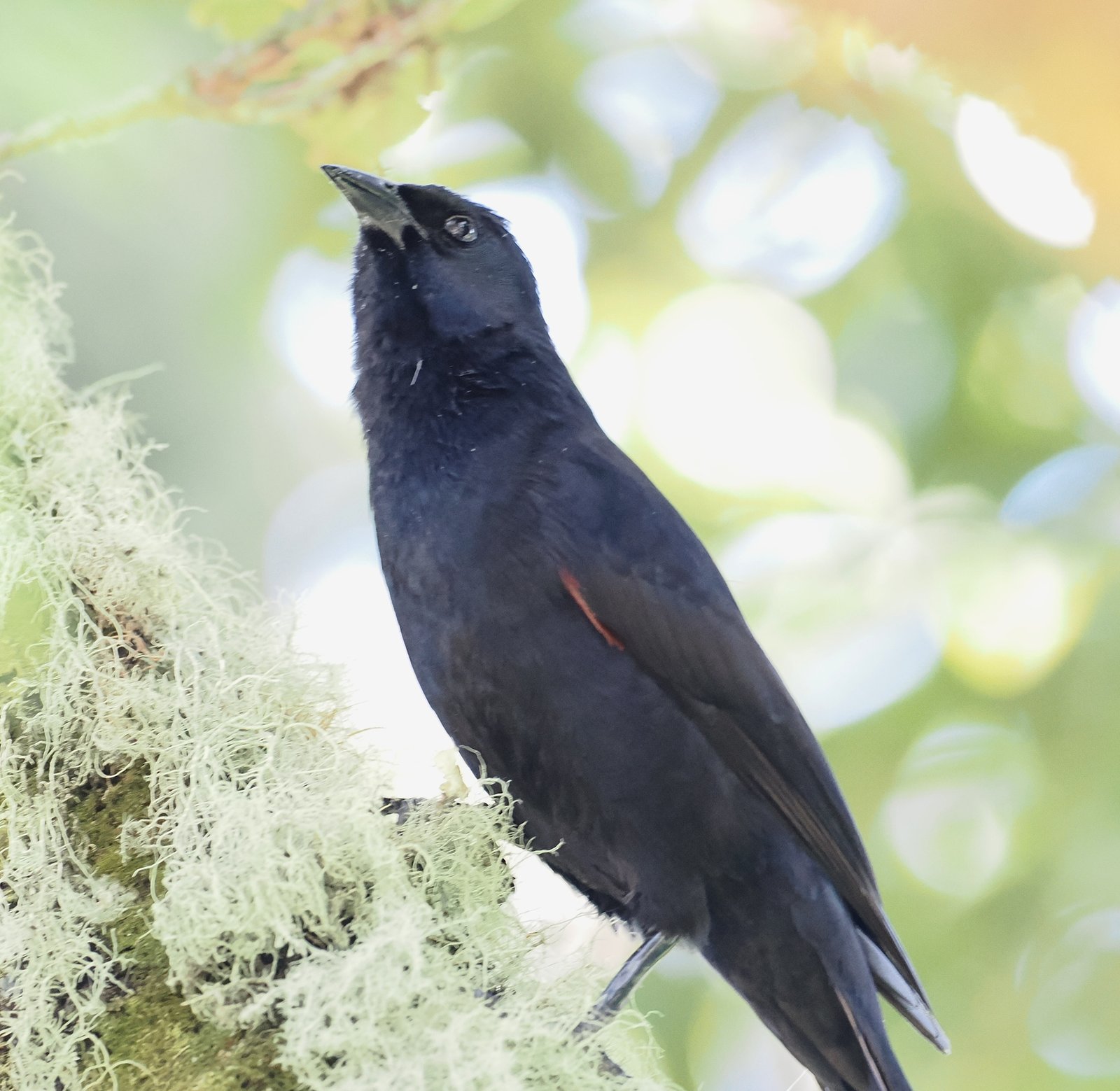
The Colombian Mountain Grackle is an endemic icterid of the Eastern Andes of Colombia. It lives in noisy groups in cloud forest and oak forest and for a long time was known from only a few sites. The conversion of montane forest to farmland has made it threatened.
Voice
Groups give a varied series of loud, squeaky, whistled and grating notes, often for long periods.
Recording: Nick Athanas — CC BY-NC-SA 3.0 · xeno-canto
Identification
27–31 cm; the male is slightly larger than the female. Entirely black with a faint blue gloss, a dark iris, a fairly slender, pointed bill and a long, slightly graduated tail. The underwing coverts and axillaries are chestnut; this is visible mainly in flight. The sexes are alike.
Confusion species
Red-bellied Grackle Hypopyrrhus pyrohypogaster has a red belly and undertail coverts and glossy, pointed feathers on the head and neck. Shiny Cowbird Molothrus bonariensis is smaller, with a shorter, thicker bill and a shorter tail, and lives in open country. Giant Cowbird Molothrus oryzivorus has a red iris and a neck ruff and lives lower.
Habitat
Humid montane forest and cloud forest, often with oaks, and forest edges, roughly between 1900 and 3100 m. It forages in groups in the middle and upper levels of the forest, often in epiphytes and bromeliads, for insects and fruit, and sometimes joins mixed flocks. Little is known about the nest.
Where the bird is most at home, classified by the vegetation units of the Andes and the west coast.


Range and movements
Only in Colombia: in the Eastern Andes, mainly on the western slope in Santander, Boyacá and Cundinamarca, with a few sites on the eastern slope. Absent from Ecuador, Peru, Bolivia and the Galápagos.
- Resident
- dark = core range, pale = thinly spread
How and when to look
Look in oak and cloud forest in the Eastern Andes of Santander and Boyacá; groups give themselves away by their loud, varied calls and move quickly through the canopy.
Conservation status
Endangered. The species has a small range and has declined sharply through the clearance of montane forest for farming and ranching. Part of the population lives in protected areas.
Scientific name
Macroagelaius subalaris | (Boissonneau, 1840)
Boissonneau described the species in 1840 as Quiscalus sub-alaris; because it was later moved to another genus, the author and year stand in brackets. The genus Macroagelaius was introduced in 1866 by Cassin. The genus name comes from Greek makros, 'long' or 'large', and the genus name Agelaius (blackbirds). The species name comes from Latin sub, 'under', and ala, 'wing', for the chestnut axillaries under the wing. The specimen the first description was based on came from Bogotá, Colombia.