All species › Passerines › New World blackbirds, troupials and allies › Velvet-fronted Grackle
Velvet-fronted Grackle | Lampropsar tanagrinus
Pluchekoptroepiaal | Clarinero frentiafelpado | Iraúna-velada
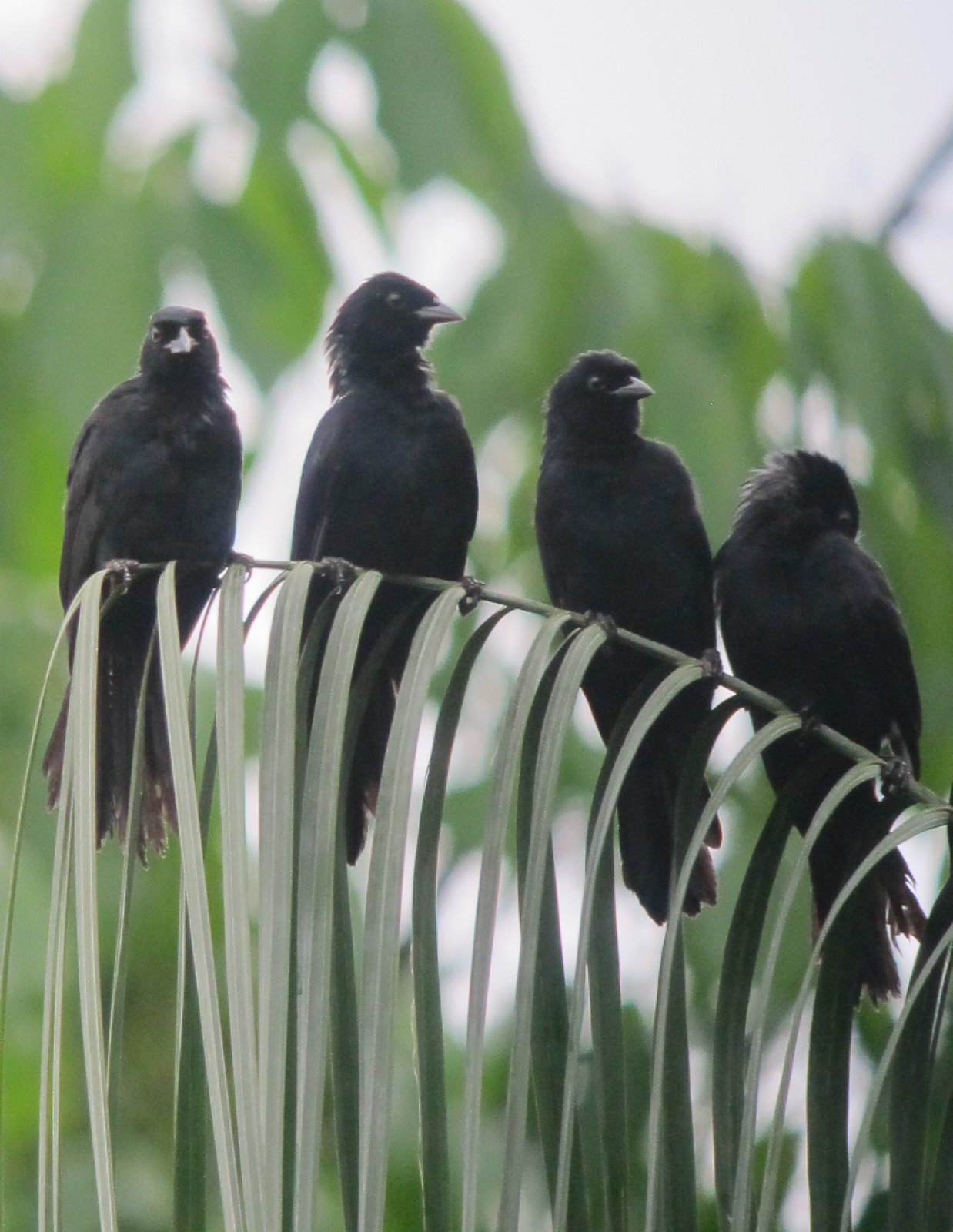
The Velvet-fronted Grackle is a small, all-black icterid of flooded forest and lake edges in Amazonia. Its name refers to the short, velvety feathers on the forehead. It lives in small groups that move through the vegetation along the water.
Voice
Groups give quick, clicking and chirping calls and short, clear whistles.
Recording: Jacob Wijpkema — CC BY-NC-SA 4.0 · xeno-canto
Identification
18–22 cm; the male is slightly larger than the female. Entirely black with a blue to purple gloss, short, dense, velvety feathers on the forehead, a dark iris, a short, fairly pointed bill and a rather long, rounded tail that is often held slightly spread. The female has less gloss. Juveniles are dull blackish brown.
Confusion species
The male Shiny Cowbird Molothrus bonariensis has a shorter tail and a stronger purple gloss and more often forages on the ground in open country. Giant Cowbird Molothrus oryzivorus is much larger, with a red iris. Unicolored Blackbird Agelasticus cyanopus has a longer, more pointed bill and lives in marsh vegetation; the female is streaked brown. Solitary Cacique Cacicus solitarius is larger, with a pale bill.
Habitat
Várzea and igapó, the edges of blackwater and oxbow lakes, flooded shrubs and palm swamps in the lowlands, mostly below 500 m. It forages in small groups in shrubs and the lower and middle levels of the forest along the water for insects and fruit. Little is known about the nest.
Where the bird is most at home, classified by the vegetation units of the Andes and the west coast.


Range and movements
In Colombia in the south-east (Amazonas, Putumayo, Caquetá). In Ecuador in the eastern lowlands, especially along lakes and rivers in the north-east. In Peru in the eastern lowlands. In Bolivia in the north. Absent from the Galápagos. Outside the guide area in southern Venezuela and western Brazilian Amazonia.
- Resident
- dark = core range, pale = thinly spread
How and when to look
Search from a canoe along flooded forest and lake edges, for example in the blackwater areas of north-eastern Ecuador; groups move through the waterside vegetation and can be recognised by their clicking calls.
Conservation status
Least Concern. The species is locally common in flooded forest, a habitat that is still intact over large parts of Amazonia.
Scientific name
Lampropsar tanagrinus | (Spix, 1824)
Spix described the species in 1824 as Icterus tanagrinus; because it was later moved to another genus, the author and year stand in brackets. The genus Lampropsar was introduced in 1847 by Cabanis. The genus name comes from Greek lampros, 'brilliant', and psar, 'starling'. The species name is Modern Latin for 'tanager-like', after the genus Tanagra. The specimen the first description was based on came from Itacoatiara, Amazonas, Brazil.