All species › Passerines › New World blackbirds, troupials and allies › Oriole Blackbird
Oriole Blackbird | Gymnomystax mexicanus
Wielewaaltroepiaal | Chango oriolino | Iratauá-grande
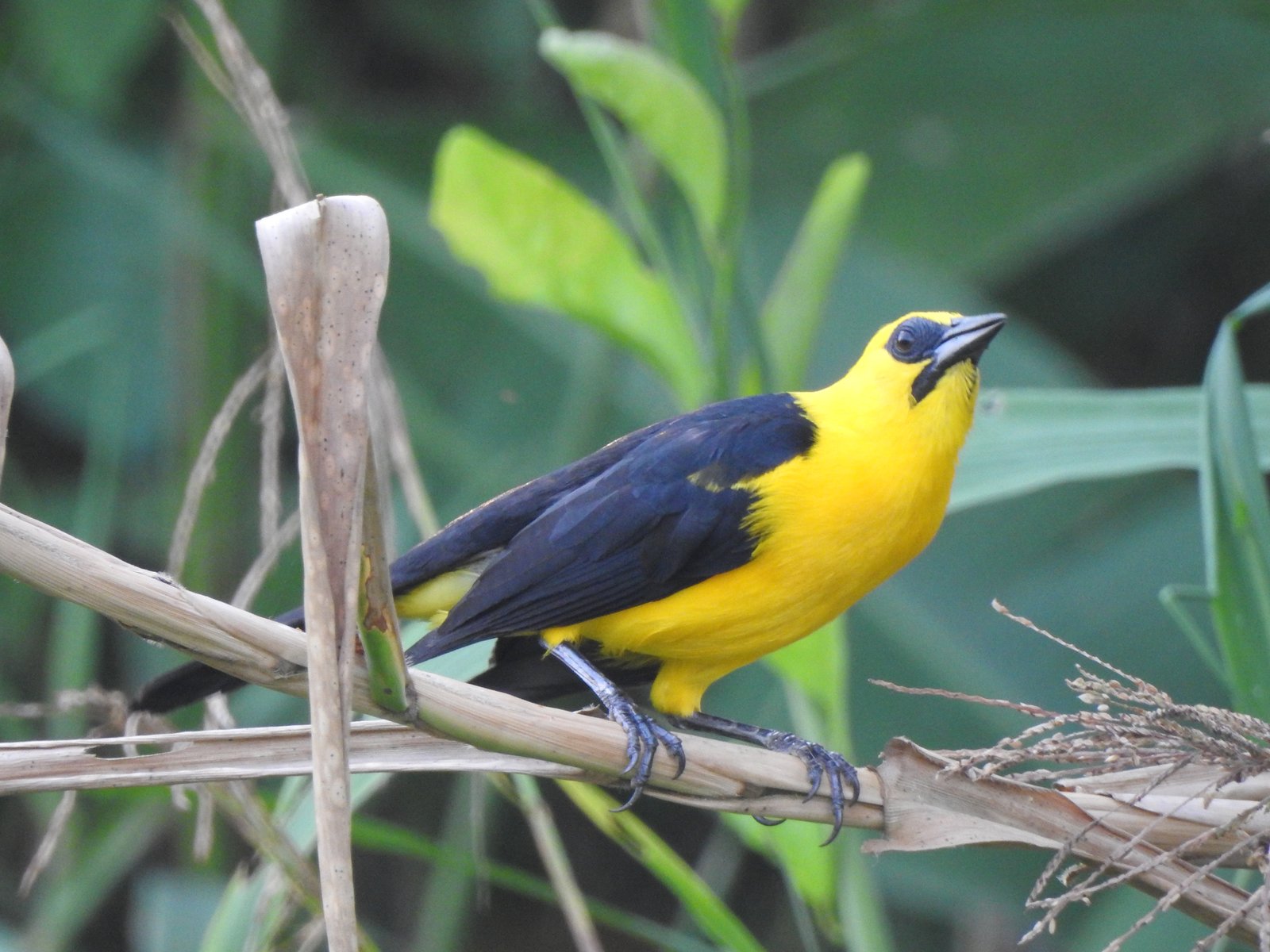
The Oriole Blackbird is a large, golden-yellow and black icterid of riverbanks, river islands and wet savannas in northern South America. It is the only member of the genus Gymnomystax, named after the bare skin at the base of the bill. It often perches conspicuously on open branches and walks a lot on the ground.
Voice
Loud, raw and grating notes, often as a short, hoarse song of a few creaky notes, and a sharp chak.
Recording: JAYRSON ARAUJO DE OLIVEIRA — CC BY-NC-SA 4.0 · xeno-canto
Identification
28–30 cm. Head, neck and entire underparts golden yellow; back, wings and tail black, with a yellow patch on the lesser wing coverts. There is bare black skin around the eye and in a stripe below the bill. The bill is black, pointed and fairly long, the iris dark. The sexes are alike. Juveniles have a black crown and less bare skin.
Confusion species
Yellow Oriole Icterus nigrogularis is smaller and slimmer, with a black throat and a yellow back. Yellow-hooded Blackbird Chrysomus icterocephalus is much smaller, with only a yellow head and an otherwise black body, and lives in marsh vegetation. Other orioles Icterus have a black throat or a black mask.
Habitat
Riverbanks, river islands with young growth, sandbars, lake edges, wet savanna, gallery forest and pastures with scattered trees in the lowlands, mostly below 500 m. It walks on the ground and on sandbars, feeding on insects, small animals, fruit and seeds. The nest is an open cup in a tree, often near water.
Where the bird is most at home, classified by the vegetation units of the Andes and the west coast.


Range and movements
In Colombia in the llanos and along the rivers of Amazonia. In Ecuador rare and local along the large rivers in the north-east. In Peru on river islands and along the banks of the Amazon and the lower Napo and Ucayali in the north-east. Absent from Bolivia and the Galápagos. Outside the guide area in Venezuela, the Guianas and along the Amazon in Brazil.
- Resident
- dark = core range, pale = thinly spread
How and when to look
Look on river islands with young shrubs and willows near Iquitos or in the llanos of Colombia; pairs and small groups perch on open branches and walk over sandbars and pastures.
Conservation status
Least Concern. Locally common in the llanos and along the large rivers.
Scientific name
Gymnomystax mexicanus | (Linnaeus, 1766)
Linnaeus described the species in 1766 as O[riolus] mexicanus; because it was later moved to another genus, the author and year stand in brackets. The genus Gymnomystax was introduced in 1850 by Reichenbach. The genus name comes from Greek gumnos, 'bare', and mustax, 'moustache', for the bare skin stripe below the eye. The species name refers to Mexico, which Linnaeus gave in error as the origin; the species does not occur there. The specimen the first description was based on came from Cayenne, French Guiana.