All species › Passerines › New World blackbirds, troupials and allies › Red-bellied Grackle
Red-bellied Grackle | Hypopyrrhus pyrohypogaster
Roodbuiktroepiaal | Cacique candela | Graúna-de-barriga-vermelha
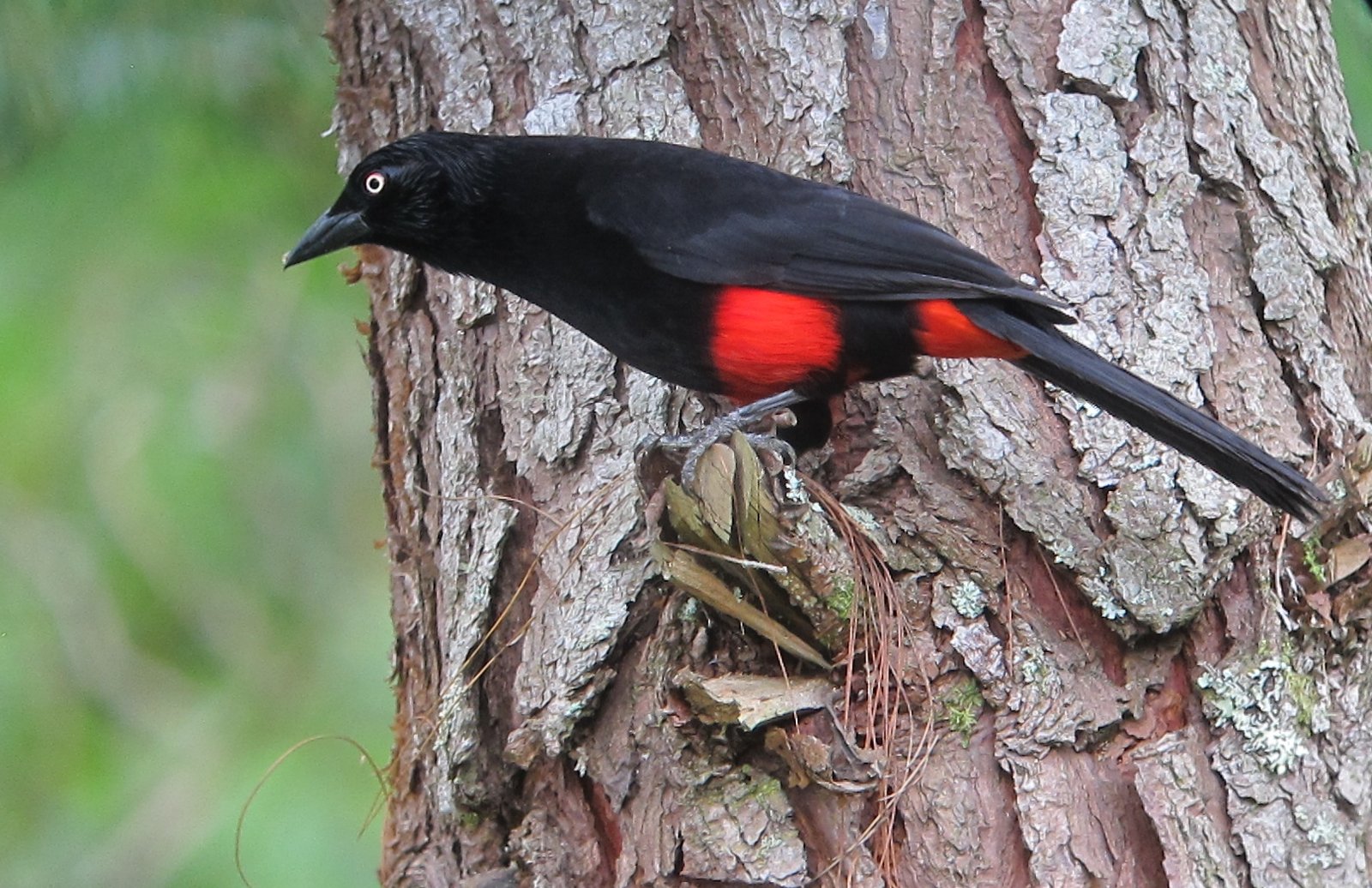
The Red-bellied Grackle is an endemic icterid of the Colombian Andes, black with a bright red belly. It lives in noisy groups in humid montane forest and is the only member of the genus Hypopyrrhus. Forest loss has made the species vulnerable.
Voice
Groups give loud, varied, ringing and grating calls and short whistled phrases.
Recording: Zsombor Károlyi — CC BY-NC-SA 4.0 · xeno-canto
Identification
27–30 cm. Mostly black; the feathers of the head, neck and breast are pointed and glossy, with paler shafts, giving a shiny, somewhat streaked effect. The belly and undertail coverts are bright red. The bill is black, stout and pointed, the iris pale, the tail long. The sexes are nearly alike. Juveniles are duller, with less red.
Confusion species
Colombian Mountain Grackle Macroagelaius subalaris has no red below, a dark iris and chestnut underwings, and lives in the Eastern Andes. Crested Oropendola Psarocolius decumanus is larger, with a pale bill and yellow tail sides. Golden-winged Cacique Cacicus chrysopterus is smaller, with yellow wing patches and a yellow rump.
Habitat
Humid montane forest, cloud forest, forest edges and old secondary forest, also shade coffee and larger forest fragments, roughly between 1200 and 2700 m. It forages in groups in the middle and upper levels, often in epiphytes, moss and under bark, for insects and fruit, and joins mixed flocks. The nest is a cup in a tree.
Where the bird is most at home, classified by the vegetation units of the Andes and the west coast.


Range and movements
Only in Colombia: locally in all three Andean ranges, mainly in the Central Andes from Antioquia to Huila, also in the Western Andes and on the western slope of the Eastern Andes. Absent from Ecuador, Peru, Bolivia and the Galápagos.
- Resident
- dark = core range, pale = thinly spread
How and when to look
Look in forest reserves in the Central Andes of Antioquia, Caldas and Risaralda; groups move noisily through the canopy, often with mixed tanager flocks.
Conservation status
Vulnerable. Most montane forest within its range has been converted to farmland and coffee plantations; the species is now restricted to the remaining forest fragments.
Scientific name
Hypopyrrhus pyrohypogaster | (de Tarragon, 1847)
De Tarragon described the species in 1847 as Cassicus pyrohypogaster; because it was later moved to another genus, the author and year stand in brackets. The genus Hypopyrrhus was introduced in 1850 by Bonaparte. The genus name comes from Greek hupo, 'below', and purrhos, 'flame-red', for the red belly. The species name comes from Greek pur, 'fire', and hupogastrion, 'belly', for the red belly. The specimen the first description was based on came from Colombia.