All species › Passerines › New World blackbirds, troupials and allies › Scarlet-headed Blackbird
Scarlet-headed Blackbird | Amblyramphus holosericeus
Roodkoptroepiaal | Federal | Cardeal-do-banhado
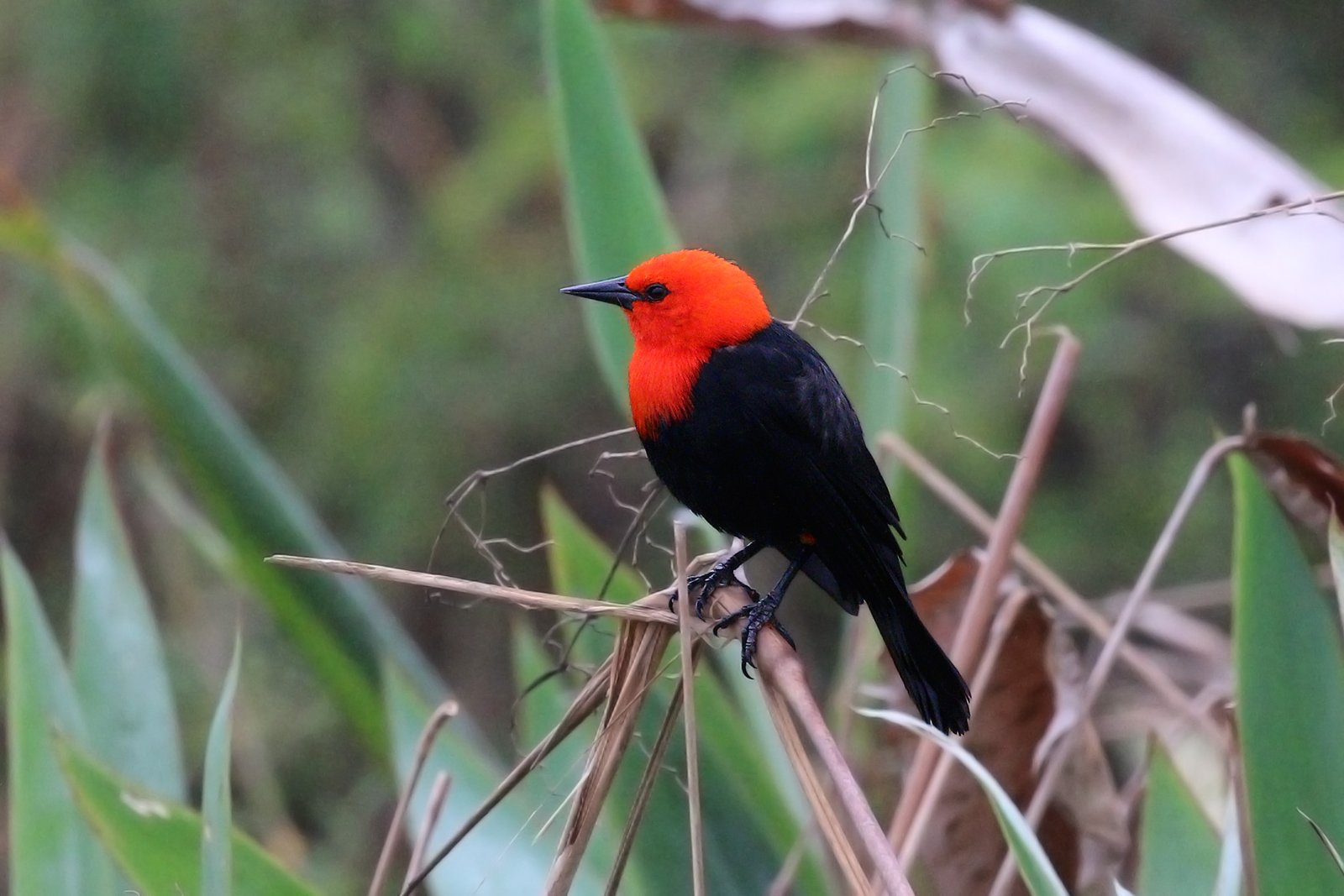
The Scarlet-headed Blackbird is a black blackbird with a scarlet to orange-red head, breast and thighs, living in tall marsh vegetation. It belongs to the southern marshes of South America and reaches the guide area only in the lowlands of Bolivia. With its long, pointed bill it opens the stems of marsh plants.
Voice
The song varies, with clear, loud whistles, rattles and a nasal buzz. The contact call of both sexes is a long, descending, hesitant whistle.
Recording: Dante Buzzetti — CC BY-NC-SA 4.0 · xeno-canto
Identification
23–25 cm; the male is on average larger than the female. The bill is long, straight, pointed and black. The plumage is deep black, with a scarlet to orange-red head, neck and upper breast and red thighs. The eyes are dark. The sexes are alike. Juveniles are entirely dull black and acquire the red gradually, first as orange patches on the head and breast.
Confusion species
Red-breasted Meadowlark Leistes militaris has a red throat and breast, but a brown-streaked back and a black head, and lives in grassland. Yellow-hooded Blackbird Chrysomus icterocephalus has a yellow hood and lives farther north. No other black blackbird in the guide area has a red head.
Habitat
Marshes with dense stands of sedge, cattail, reed and arrowroot, along lakes, river channels and in flooded savannas, also adjacent wet grassland; in the guide area in the lowlands, well below 600 m. It searches for insects and their larvae in and on marsh plants. The nest is a woven cup of strips of marsh plants, about a metre above the water.
Where the bird is most at home, classified by the vegetation units of the Andes and the west coast.


Range and movements
In Bolivia in the marshes and flooded savannas of the northern and eastern lowlands, in Beni and Santa Cruz. Not reliably known from Peru. Absent from Colombia, Ecuador and the Galápagos. Outside the guide area in Paraguay, Uruguay, north-eastern Argentina and southern Brazil, from the Pantanal to Rio Grande do Sul.
- Resident
- dark = core range, pale = thinly spread
How and when to look
In the marshes of the Beni savanna, search the edges of tall marsh vegetation; males often sing from the top of a reed or cattail stem.
Conservation status
Least Concern. Habitat is lost locally to drainage and conversion to farmland, but the species is common in the large wetlands.
Scientific name
Amblyramphus holosericeus | (Scopoli, 1786)
Scopoli described the species in 1786 as Xanthornus (holosericeus); because it was later moved to another genus, the author and year stand in brackets. The genus Amblyramphus was introduced in 1814 by Leach. The genus name comes from Greek amblus, 'blunt', and rhamphos, 'bill'. The species name comes from Latin holosericeus, 'all silk', for the silky plumage. The specimen the first description was based on came from Paraná Delta, Argentina.