All species › Passerines › New World blackbirds, troupials and allies › Chopi Blackbird
Chopi Blackbird | Gnorimopsar chopi
Chopitroepiaal | Chopí | Pássaro-preto
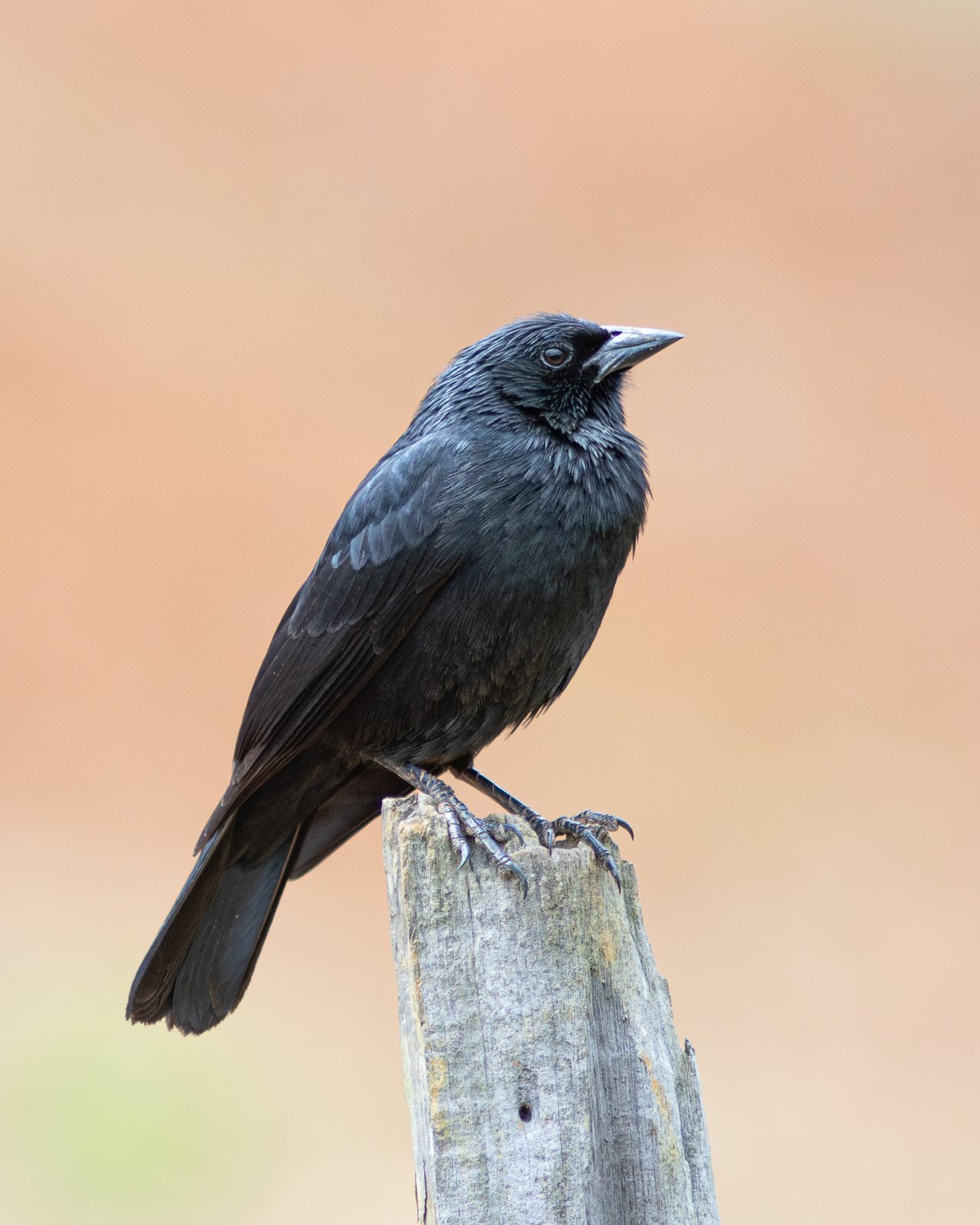
The Chopi Blackbird is an all-black blackbird of open woodland, savanna and farmland in central and eastern South America. It lives in noisy groups and sings before sunrise. Its name imitates its call.
Voice
A loud, varied song of clear whistles, rattles and clucking notes, often starting with a repeated chopee. Groups sing in chorus, especially in the early morning.
Recording: Robson Silva e Silva — CC BY-NC-SA 4.0 · xeno-canto
Identification
21–25 cm; birds in Bolivia and Peru belong to a large subspecies. Entirely black with a faint bluish gloss. The feathers of the crown and nape are narrow and pointed, giving the head a slightly shaggy look. The bill is black and fairly thick, with a distinctive groove at the base of the lower mandible. The eyes are dark. The sexes are alike. Juveniles are duller black.
Confusion species
Shiny Cowbird Molothrus bonariensis is smaller, with a shorter, conical bill; the male is strongly glossed purple and the female greyish brown. Unicolored Blackbird Agelasticus cyanopus is smaller and slimmer, with a more pointed bill, and lives in marshes. Bolivian Blackbird Oreopsar bolivianus is browner black, with brown primaries, and lives in dry Andean valleys. Giant Cowbird Molothrus oryzivorus is much larger, with a ruff and a longer tail.
Habitat
Savanna with scattered trees and palms, open dry woodland, forest edges, riparian woodland, pastures and villages in the lowlands and foothills, up to about 1500 m. It forages on the ground and in trees for insects, seeds and fruit, and also visits fields. It breeds in cavities, such as old woodpecker holes and holes in palms, and sometimes uses the nests of other birds.
Where the bird is most at home, classified by the vegetation units of the Andes and the west coast.


Range and movements
In Bolivia in the lowlands of the north and east, in Beni and Santa Cruz, and locally in the foothills. In Peru only in the far south-east, in the Pampas del Heath in Madre de Dios. Absent from Colombia, Ecuador and the Galápagos. Outside the guide area in Brazil, Paraguay and north-eastern Argentina.
- Resident
- dark = core range, pale = thinly spread
How and when to look
In the early morning, search palm savannas and forest edges for groups in the treetops; the chorus often gives the group away from far off.
Conservation status
Least Concern. The species benefits from open farmland, but is trapped as a cage bird in parts of its range.
Scientific name
Gnorimopsar chopi | (Vieillot, 1819)
Vieillot described the species in 1819 as Agelaius chopi; because it was later moved to another genus, the author and year stand in brackets. The genus Gnorimopsar was introduced in 1908 by Richmond. The genus name comes from Greek gnōrimos, 'well-known', and psar, 'starling'. The species name is onomatopoeic, from the bird's common call, rendered as 'chop-ee'. The specimen the first description was based on came from Paraguay.