All species › Passerines › New World blackbirds, troupials and allies › Pale-eyed Blackbird
Pale-eyed Blackbird | Agelasticus xanthophthalmus
Drijftiltroepiaal | Varillero ojipálido | Carretão-de-olho-claro
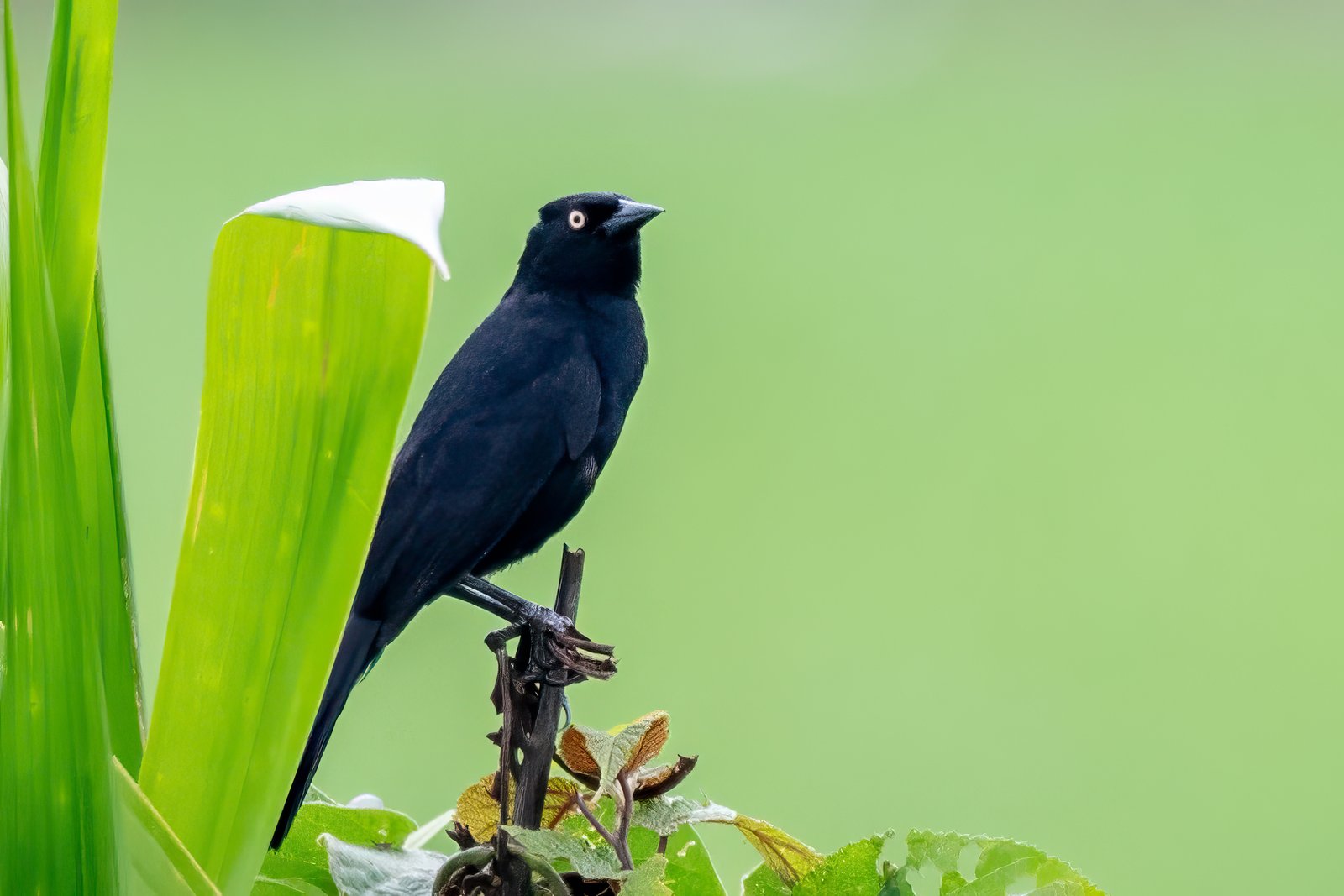
The Pale-eyed Blackbird is a black blackbird with pale eyes, found almost only in western Amazonia. It lives on floating vegetation and in the marshy edges of oxbow lakes. The species was described only in 1969 and is local throughout its range.
Voice
A loud, metallic series tew-tew-tew-tew, often sung from the top of a shrub; it resembles the call of Black-capped Donacobius. Also short, harsh calls.
Recording: Guilherme Melo Becher — CC BY-NC-SA 4.0 · xeno-canto
Identification
20–22 cm, with a pointed black bill. The male is entirely black with a faint gloss; the female is duller and browner black. In both sexes the iris is pale yellow to whitish, separating the species from the other black blackbirds of the lowlands. Juveniles are brownish black, with a darker eye at first.
Confusion species
Velvet-fronted Grackle Lampropsar tanagrinus is also all black, but has dark eyes, a shorter bill and a velvety forehead, and lives in groups in flooded forest. Male Shiny Cowbird Molothrus bonariensis has dark eyes, a conical bill and a purple gloss. Oriole Blackbird Gymnomystax mexicanus is much larger, with a yellow head and underparts.
Habitat
Floating mats of grass and herbs, marshy edges and shoreline scrub along oxbow lakes (cochas) and lagoons, and adjacent wet grassland in the Amazonian lowlands, below about 500 m. It spends most of the day low in dense marsh vegetation. It searches the vegetation for insects. Little is known about the nest.
Where the bird is most at home, classified by the vegetation units of the Andes and the west coast.


Range and movements
In Ecuador locally in the north-east, along lakes in the Napo drainage. In Peru locally in the eastern lowlands, including Loreto and Madre de Dios. From Colombia and Bolivia at most a few unconfirmed reports. Absent from the Galápagos. Outside the guide area at most in adjacent western Brazil.
- Resident
- dark = core range, pale = thinly spread
How and when to look
Search the shores of cochas with floating grass mats, for example on a canoe trip; listen for the metallic series from a shrub top and look for the pale eyes.
Conservation status
Least Concern. The species is local and little studied; its lakeside habitat is still intact in most of its range.
Scientific name
Agelasticus xanthophthalmus | (Short, 1969)
Short described the species in 1969 as Agelaius xanthophthalmus; because it was later moved to another genus, the author and year stand in brackets. The genus Agelasticus was introduced in 1851 by Cabanis. The genus name comes from Greek agelastikos, 'gregarious, living in groups', from agelē, 'herd'. The species name comes from Greek xanthos, 'yellow', and ophthalmos, 'eye', for the pale eye. The specimen the first description was based on came from (per the description).