All species › Passerines › New World blackbirds, troupials and allies › Unicolored Blackbird
Unicolored Blackbird | Agelasticus cyanopus
Moerastroepiaal | Varillero negro | Carretão
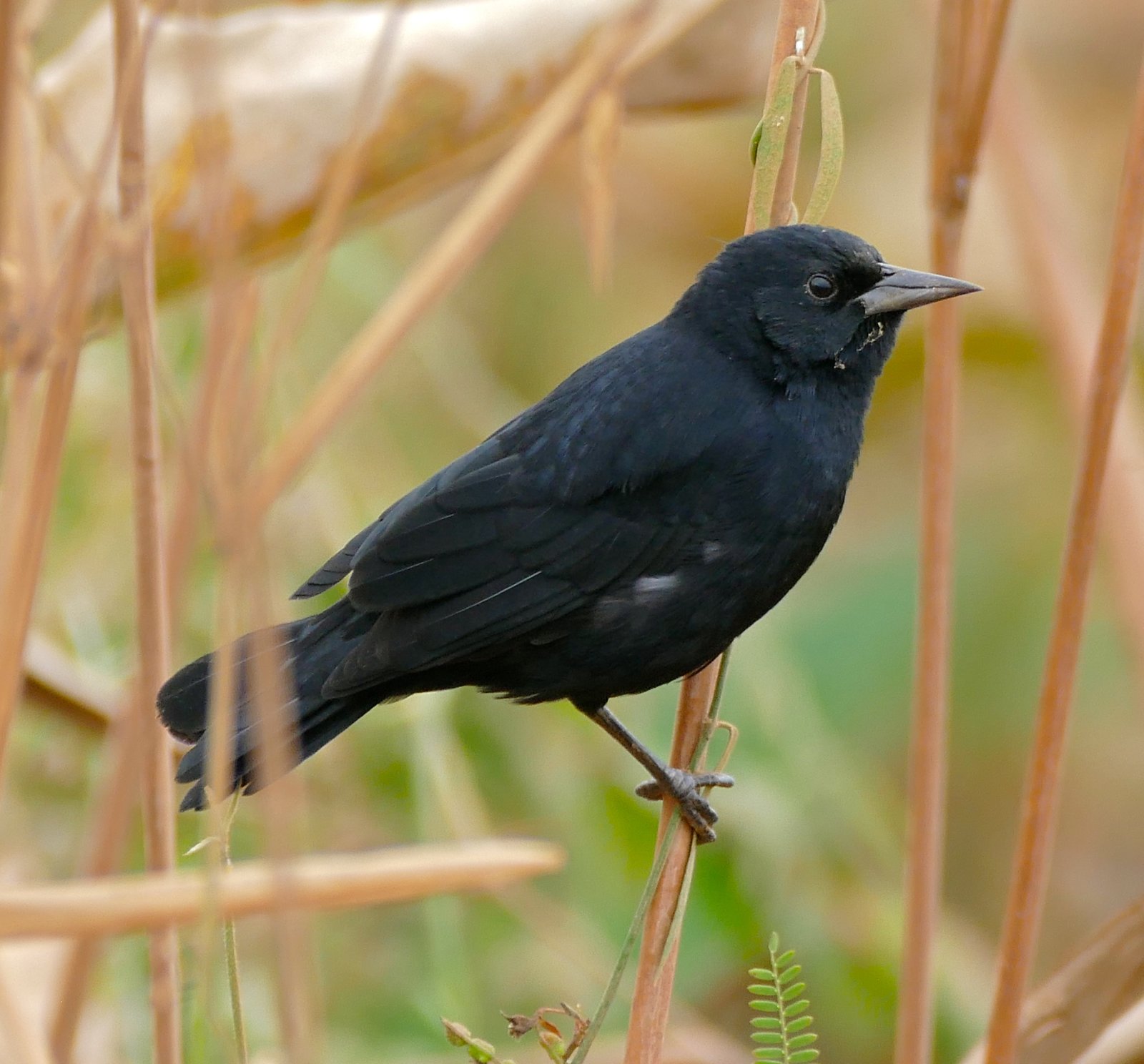
The Unicolored Blackbird is a blackbird of marshes and wet savannas in central South America, in which the sexes differ strongly. The male is entirely black, the female brown and yellow and streaked. In the guide area it lives only in the lowlands of Bolivia.
Voice
The song is a series of clear, rather shrill whistles and short trills, often from a marsh plant. Calls are short, harsh chek notes.
Recording: Fernando Igor de Godoy — CC BY-NC-SA 4.0 · xeno-canto
Identification
18–21 cm, with a pointed black bill; the female is smaller. The male is entirely black with a weak bluish gloss and dark eyes. The female has brown, darkly streaked upperparts, rufous edges to the wing feathers, a yellowish supercilium and throat, and yellow to buffy yellow, finely streaked underparts. Juveniles resemble the female.
Confusion species
Male Shiny Cowbird Molothrus bonariensis has a conical bill and a strong purple gloss, and forages on open ground. Chopi Blackbird Gnorimopsar chopi is larger, with a thicker, grooved bill, and lives in savanna and open woodland. Female Chestnut-capped Blackbird Chrysomus ruficapillus is smaller and more olive-brown, with less rufous in the wing.
Habitat
Marshes with reeds, cattails and tall grasses, flooded savannas, lake shores and wet scrub in the lowlands, below about 500 m. It lives in pairs or family groups and forages low in the vegetation and on floating plants for insects. The nest is a cup in marsh vegetation, above the water.
Where the bird is most at home, classified by the vegetation units of the Andes and the west coast.


Range and movements
In Bolivia in the marshes and flooded savannas of the northern and eastern lowlands, in Beni and Santa Cruz. Absent from Colombia, Ecuador, Peru and the Galápagos. Outside the guide area in Brazil, mainly in the Pantanal and the east, in Paraguay and in north-eastern Argentina.
- Resident
- dark = core range, pale = thinly spread
How and when to look
Search the marshes of the Beni and eastern Santa Cruz along edges of reeds and cattails; pairs show themselves on the tops of marsh plants.
Conservation status
Least Concern. The large lowland wetlands provide plenty of habitat; locally the species loses ground to drainage.
Scientific name
Agelasticus cyanopus | (Vieillot, 1819)
Vieillot described the species in 1819 as Agelaius cyanopus; because it was later moved to another genus, the author and year stand in brackets. The genus Agelasticus was introduced in 1851 by Cabanis. The genus name comes from Greek agelastikos, 'gregarious, living in groups', from agelē, 'herd'. The species name comes from Greek kuanos, 'dark blue', and pous, 'foot'. The specimen the first description was based on came from Paraguay or Río de la Plata region.