All species › Passerines › New World blackbirds, troupials and allies › Yellow-winged Blackbird
Yellow-winged Blackbird | Agelasticus thilius
Geelboegtroepiaal | Varillero aliamarillo | Sargento
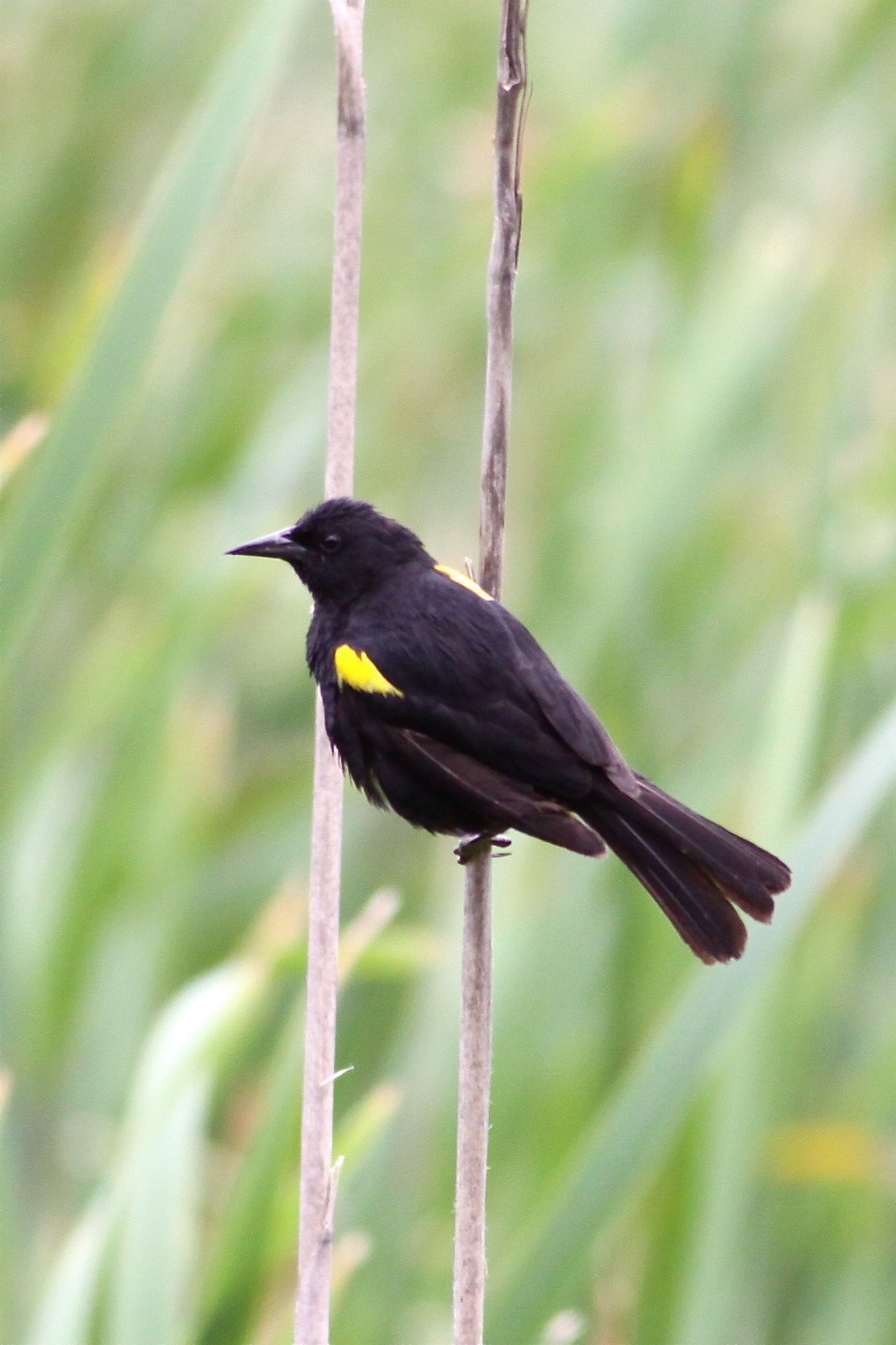
The Yellow-winged Blackbird is a small black blackbird with a yellow shoulder patch. In the guide area it lives in reedbeds and wet meadows on the altiplano of southern Peru and Bolivia, including the totora beds of Lake Titicaca.
Voice
The song is a buzzy, squeaky chew-weeee, from a reed or totora stem. Calls are a short chek and a soft, whistled chew.
Recording: Cristian Pinto Fernandez — CC BY-NC-SA 4.0 · xeno-canto
Identification
17–19 cm, with a pointed black bill. The male is dull black with a bright yellow shoulder (lesser coverts), often partly hidden at rest and well visible in flight and when singing; the axillaries are also yellow. The female is brown, heavily streaked dark, with a pale supercilium and also a yellow shoulder patch. Juveniles resemble the female, with little or no yellow.
Confusion species
Male Shiny Cowbird Molothrus bonariensis lacks the yellow shoulder and has a conical bill and a purple gloss. The female resembles female Shiny Cowbird, but is more heavily streaked and has the yellow shoulder patch and an obvious supercilium. The other black blackbirds of the guide area do not live on the altiplano.
Habitat
Totora beds and reed fringes along lakes, bofedales, wet meadows, ditches and field edges on the altiplano, roughly between 3000 and 4300 m. It forages in small groups on the ground and in the marsh vegetation for insects and seeds. The nest is a cup in reeds or totora, above the water or low in the vegetation.
Where the bird is most at home, classified by the vegetation units of the Andes and the west coast.


Range and movements
In Peru in the Andes of the south, mainly in Puno around Lake Titicaca and locally in Cusco and Arequipa. In Bolivia on the altiplano and in the high valleys of La Paz, Oruro, Cochabamba and Potosí. Absent from Colombia, Ecuador and the Galápagos. Outside the guide area in Chile, Argentina, Uruguay and southern Brazil, there in the lowlands.
- Resident
- dark = core range, pale = thinly spread
How and when to look
Walk along the totora beds on the shores of Lake Titicaca; males sing from the tops of the stems and then show the yellow shoulder.
Conservation status
Least Concern. In the guide area the species depends on high-altitude marshes and totora beds, which are locally degraded by drainage, cutting and pollution.
Scientific name
Agelasticus thilius | (Molina, 1782)
Molina described the species in 1782 as Turdus Thilius; because it was later moved to another genus, the author and year stand in brackets. The genus Agelasticus was introduced in 1851 by Cabanis. The genus name comes from Greek agelastikos, 'gregarious, living in groups', from agelē, 'herd'. The species name comes from the Chilean onomatopoeic names trile or thili for this bird, which Molina used as the species name in 1782. The specimen the first description was based on came from Chile.