All species › Passerines › New World blackbirds, troupials and allies › Bolivian Blackbird
Bolivian Blackbird | Oreopsar bolivianus
Boliviaanse troepiaal | Tordo boliviano | Pássaro-preto-boliviano
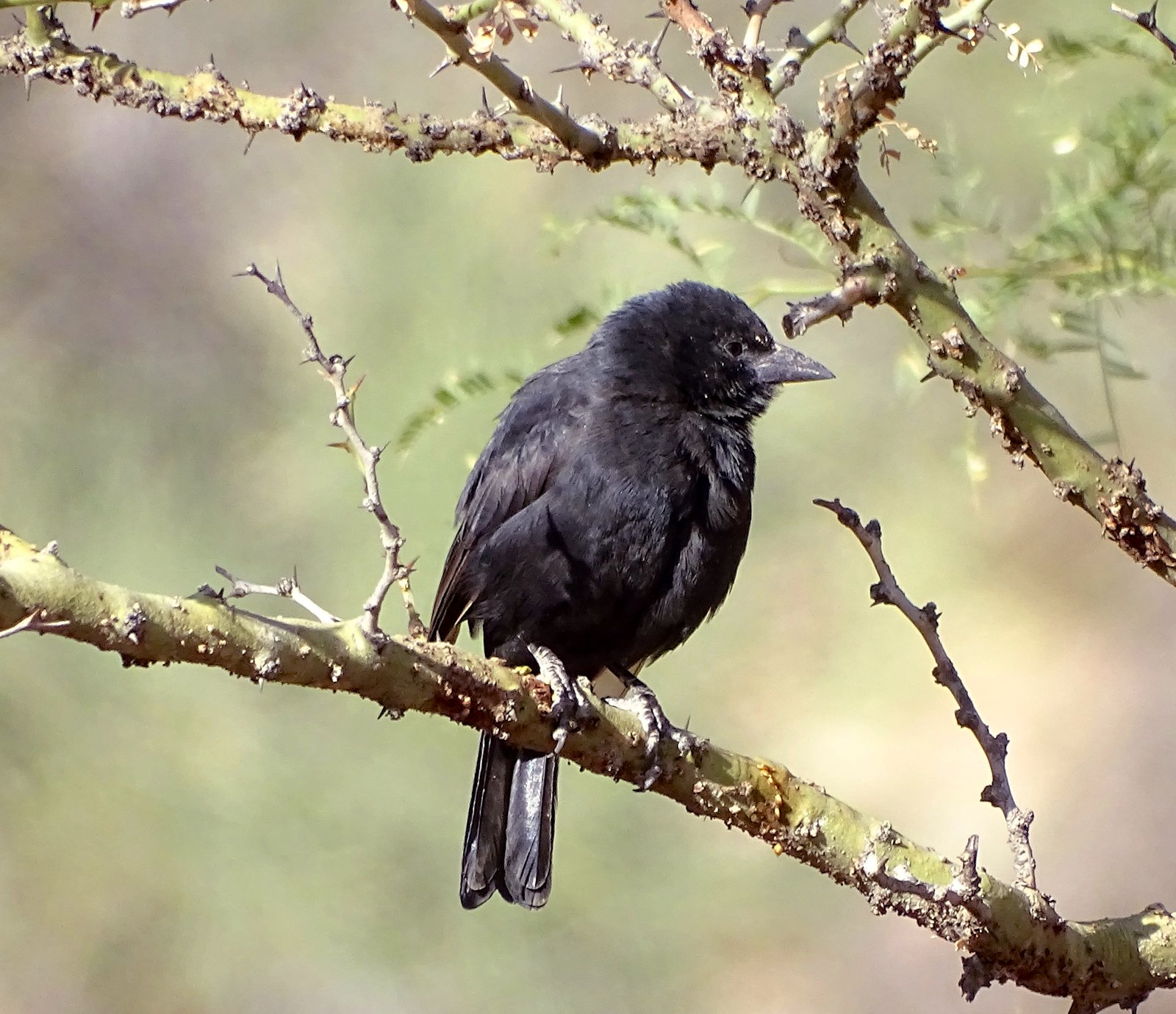
The Bolivian Blackbird is a brownish-black blackbird found only in Bolivia, in the dry valleys of the eastern Andes. It lives in groups on rocky slopes with cacti and scrub and breeds in rock crevices. It is the only species in its genus.
Voice
Groups give a varied mixture of clear whistles, gurgling notes and busy chatter. Calls are short, harsh chek notes.
Recording: Richard E. Webster — CC BY-NC-SA 4.0 · xeno-canto
Identification
22–24 cm, with a fairly long, pointed black bill. The plumage is dull brownish black, without gloss. The primaries are brown and form a paler, brown wing patch in flight; at rest they show as brown edges on the folded wing. The eyes are dark. The sexes are alike. Juveniles are slightly browner.
Confusion species
Greyish Baywing Agelaioides badius, which lives in the same valleys, is smaller and greyish brown, with chestnut wings and a shorter bill. Chopi Blackbird Gnorimopsar chopi is glossy black, without brown in the wing, and lives in the lowlands. Male Shiny Cowbird Molothrus bonariensis is smaller and glossed purple, with a conical bill.
Habitat
Dry, rocky slopes with cacti and thorn scrub, cliffs, ravines and field edges in the dry inter-Andean valleys, roughly between 1100 and 3100 m. It forages in small groups mainly on the ground for insects and seeds, also in fields. The nest is in a crevice in a rock face or in a hole in a steep bank.
Where the bird is most at home, classified by the vegetation units of the Andes and the west coast.


Range and movements
Endemic to Bolivia: in the dry inter-Andean valleys of Cochabamba, Chuquisaca, Potosí and western Santa Cruz. Absent from Colombia, Ecuador, Peru and the Galápagos. Does not occur outside the guide area.
- Resident
- dark = core range, pale = thinly spread
How and when to look
Search the dry valleys south and east of Cochabamba, for example along roads through cactus scrub with rock faces; groups often perch on rocks or telegraph wires.
Conservation status
Least Concern. The species has a small range, but tolerates the small-scale farmland of the dry valleys.
Scientific name
Oreopsar bolivianus | Sclater, 1939 (GBIF: Agelaioides oreopsar)
Sclater described the species in 1939 and placed it straight away in the genus where it still stands. He introduced the genus Oreopsar in that same work. The genus name comes from Greek oros, 'mountain', and psar, 'starling': a mountain starling. The species name refers to Bolivia. The specimen the first description was based on came from Sucre, Chuquisaca, Bolivia.