All species › Passerines › New World blackbirds, troupials and allies › Greyish Baywing
Greyish Baywing | Agelaioides badius
Grijze koevogel | Tordo músico | Asa-de-telha
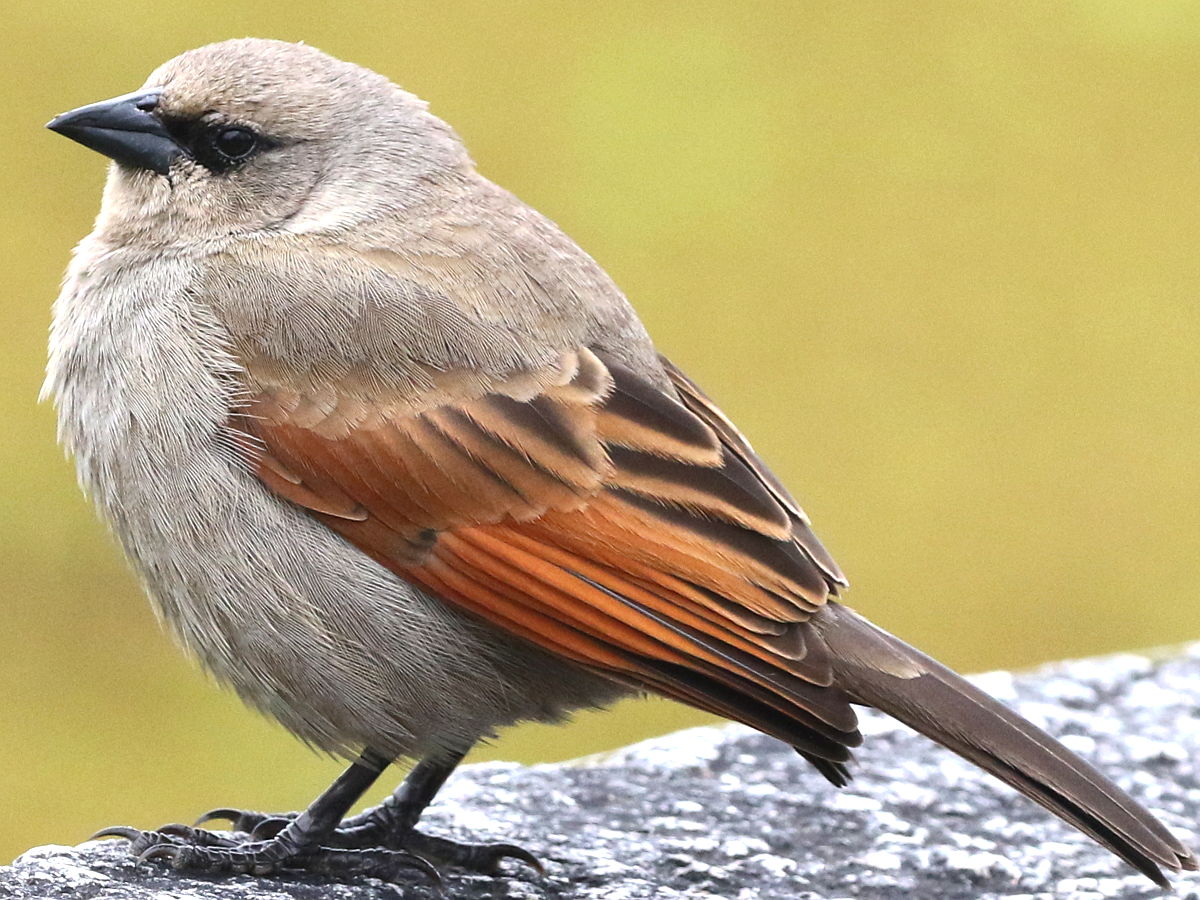
The Greyish Baywing is a greyish-brown blackbird with chestnut wings of dry woodland and open country in southern South America. Unlike true cowbirds it breeds itself, often in nests built by other birds, and it is almost the only host of the Screaming Cowbird. It lives in groups in which helpers assist in feeding the young.
Voice
Groups sing a melodious, varied chatter of whistles and trills, often in chorus. Calls are short, clear chip notes.
Recording: Franco Vushurovich — CC BY-NC-SA 4.0 · xeno-canto
Identification
17–19 cm, with a short, pointed black bill. The plumage is greyish brown to olive-grey, with dark lores and a dark area around the eye. The wings are rich chestnut, especially the primaries, which gives a rufous wing in flight. The tail is dark. The sexes are alike. Juveniles resemble the adults, slightly paler and faintly streaked on the breast.
Confusion species
Juvenile Screaming Cowbirds Molothrus rufoaxillaris closely resemble juvenile baywings, with the same rufous wings, and are raised by them; adult Screaming Cowbirds are black. Female Shiny Cowbird Molothrus bonariensis is uniformly greyish brown, without chestnut wings. Bolivian Blackbird Oreopsar bolivianus is larger and brownish black.
Habitat
Dry forest and Chaco scrub, open woodland, forest edges, riparian woodland, pastures with trees, gardens and villages, in the lowlands and in the dry Andean valleys up to roughly 2500 m. It forages in small groups on the ground and in trees for insects and seeds. It often breeds in abandoned or taken-over nests of ovenbirds and other species, sometimes in cavities.
Where the bird is most at home, classified by the vegetation units of the Andes and the west coast.


Range and movements
In Bolivia in the east and south, in Santa Cruz, Chuquisaca, Tarija and the dry valleys of Cochabamba. Absent from Colombia, Ecuador, Peru and the Galápagos. Outside the guide area in Paraguay, Argentina, Uruguay and southern and central Brazil.
- Resident
- dark = core range, pale = thinly spread
How and when to look
In the Chaco and the dry valleys of southern Bolivia, search forest edges and farmyards for groups on the ground; in flight look for the rufous wings.
Conservation status
Least Concern. The species is common and tolerates farmland and villages well.
Scientific name
Agelaioides badius | (Vieillot, 1819)
Vieillot described the species in 1819 as Agelaius badius; because it was later moved to another genus, the author and year stand in brackets. The genus Agelaioides was introduced in 1866 by Cassin. The genus name is formed from the genus name Agelaius (from Greek agelaios, 'living in flocks') and Greek -oidēs, 'resembling'. The species name comes from Latin badius, 'bay' or 'chestnut-brown', for the rufous wings. The specimen the first description was based on came from Paraguay.