All species › Passerines › New World blackbirds, troupials and allies › Chestnut-capped Blackbird
Chestnut-capped Blackbird | Chrysomus ruficapillus
Bruinkaptroepiaal | Varillero congo | Garibaldi
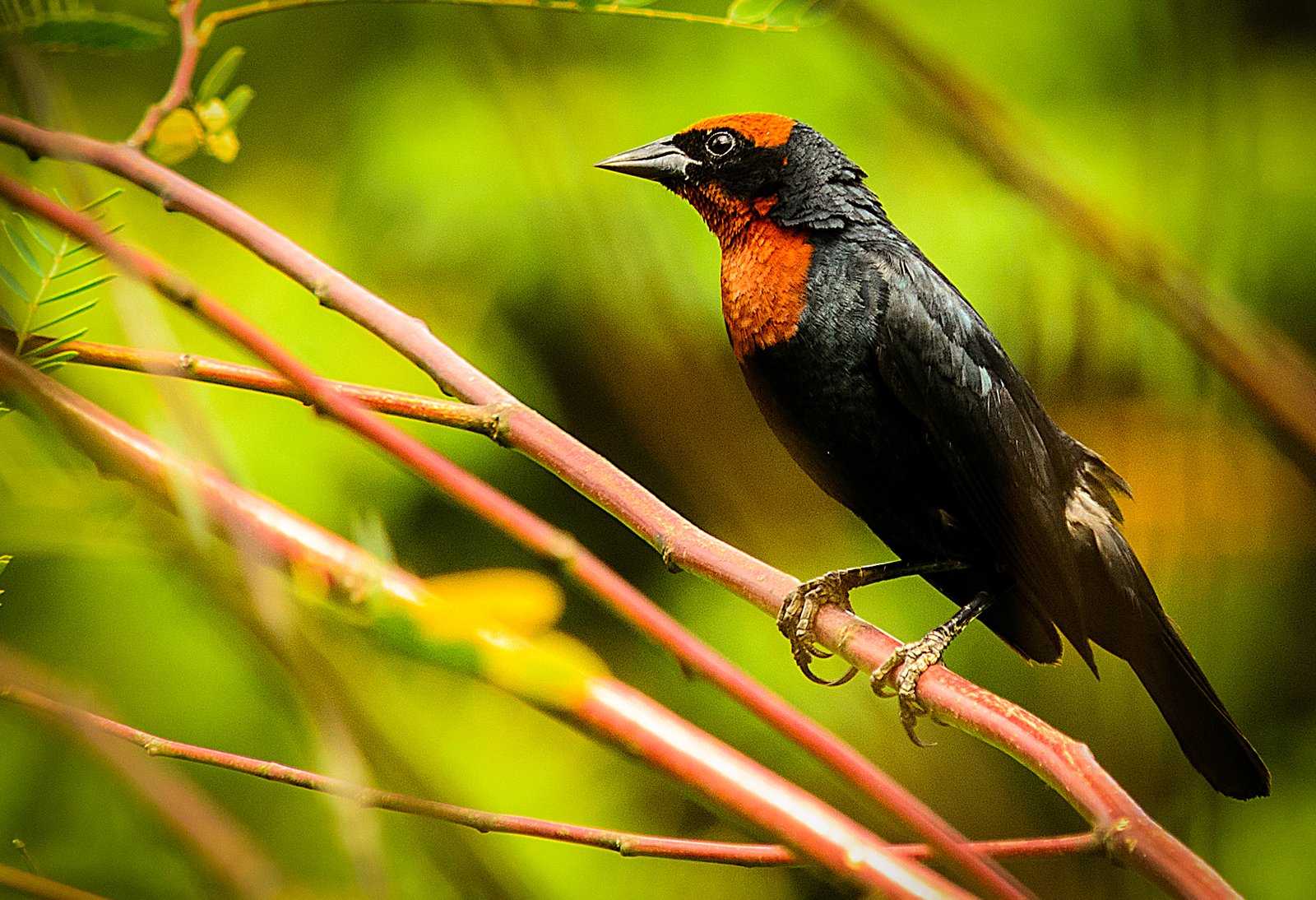
The Chestnut-capped Blackbird is a small blackbird of marshes and rice fields in south-eastern South America. The male is glossy black with a chestnut crown and throat, the female olive-brown. In the guide area it occurs only in eastern Bolivia.
Voice
The song is a series of short, shrill notes ending in a buzzy, descending whistle. Groups give a busy chatter; calls are a short chek.
Recording: Fabrício Grigolin — CC BY-NC-SA 4.0 · xeno-canto
Identification
17–19 cm, with a pointed black bill. The male is glossy blue-black, with a chestnut crown and a chestnut throat and foreneck; in poor light it looks entirely black. The female is olive-brown, finely streaked dark on the upperparts, with a yellowish supercilium, throat and breast and a darker belly. Young males resemble the female at first.
Confusion species
Male Yellow-hooded Blackbird Chrysomus icterocephalus has a yellow hood; females of the two species are alike, but those of Yellow-hooded have a brighter yellow throat and supercilium. Their ranges do not overlap in the guide area. Male Unicolored Blackbird Agelasticus cyanopus is larger and entirely black; the female has rufous wing edges and heavily streaked yellow underparts.
Habitat
Marshes with reeds and cattails, waterside vegetation, wet meadows, flooded savannas and rice fields in the lowlands, below about 500 m. It breeds in colonies in marsh vegetation; outside the breeding season in large flocks, which can cause damage in rice-growing areas. It eats seeds, rice and insects. The nest is a cup among marsh plants.
Where the bird is most at home, classified by the vegetation units of the Andes and the west coast.


Range and movements
In Bolivia locally in the eastern lowlands, mainly in Santa Cruz and possibly in Beni. Absent from Colombia, Ecuador, Peru and the Galápagos. Outside the guide area in eastern and southern Brazil, Paraguay, Uruguay and northern Argentina, with a separate population in French Guiana.
- Resident
- dark = core range, pale = thinly spread
How and when to look
In eastern Santa Cruz, search marshes and rice fields for flocks on the rice heads or in the reeds; males show the chestnut cap mainly in sunlight.
Conservation status
Least Concern. The species benefits from rice cultivation and is controlled locally there as a pest.
Scientific name
Chrysomus ruficapillus | (Vieillot, 1819)
Vieillot described the species in 1819 as Agelaius ruficapillus; because it was later moved to another genus, the author and year stand in brackets. The genus Chrysomus was introduced in 1837 by Swainson. The genus name is a transliteration of Greek khrusōma, 'wrought gold' or 'something made of gold'. The species name comes from Latin rufus, 'red', and capillus, 'hair', for the chestnut crown. The specimen the first description was based on came from Paraguay.