All species › Passerines › New World blackbirds, troupials and allies › Yellow-hooded Blackbird
Yellow-hooded Blackbird | Chrysomus icterocephalus
Geelkaptroepiaal | Turpial cabeciamarillo | Iratauá-pequeno
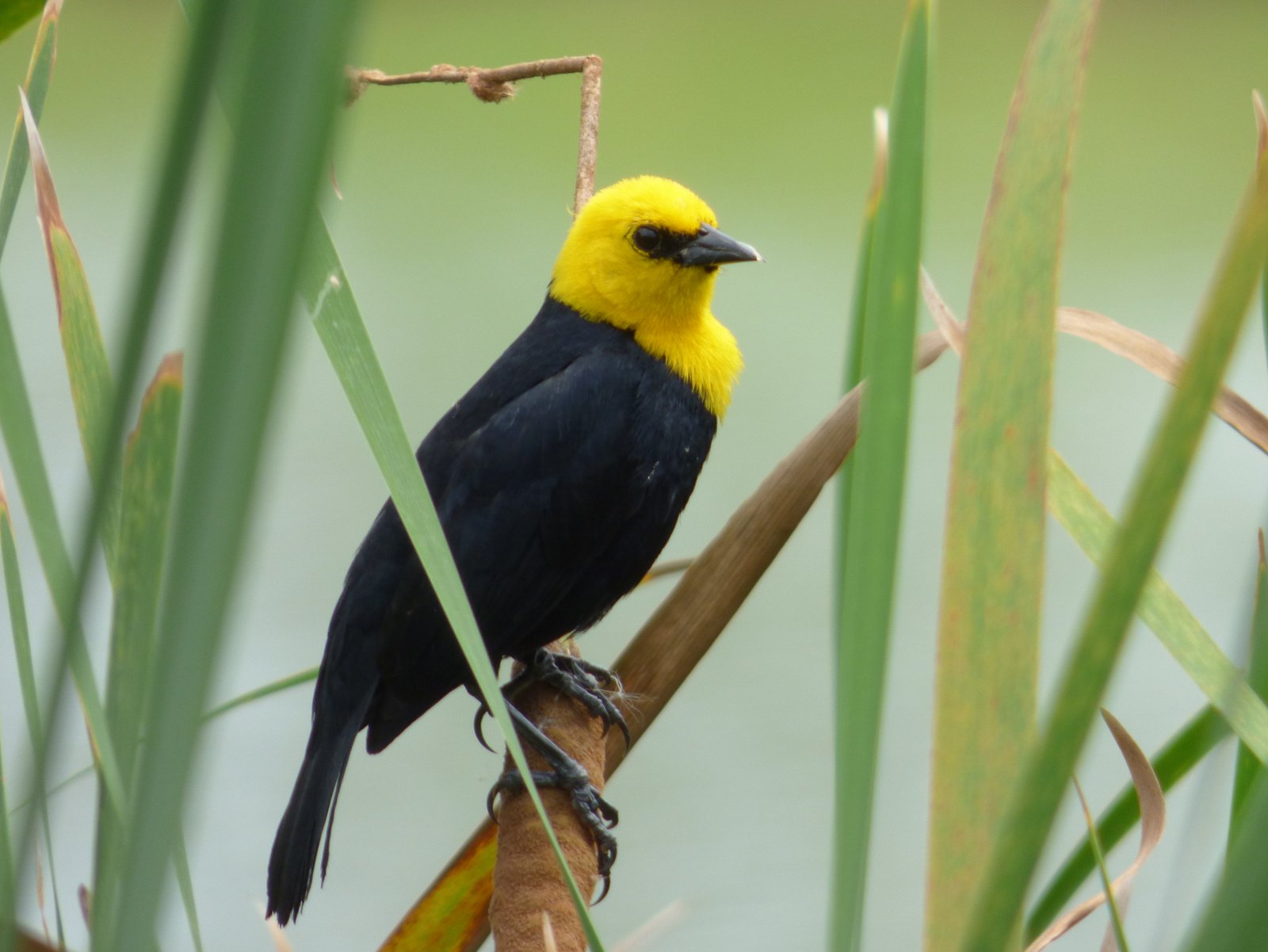
The Yellow-hooded Blackbird is a small blackbird of marshes and wet grasslands in northern South America. The male is black with a bright yellow hood, the female olive-brown with a yellow throat. In the guide area it lives mainly in Colombia, up to the Bogotá plateau.
Voice
The song is a short, scratchy chatter ending in a buzzy, drawn-out note, something like chuk-chuk-dzheeeeh. Calls are a short chek.
Recording: Bernard BOUSQUET — CC BY-NC-SA 4.0 · xeno-canto
Identification
16–18 cm, with a pointed black bill; the female is smaller. The male is glossy black with a bright yellow head, throat and upper breast; the lores and a narrow line around the bill base are black. The female is olive-brown, finely streaked on the upperparts, with a yellow supercilium, throat and upper breast, which grade into olive-brown on the belly. Young males resemble the female at first.
Confusion species
Oriole Blackbird Gymnomystax mexicanus is much larger, with yellow underparts too and a yellow shoulder. Yellow-headed Blackbird Xanthocephalus xanthocephalus, an extremely rare vagrant, is larger and has a white wing patch. Scarlet-headed Blackbird Amblyramphus holosericeus has a red head and lives only in Bolivia. The female resembles that of Chestnut-capped Blackbird Chrysomus ruficapillus, which occurs in the guide area only in Bolivia.
Habitat
Marshes with cattails and reeds, wet meadows, ditch edges, rice fields and river islands with tall grass, in the lowlands and on the Bogotá plateau up to about 2600 m. It breeds in colonies in marsh vegetation and forms large flocks outside the breeding season, often with other blackbirds. It eats seeds and insects. The nest is a cup among marsh plants.
Where the bird is most at home, classified by the vegetation units of the Andes and the west coast.


Range and movements
In Colombia in the Caribbean lowlands, the Magdalena and Cauca valleys, the llanos, along the Amazon near Leticia and on the Bogotá plateau. In Ecuador rare and local in the north-east. In Peru in the north-east, along the Amazon and the lower Napo and Marañón in Loreto. Absent from Bolivia and the Galápagos. Outside the guide area in Venezuela, the Guianas, Trinidad and Brazilian Amazonia.
- Resident
- dark = core range, pale = thinly spread
How and when to look
Search cattail beds in the wetlands around Bogotá or in marshes in the Colombian llanos; males sing from the stems. Near Iquitos on river islands with tall grass.
Conservation status
Least Concern. The species benefits from rice cultivation and wet pastures; birds on the Bogotá plateau depend on the remaining marshes, which have shrunk greatly.
Scientific name
Chrysomus icterocephalus | (Linnaeus, 1766)
Linnaeus described the species in 1766 as O[riolus] icterocephalus; because it was later moved to another genus, the author and year stand in brackets. The genus Chrysomus was introduced in 1837 by Swainson. The genus name is a transliteration of Greek khrusōma, 'wrought gold' or 'something made of gold'. The species name comes from Greek ikteros, 'jaundice' or 'yellow', and kephalē, 'head'. The specimen the first description was based on came from Cayenne, French Guiana.