All species › Passerines › New World blackbirds, troupials and allies › Yellow-headed Blackbird
Yellow-headed Blackbird | Xanthocephalus xanthocephalus
Geelkoptroepiaal | Tordo cabeza amarilla | Pássaro-preto-de-cabeça-amarela
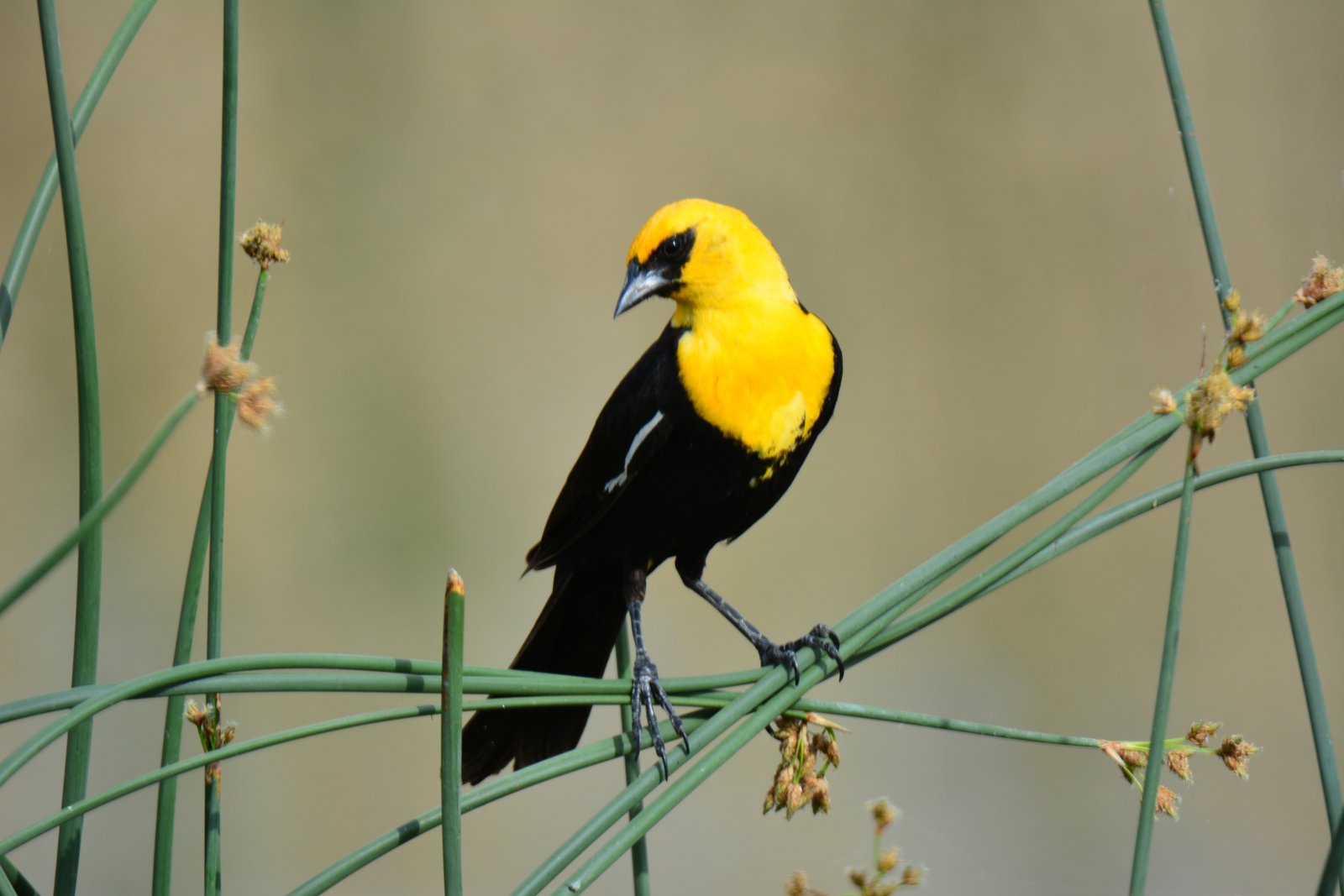
The Yellow-headed Blackbird is a large blackbird of reed marshes in western North America. The male is black with a yellow head and breast and a white wing patch. It winters in the southern United States and Mexico; in the guide area it is an exceptional vagrant, with a few records from northern Colombia.
Voice
The call is a low, dry chek or klak. The male's song is a rasping, creaking sound, recalling a rusty hinge, preceded by a few short notes.
Recording: Richard E. Webster — CC BY-NC-SA 4.0 · xeno-canto
Identification
21–26 cm; the male is clearly larger than the female. The male is glossy black, with a bright yellow head, neck and breast, a black mask around the eye and bill base, and a large white patch on the primary coverts, visible mainly in flight. The female is smaller and blackish brown, with a duller yellow face, throat and breast, a pale eyebrow and white streaks on the lower breast; she lacks the white wing patch. Young males resemble the female but are larger and yellower. The bill is pointed and black.
Confusion species
Yellow-hooded Blackbird Chrysomus icterocephalus of the marshes of northern Colombia is much smaller; the male has a yellow hood but a black breast and no white wing patch, and the female is olive-brown with a yellow throat and eyebrow. Oriole Blackbird Gymnomystax mexicanus is larger, with a yellow head and yellow underparts, a black back and a black patch around the eye.
Habitat
Breeds in reed and cattail marshes in the interior of North America. In winter in flocks, often with other blackbirds, on farmland, pastures, stubble fields and at cattle yards. In winter it eats mainly seeds and grain, in the breeding season also insects. The nest is a woven cup among reed stems above water.
Where the bird is most at home, classified by the vegetation units of the Andes and the west coast.


Range and movements
In the guide area only a few records as a vagrant from northern Colombia, mainly in the Caribbean lowlands. No records from Ecuador, Peru, Bolivia or the Galápagos. Breeds in western and central Canada and the United States; winters in the south-western United States and Mexico.
How and when to look
Check flocks of blackbirds and Shiny Cowbirds on farmland, in rice fields and near marshes in northern Colombia, especially in the northern winter. Document any sighting with photographs.
Conservation status
Least Concern. A numerous North American species that reaches the guide area only exceptionally as a vagrant.
Scientific name
Xanthocephalus xanthocephalus | (Bonaparte, 1826)
Bonaparte described the species in 1826 as Icterus xanthocephalus; because it was later moved to another genus, the author and year stand in brackets. The genus Xanthocephalus was introduced in 1850 by Bonaparte. The genus name comes from Greek xanthos, 'yellow', and kephalē, 'head': yellow-headed. The species name repeats the genus name: Greek for 'yellow-headed'. The specimen the first description was based on came from Fullerton, Nebraska, United States.