All species › Passerines › New World warblers › Ovenbird
Ovenbird | Seiurus aurocapilla
Ovenvogel | Reinita hornera | Mariquita-forneira
The Ovenbird is a North American warbler that walks over the forest floor like a small thrush. It winters mainly in Central America and the Caribbean; northern Colombia lies at the southern edge of its winter range. The name refers to the domed, oven-shaped nest on the ground.
Voice
In winter mainly a dry, sharp chuk or tseek. The song, seldom heard on the wintering grounds, is a loud, crescendo series teacher-teacher-teacher.
Recording: Scott Olmstead — CC BY-NC-SA 4.0 · xeno-canto
Identification
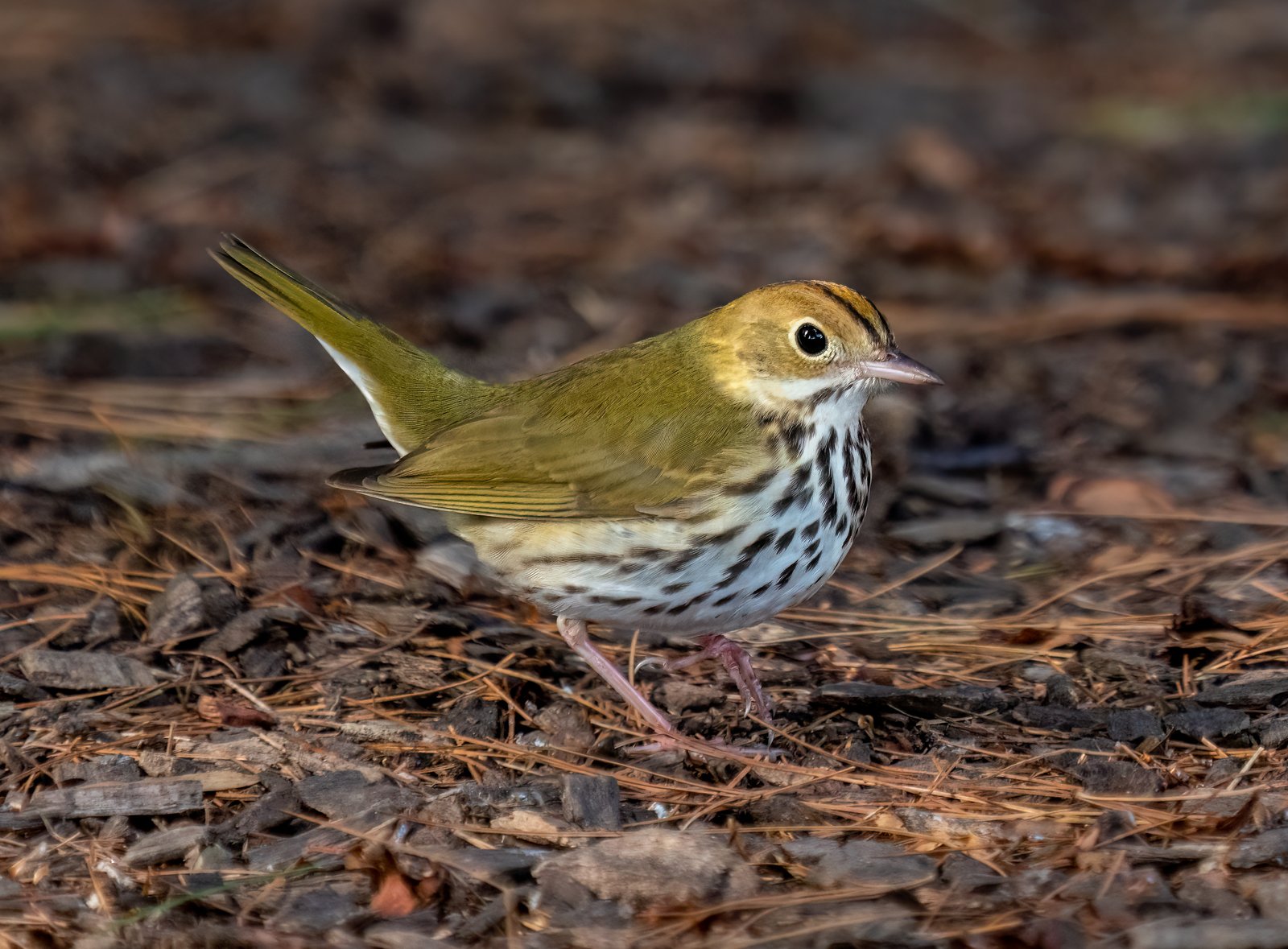
14–15 cm, with olive-brown upperparts and white underparts boldly streaked and spotted black on the breast and flanks. The crown has an orange central stripe, bordered on each side by a black stripe. A conspicuous white eye-ring gives the head a large-eyed look. The legs are pink. The sexes are alike; first-winter birds sometimes show rusty tips to the greater coverts.
Confusion species
Northern Waterthrush Parkesia noveboracensis and Louisiana Waterthrush Parkesia motacilla have a long, pale supercilium instead of an eye-ring and a plain crown, bob their rear constantly and live near water. Swainson's Thrush Catharus ustulatus and Grey-cheeked Thrush Catharus minimus are larger, with spots mainly on the upper breast and no crown stripes.
Habitat
On the wintering grounds in the understorey of humid and drier forest, old secondary forest and shade coffee, mainly below 1500 m, sometimes higher. It walks over the leaf litter with a slightly bobbing tail, feeding on insects, spiders and other invertebrates. It does not breed in the guide area.
Where the bird is most at home, classified by the vegetation units of the Andes and the west coast.


Range and movements
Winter visitor, mainly October to April. In Colombia scarce in the Caribbean lowlands, the Sierra Nevada de Santa Marta, the Magdalena valley and on the lower Andean slopes. In Ecuador rare, with a few records. Absent from Peru, Bolivia and the Galápagos. Breeds in deciduous and mixed forest in eastern and central North America and winters from Florida and Mexico to Panama, the Caribbean and northern South America.
- Winter visitor (c. Oct–Mar)
- dark = core range, pale = thinly spread
How and when to look
In the winter months in northern Colombia, listen for a sharp chuk from the understorey of forest and coffee plantations; the bird walks calmly over the ground and often pauses briefly.
Conservation status
Least Concern. The North American population is large; fragmentation of breeding forest and loss of forest on the wintering grounds are local threats.
Scientific name
Seiurus aurocapilla | (Linnaeus, 1766)
Linnaeus described the species in 1766 as Motacilla aurocapilla; because it was later moved to another genus, the author and year stand in brackets. The genus Seiurus was introduced in 1827 by Swainson. The genus name comes from Greek seiouros, 'wagtail', literally 'tail-shaking'. The species name comes from Latin aurum, 'gold', and -capillus, '-crowned', for the orange-yellow crown stripe. The specimen the first description was based on came from Pennsylvania, United States.