All species › Swifts › Hummingbirds › Golden-tailed Sapphire
Golden-tailed Sapphire | Chrysuronia oenone
Bronsstaartsaffierkolibrie | Zafiro colidorado | Beija-flor-de-cauda-dourada
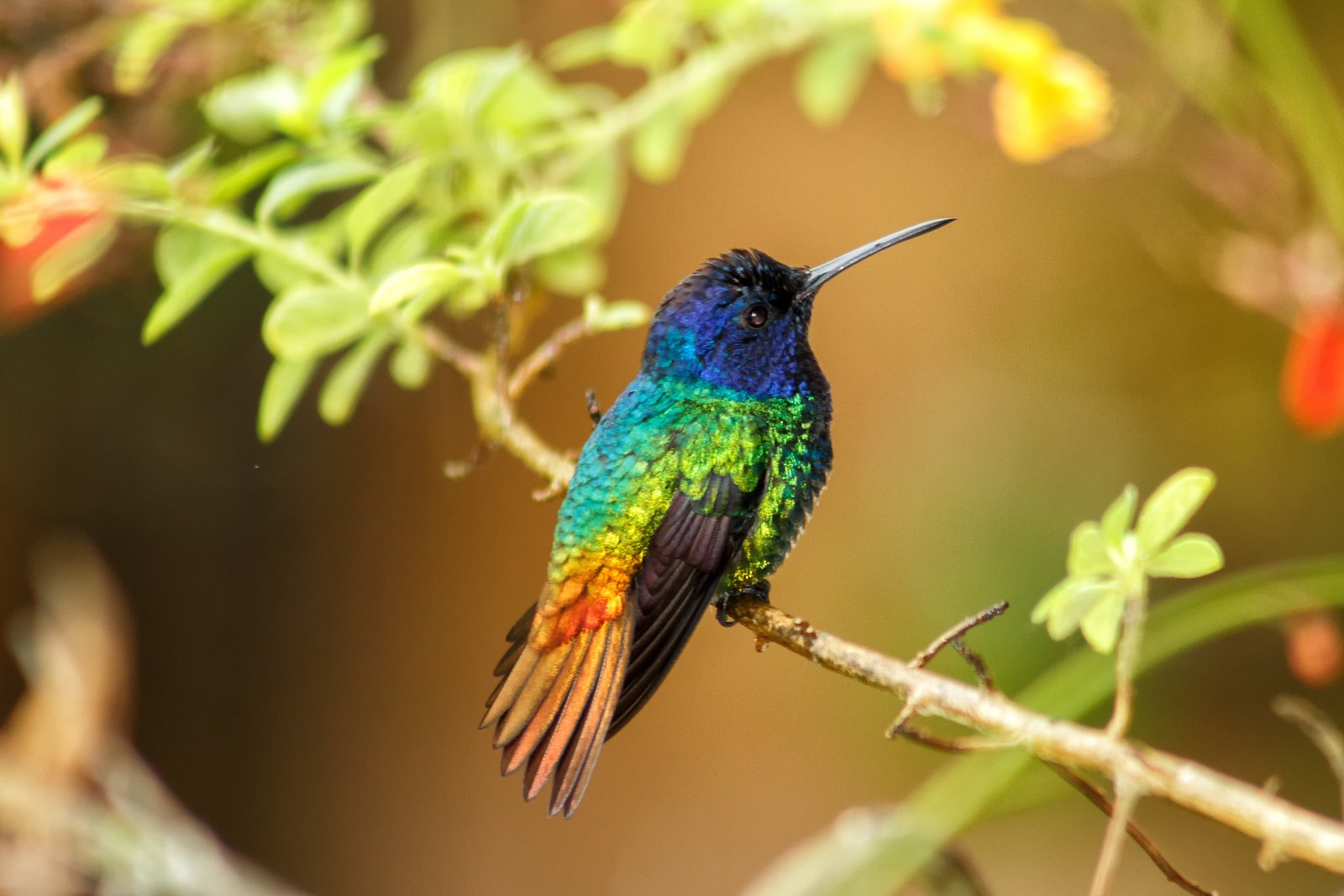
The Golden-tailed Sapphire is a hummingbird of the foothills and lower slopes on the eastern side of the Andes, from Venezuela to Bolivia. It has a coppery-bronze tail and a red lower mandible; in the north of its range the male has a violet-blue head. It lives in forest edges, clearings, plantations and gardens.
Voice
Variable. The song is a repeated, rhythmic phrase that starts with a burry note, followed by several squeaky or scratchy notes, and ends in repeated chips. Also a drawn-out metallic trill and short tsip calls.
Recording: JAYRSON ARAUJO DE OLIVEIRA — CC BY-NC-SA 4.0 · xeno-canto
Identification
9–10 cm, with a slightly decurved bill: the upper mandible is black, the lower mandible red with a black tip. The male in Colombia, Ecuador and northern Peru has a violet-blue head and throat, a green back shading to bronze and coppery uppertail coverts, a glittering green breast and a bronze-green belly; the tail is coppery bronze. In most of Peru the male has a mostly green throat, and in Bolivia an entirely green throat with at most some blue on the cheeks. The female has a bluish crown, a green back and a coppery-bronze tail; the underparts are mostly whitish, with blue-green spots on the throat and neck sides and green on the breast and flanks.
Confusion species
Blue-chinned Sapphire Chlorestes notata lives mainly in the lowlands and has a blue-black tail and a blue chin. Gilded Sapphire Hylocharis chrysura of the Bolivian lowlands is entirely golden green to bronze, with a rufous chin and a mostly red bill. The male Fork-tailed Woodnymph Thalurania furcata has a violet belly and shoulders, a black bill and a forked, blue-black tail.
Habitat
Semi-open areas in and near humid forest: forest edges, clearings, mature secondary forest, gallery forest, shaded cacao and coffee plantations and gardens. In Colombia from sea level to about 1500 m, in Ecuador mostly between 400 and 1200 m. It takes nectar from the flowers of shrubs, herbs and epiphytes and catches small insects. The nest is a small cup on a twig.
Where the bird is most at home, classified by the vegetation units of the Andes and the west coast.


Range and movements
In Colombia on the eastern slope of the Andes and in the foothills, also in the Serranía del Perijá and locally in the centre of the country. In Ecuador on the eastern slope and in the adjacent foothills. In Peru along the entire eastern slope and in the foothills, locally in the adjacent lowlands. In Bolivia in the foothills and lower montane forest of the eastern slope in the north. Absent from the Galápagos. Outside the guide area in western and northern Venezuela and in extreme western Brazil.
- Resident
- dark = core range, pale = thinly spread
How and when to look
Look at flowering shrubs and in gardens in the foothill zone of the eastern slope, for example along roads that descend from the Andes to the lowlands. The species also visits feeders at lodges.
Conservation status
Least Concern. The species has a large range and tolerates forest edges, plantations and gardens.
Scientific name
Chrysuronia oenone | (Lesson, 1832)
Lesson described the species in 1832 as Ornismya oenone; because it was later moved to another genus, the author and year stand in brackets. The genus Chrysuronia was introduced in 1850 by Bonaparte. The genus name is a blend of two old species names of the Golden-tailed Sapphire: chrysura (Greek khrusos, 'gold', and oura, 'tail') and oenone. The species name refers to Oenone (Greek Oinōnē), a nymph in Greek mythology and the first wife of Paris. The specimen the first description was based on came from Trinidad.