All species › Swifts › Hummingbirds › Sapphire-throated Hummingbird
Sapphire-throated Hummingbird | Chrysuronia coeruleogularis
Saffierkeelkolibrie | Colibrí gorjizafiro | Beija-flor-de-garganta-safira
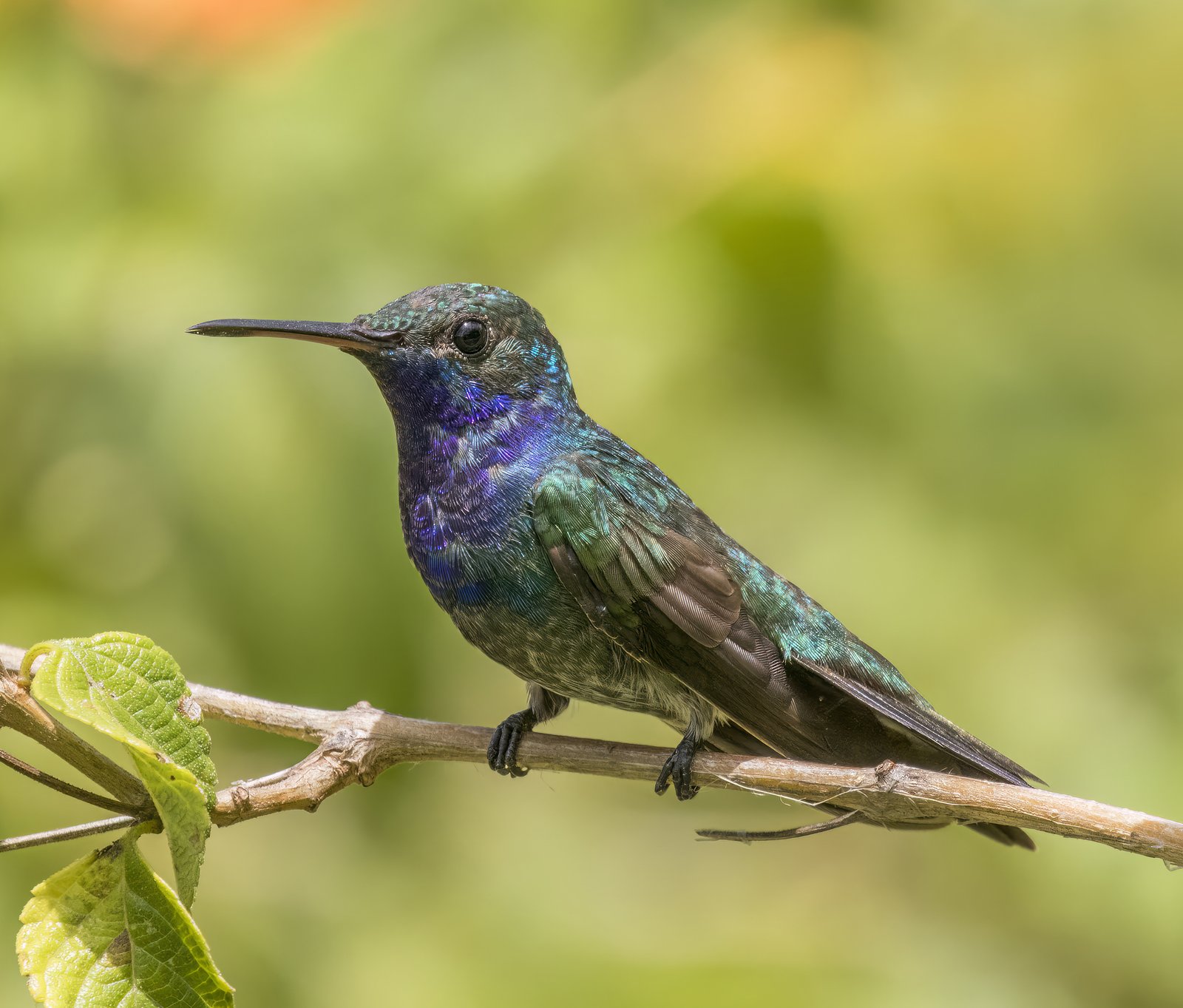
The Sapphire-throated Hummingbird is a small hummingbird of mangroves and coastal scrub, from Costa Rica and Panama to northern Colombia. The male has a glittering violet-blue throat and a deeply forked tail. In the guide area it occurs only in the Caribbean coastal region of Colombia.
Voice
Short, dry chip notes and a high twittering; little is known about the song.
Recording: Kent Livezey — CC BY-NC-SA 4.0 · xeno-canto
Identification
8–9 cm, with a fairly straight bill: the upper mandible is black, the lower mandible pink with a dark tip. The male is glossy green, with a glittering violet-blue throat and upper breast and a deeply forked, blue-black tail. The female is green above and greyish white below, with green spots on the sides; the tail is less deeply forked, with pale tips to the outer feathers. Young birds resemble the female.
Confusion species
The male Sapphire-bellied Hummingbird Chrysuronia lilliae is glittering blue on the breast and belly as well; that species is known only from the mangroves of the Ciénaga Grande de Santa Marta. Shining-green Hummingbird Chrysuronia goudoti lacks the blue throat and is bluish green below with a whitish belly; the females of the two species are very similar. Red-billed Emerald Chlorostilbon gibsoni is smaller, without a blue throat, and has a red bill with a black tip.
Habitat
Mangroves, coastal scrub, dry forest and forest edges and semi-open country with shrubs and gardens near the coast, mostly below 500 m. It takes nectar from flowers, including those of mangrove trees, and catches small insects. The nest is a small cup on a twig.
Where the bird is most at home, classified by the vegetation units of the Andes and the west coast.


Range and movements
In Colombia along the Caribbean coast, from the Gulf of Urabá east to the lower Magdalena and the Santa Marta area. Absent from Ecuador, Peru, Bolivia and the Galápagos. Outside the guide area in Panama, mainly on the Pacific side, and in south-western Costa Rica.
- Resident
- dark = core range, pale = thinly spread
How and when to look
Search mangroves and flowering coastal scrub along the Caribbean coast, for example at the lagoons between Barranquilla and Santa Marta.
Conservation status
Least Concern. Degradation of mangroves and coastal forest affects the species locally.
Scientific name
Chrysuronia coeruleogularis | (Gould, 1851)
Gould described the species in 1851 as Trochilus (--?) coeruleogularis; because it was later moved to another genus, the author and year stand in brackets. The genus Chrysuronia was introduced in 1850 by Bonaparte. The genus name is a blend of two old species names of the Golden-tailed Sapphire: chrysura (Greek khrusos, 'gold', and oura, 'tail') and oenone. The species name comes from Latin caeruleus, 'blue', and gula, 'throat', for the blue throat. The specimen the first description was based on came from David, Chiriquí, Panama.