All species › Swifts › Hummingbirds › Sapphire-bellied Hummingbird
Sapphire-bellied Hummingbird | Chrysuronia lilliae
Lillies kolibrie | Colibrí ventrizafiro | Beija-flor-de-ventre-safira
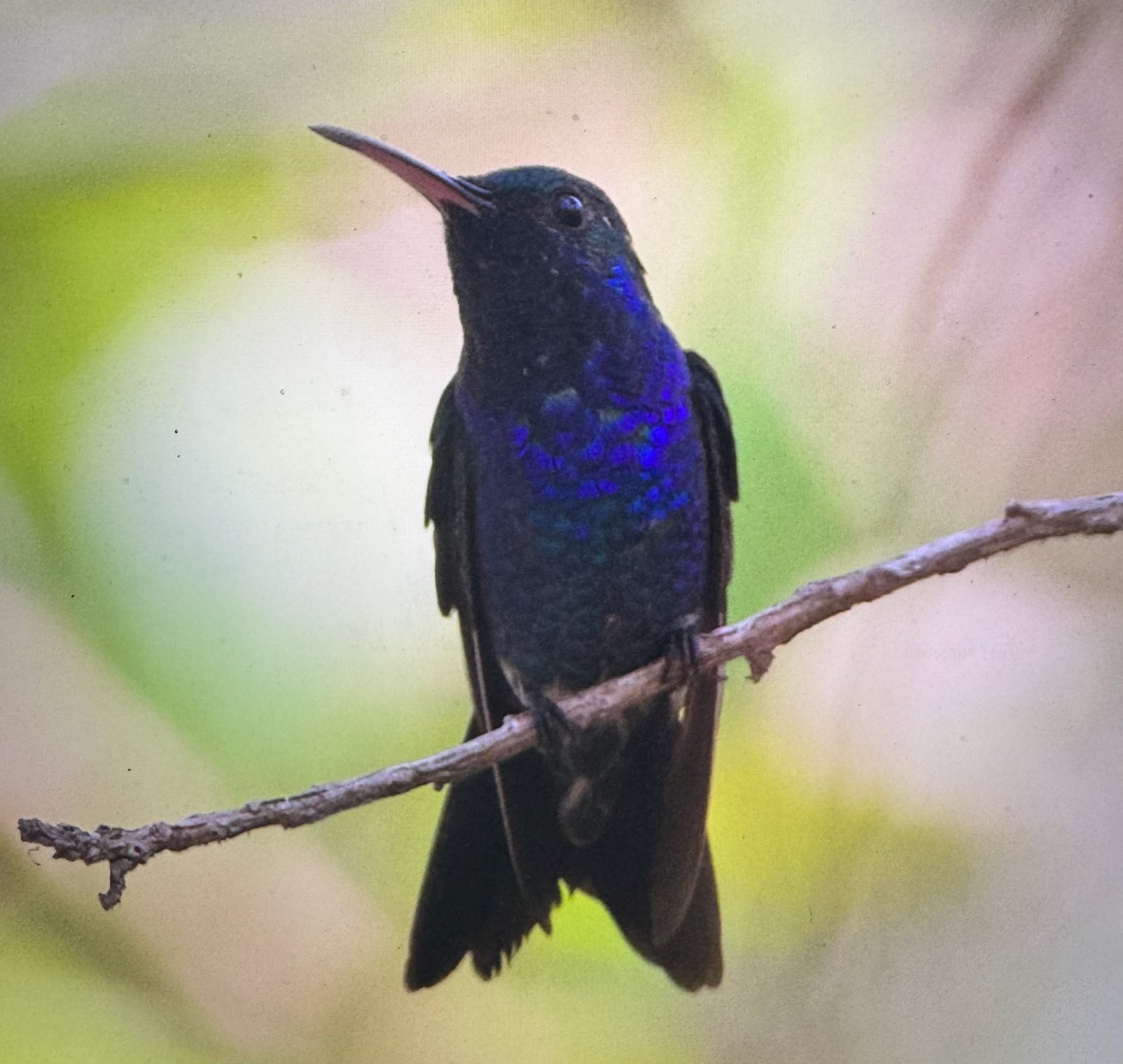
The Sapphire-bellied Hummingbird is a hummingbird endemic to Colombia, known only from the mangroves of the Ciénaga Grande de Santa Marta and its immediate surroundings. The male is glittering blue on the breast and belly. There are very few records; some authors regard the form as a colour variant or subspecies of the Sapphire-throated Hummingbird.
Voice
There are very few recordings; the voice has been described as series of short, chattering notes.
Recording: Oswaldo Cortes — CC BY-NC-SA 4.0 · xeno-canto
Identification
9 cm. The upper mandible is black, the lower mandible pink with a black tip. The male has a glossy green crown, back and rump, a glittering violet throat patch and otherwise glittering blue underparts; the tail is forked and blue-black. The female has not been described with certainty; it probably resembles the male, with greyer underparts.
Confusion species
Sapphire-throated Hummingbird Chrysuronia coeruleogularis occurs in the same region; in the male the blue is restricted to the throat and upper breast and the belly is green. Shining-green Hummingbird Chrysuronia goudoti has no blue or violet on the throat and breast and has a whitish belly.
Habitat
Coastal mangroves and adjacent dry scrub at sea level. It takes nectar mainly from the flowers of tea mangrove, Pelliciera rhizophorae, and catches small insects. Little is known about the nest.
Where the bird is most at home, classified by the vegetation units of the Andes and the west coast.


Range and movements
Only in Colombia: in the mangroves of the Ciénaga Grande de Santa Marta and the Isla de Salamanca, in the department of Magdalena. Absent from Ecuador, Peru, Bolivia and the Galápagos, and does not occur outside the guide area.
- Resident
- dark = core range, pale = thinly spread
How and when to look
The species can only be searched for in the mangroves around the Ciénaga Grande, preferably at flowering mangroves. A blue-bellied male calls for good photographs of the entire underparts.
Conservation status
Endangered. The population is estimated at a few hundred mature birds and is declining. The habitat is very small and is shrinking through mangrove die-off after disruption of the water regime, logging and road construction.
Scientific name
Chrysuronia lilliae | (Stone, 1917)
Stone described the species in 1917 as Lepidopyga lilliae; because it was later moved to another genus, the author and year stand in brackets. The genus Chrysuronia was introduced in 1850 by Bonaparte. The genus name is a blend of two old species names of the Golden-tailed Sapphire: chrysura (Greek khrusos, 'gold', and oura, 'tail') and oenone. The species name honours Lillian 'Lillie' May Stone, née Lafferty (1872–1940), wife of the describer, the American ornithologist Witmer Stone. The specimen the first description was based on came from Punto Caimán, Santa Marta, Colombia.