All species › Swifts › Hummingbirds › Humboldt's Sapphire
Humboldt's Sapphire | Chrysuronia humboldtii
Humboldts saffierkolibrie | Zafiro de Humboldt | Safira-de-humboldt
Humboldt's Sapphire is a hummingbird of the mangroves along the Pacific coast, from extreme south-eastern Panama to north-western Ecuador. It is closely tied to tea mangrove and lives almost only in a narrow coastal strip. The male has a deep blue forehead and a blue throat.
Voice
There are few recordings. The song is probably a repeated high phrase of hissing notes and trills; also a descending, squeaky twittering.
Recording: Olaf Jahn — CC BY-NC-SA 4.0 · xeno-canto
Identification
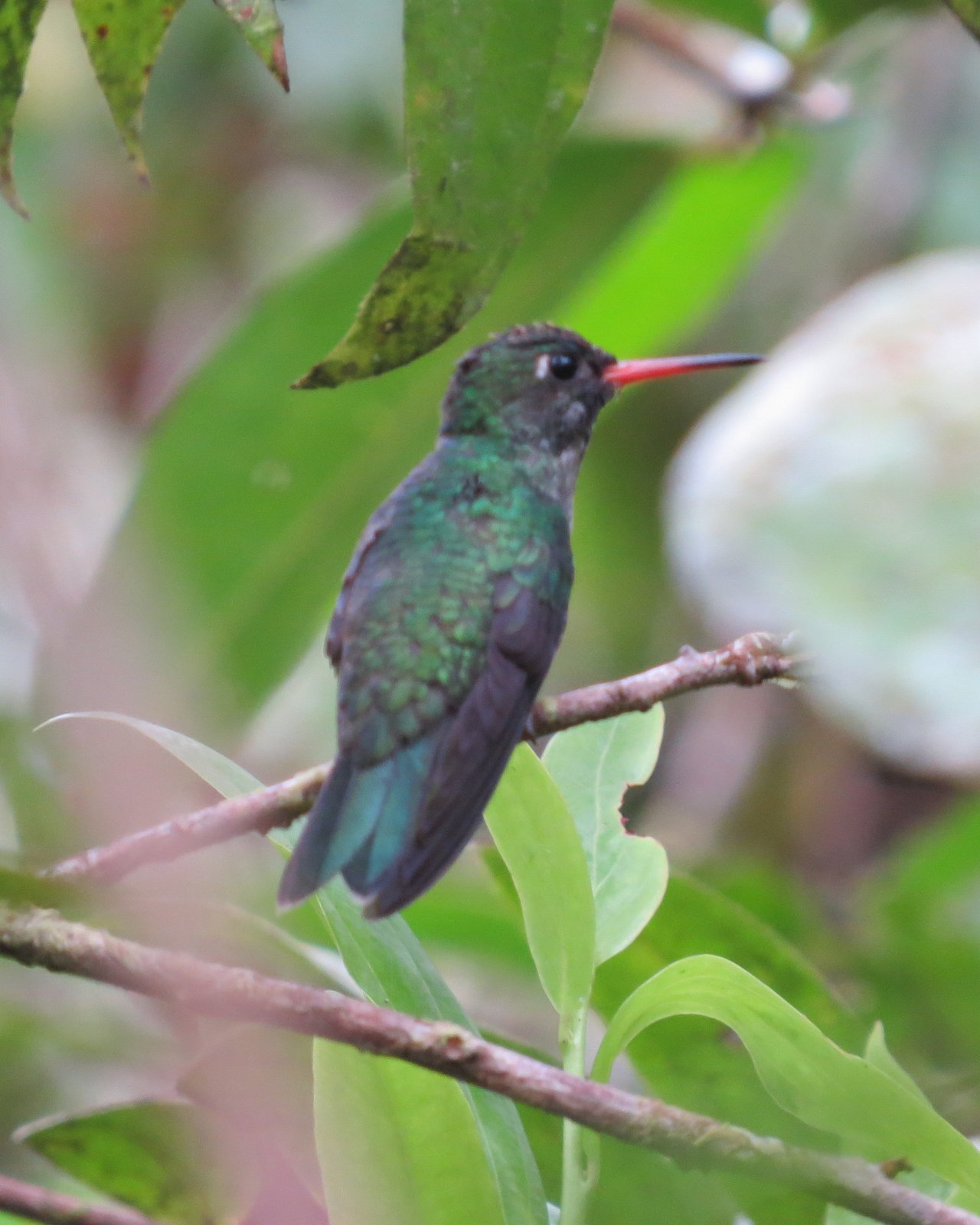
9–10 cm, with a fairly straight bill: in the male coral red with a black tip, in the female with a black upper mandible with a red base and a pink lower mandible with a black tip. The male has a deep blue forehead, a dull dark blue-green crown, a blue centre to the throat and blue-green to green cheeks and breast; the tail is dark metallic green to blue, with grey tips to the outer feathers. The female is green above and mostly white below, with green spots on the sides of the throat and breast; the tail is metallic green to bronze-green, with grey tips.
Confusion species
The male Blue-headed Sapphire Chrysuronia grayi has an entirely glittering blue head and a steel-blue tail and lives in dry Andean valleys, not on the coast. The male Violet-bellied Hummingbird Chlorestes julie is smaller, with a violet-blue belly. The male Crowned Woodnymph Thalurania colombica has a violet belly, a black bill and a deeply forked tail; the female is grey below.
Habitat
Mangroves and adjacent wet secondary forest and forest edges, outside the mangrove flowering season also fields and scrub along the coast, mostly below 50 m. Most numerous in mangroves with tea mangrove, Pelliciera rhizophorae, whose flowers it visits; it also catches small insects.
Where the bird is most at home, classified by the vegetation units of the Andes and the west coast.


Range and movements
In Colombia in a narrow strip along the Pacific coast, from the Panama border south to Nariño, very locally. In Ecuador only in the north-west, in Esmeraldas, where it is very scarce. Absent from Peru, Bolivia and the Galápagos. Outside the guide area in extreme south-eastern Panama.
- Resident
- dark = core range, pale = thinly spread
How and when to look
Search flowering mangroves along the Pacific coast, for example around Bahía Solano; a boat trip along the mangrove edge gives the best view.
Conservation status
Least Concern. The population is estimated at 20,000–50,000 mature birds and is thought to be declining, mainly because mangroves are converted into shrimp farms.
Scientific name
Chrysuronia humboldtii | (Bourcier & Mulsant, 1852)
Bourcier & Mulsant described the species in 1852 as Trochilus humboldtii; because it was later moved to another genus, the author and year stand in brackets. The genus Chrysuronia was introduced in 1850 by Bonaparte. The genus name is a blend of two old species names of the Golden-tailed Sapphire: chrysura (Greek khrusos, 'gold', and oura, 'tail') and oenone. The species name honours Alexander von Humboldt (1769–1859), a German naturalist and explorer who travelled the Andes and northern South America. The specimen the first description was based on came from Río Mira, Esmeraldas, Ecuador.