All species › Swifts › Hummingbirds › Blue-headed Sapphire
Blue-headed Sapphire | Chrysuronia grayi
Blauwkopsaffierkolibrie | Zafiro cabeciazul | Safira-de-cabeça-azul
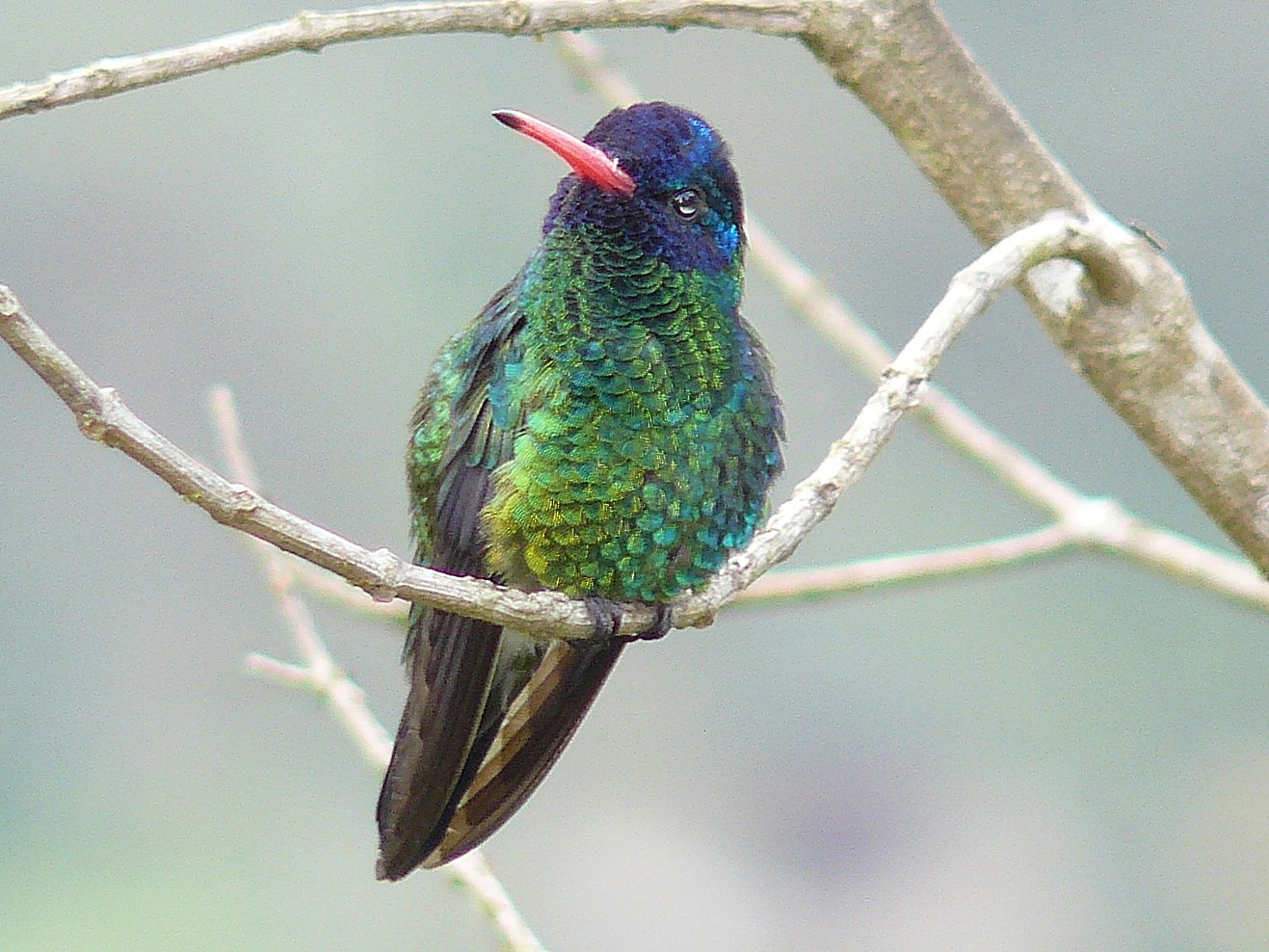
The Blue-headed Sapphire is a hummingbird of dry, semi-open valleys in the Andes of south-western Colombia and northern Ecuador. The male has an entirely glittering blue head and a coral-red bill. It lives in scrub, forest edges and farmland, also in gardens around Cali.
Voice
A repeated short, warbled phrase that begins with a squeaky note. Also short chip calls and a high, descending rattle.
Recording: José María Loaiza B. — CC BY-NC-SA 4.0 · xeno-canto
Identification
9–10 cm, with a fairly straight bill: in the male coral red with a black tip, in the female with a black upper mandible with a red base and a mostly pink lower mandible with a black tip. In the male the throat, face and crown are deep glittering blue and the rest is green; the tail is dark steel blue. The female is metallic green to bronze-green above and dull greyish white below, with bronze-green on the sides of the throat and breast; the tail is bronze-green at the base and otherwise blue-black, with grey tips to the outer feathers.
Confusion species
Humboldt's Sapphire Chrysuronia humboldtii lives in coastal mangroves; the male has only the forehead and throat blue and a greener tail. The male Golden-tailed Sapphire Chrysuronia oenone has a coppery-bronze tail and lives on the eastern slope. Andean Emerald Uranomitra franciae has pure white underparts and an almost black bill.
Habitat
Dry scrub, open woodland, edges of taller forest and farmland with shrubs and gardens, mostly between 500 and 2000 m, occasionally to 2600 m. In dry valleys often near cacti and flowering shrubs; it also comes to feeders in cloud forest a little higher up. It takes nectar from flowers and catches small insects.
Where the bird is most at home, classified by the vegetation units of the Andes and the west coast.


Range and movements
In Colombia in the valleys of the south-west, from Valle del Cauca south through the Patía valley into Nariño. In Ecuador in the northern inter-Andean valleys, south to Pichincha. Absent from Peru, Bolivia and the Galápagos, and does not occur outside the guide area.
- Resident
- dark = core range, pale = thinly spread
How and when to look
Look at flowering shrubs and cacti in the dry valleys, such as the Patía valley and the dry slopes around Cali; in the Cali area it also comes to feeders.
Conservation status
Least Concern. The species tolerates scrub, farmland and gardens.
Scientific name
Chrysuronia grayi | (Delattre & Bourcier, 1846)
Delattre & Bourcier described the species in 1846 as Trochilus Grayi; because it was later moved to another genus, the author and year stand in brackets. The genus Chrysuronia was introduced in 1850 by Bonaparte. The genus name is a blend of two old species names of the Golden-tailed Sapphire: chrysura (Greek khrusos, 'gold', and oura, 'tail') and oenone. The species name is an eponym for someone named Gray, possibly the British zoologist George Robert Gray or his brother John Edward Gray, both of the British Museum. The specimen the first description was based on came from Popayán, Cauca, Colombia.