All species › Swifts › Hummingbirds › Sapphire-spangled Emerald
Sapphire-spangled Emerald | Chionomesa lactea
Saffieramazilia | Amazilia zafirina | Beija-flor-de-peito-azul
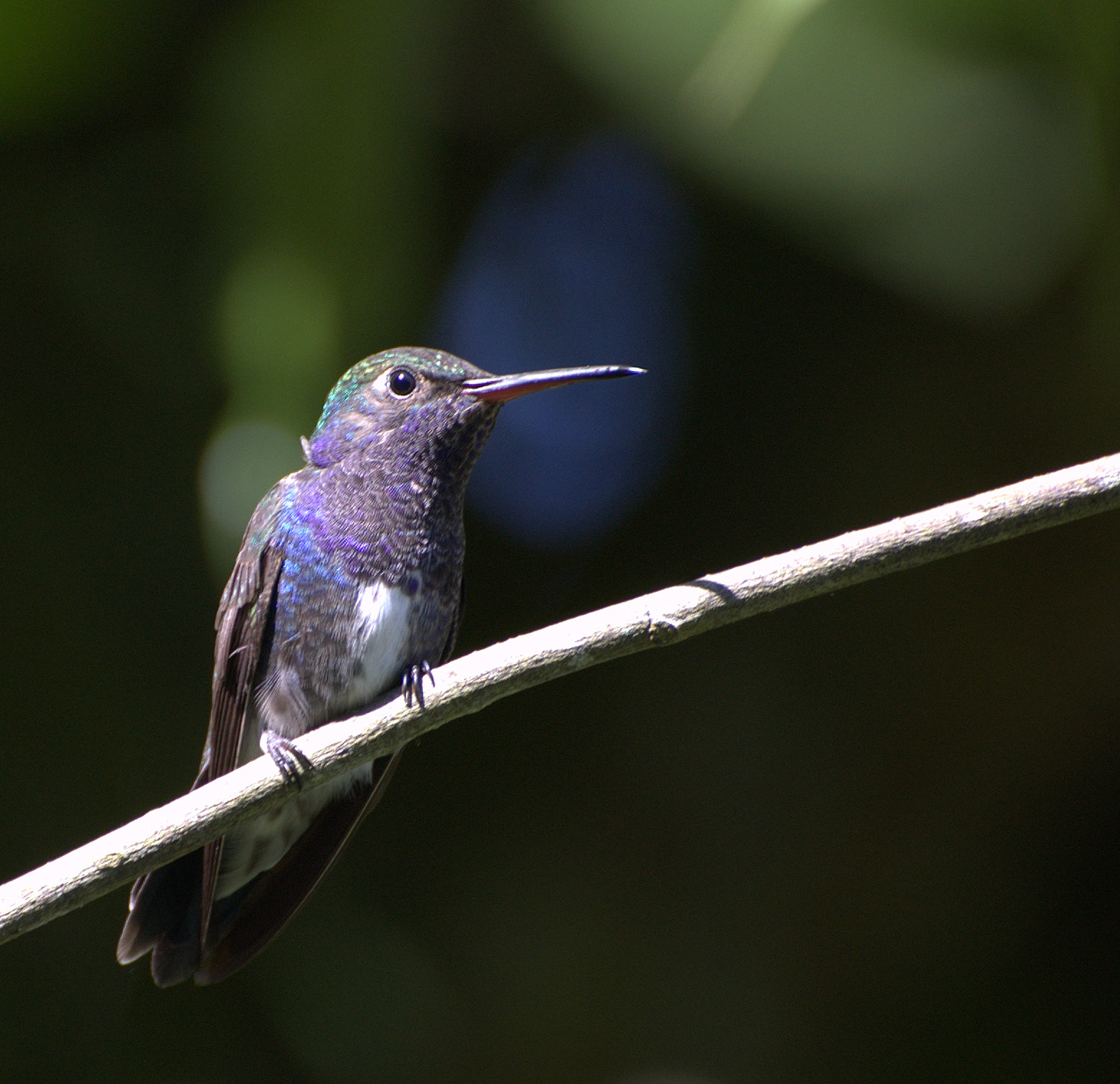
The Sapphire-spangled Emerald is a medium-sized hummingbird of forest edges and semi-open country in the lowlands east of the Andes. The male has a glittering violet-blue throat and breast and a white stripe down the centre of the belly. In the guide area the species occurs mainly in eastern Peru and northern Bolivia.
Voice
A dry, repeated tsip or tchik. The song is a series of high, thin, squeaky notes, often from a fixed perch.
Recording: JAYRSON ARAUJO DE OLIVEIRA — CC BY-NC-SA 4.0 · xeno-canto
Identification
9–10 cm, with a straight bill; the upper mandible is black, the lower mandible pink with a dark tip. The male is shining green above, with a glittering violet-blue throat and breast, a white median stripe on the belly and green flanks. The tail is steel-blue to blue-black. The female is duller, with white fringes to the blue throat and breast feathers, so the underparts look more spotted. Young birds resemble the female, with brownish fringes to the head feathers.
Confusion species
Glittering-throated Emerald Chionomesa fimbriata has a glittering green rather than blue throat and breast and a bronze-green tail. Versicolored Emerald Chrysuronia versicolor is smaller, with a blue-green throat, more white on the underparts and a grey-green tail. Blue-chinned Sapphire Chlorestes notata has entirely green underparts and only a blue chin. The female Fork-tailed Woodnymph Thalurania furcata has grey underparts without blue and a forked tail.
Habitat
Forest edges, riverine forest, secondary forest, open woodland with scattered trees, plantations and gardens, from the lowlands up to about 1300 m. It takes nectar from flowering trees, shrubs and epiphytes and catches small insects in flight. The cup nest is placed on a twig or branch, usually not high above the ground.
Where the bird is most at home, classified by the vegetation units of the Andes and the west coast.


Range and movements
In Peru in the eastern lowlands and the Andean foothills, mainly south of the Amazon, up to about 1300 m. In Bolivia in the lowlands of the north and east. Absent from Colombia and the Galápagos; from Ecuador there is at most a single record. Outside the guide area in southern Venezuela and over much of Brazil.
- Resident
- dark = core range, pale = thinly spread
How and when to look
Look at flowering trees and shrubs along forest edges, riverbanks and in village gardens in the lowlands, for example in Madre de Dios. Males often sing for long periods from a fixed, exposed perch.
Conservation status
Not Evaluated in its current circumscription. The species has a large range and tolerates man-made habitats such as forest edges, plantations and gardens.
Scientific name
Chionomesa lactea | (Lesson, 1832)
Lesson described the species in 1832 as Ornismya lactea; because it was later moved to another genus, the author and year stand in brackets. The genus Chionomesa was introduced in 1921 by Simon. The genus name combines Greek khiōn, 'snow', with mesos, 'middle'. The species name comes from Latin lacteus, 'milk-white', referring to the white belly. The specimen the first description was based on came from (according to the description).