All species › Swifts › Hummingbirds › Glittering-throated Emerald
Glittering-throated Emerald | Chionomesa fimbriata
Franjeamazilia | Amazilia buchiblanca | Beija-flor-de-garganta-verde
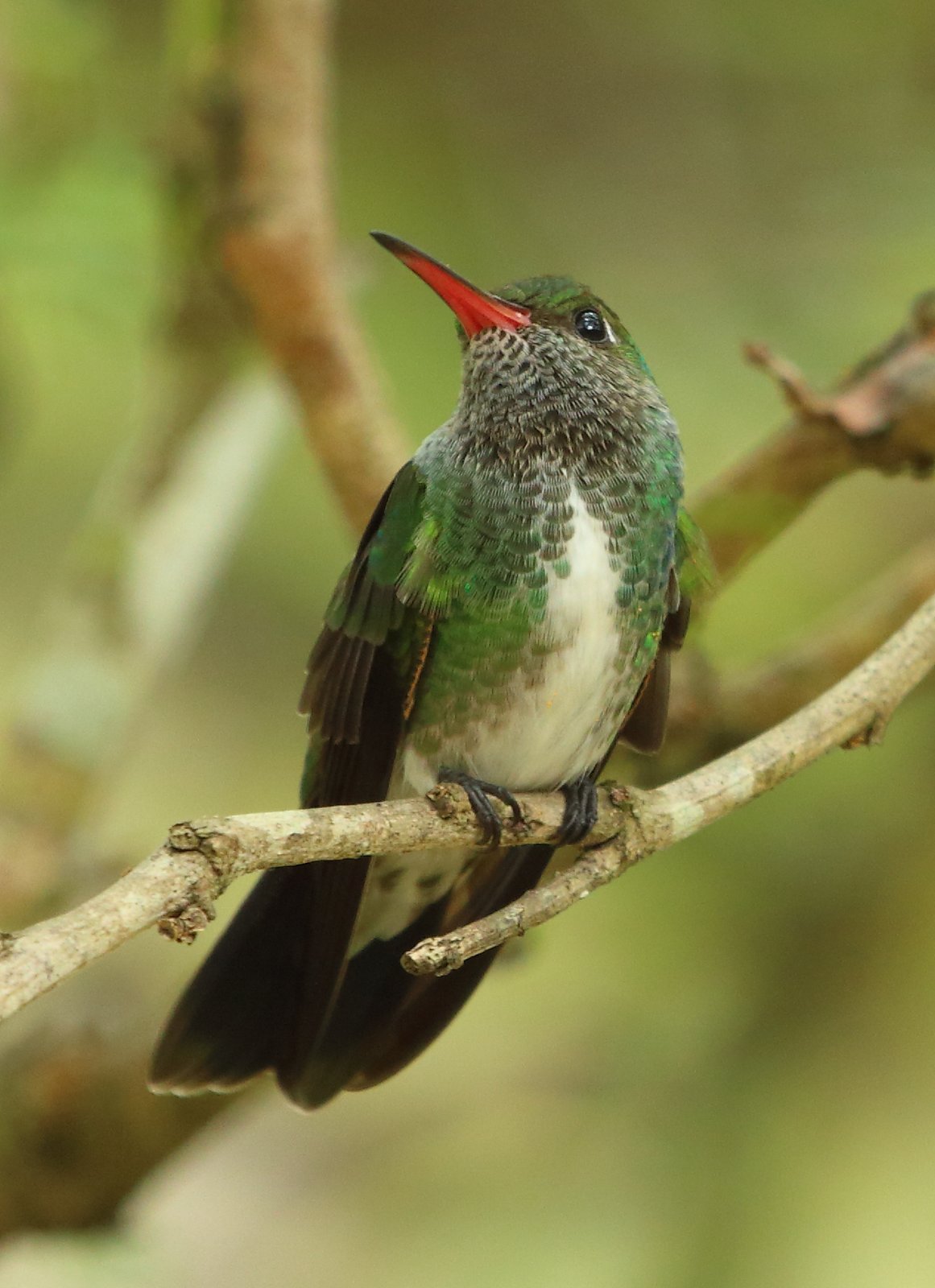
The Glittering-throated Emerald is one of the most widespread hummingbirds of the lowlands east of the Andes. It lives in semi-open country, along rivers and in gardens, and is mainly green, with a white stripe down the centre of the belly. The throat and breast glitter green.
Voice
A dry, sharp tchip, sometimes in rapid series. The song is a repeated series of high, thin notes, given from a perch in shrubs or low trees.
Recording: JAYRSON ARAUJO DE OLIVEIRA — CC BY-NC-SA 4.0 · xeno-canto
Identification
8–10 cm, with a straight bill; the upper mandible is black, the lower mandible pink with a dark tip. Both sexes are bronze-green above. The throat and breast are glittering green, with a narrow white median stripe that continues to the white undertail coverts; the flanks are green. The tail is bronze-green to grey-green, with a dark subterminal band. The female is duller, with grey fringes to the throat feathers. Young birds have brownish fringes to the head feathers.
Confusion species
Sapphire-spangled Emerald Chionomesa lactea has, in the male, a violet-blue throat and breast and a steel-blue tail. Versicolored Emerald Chrysuronia versicolor is smaller, with more white on the throat and belly and a blue-green sheen on the throat. Blue-chinned Sapphire Chlorestes notata has entirely green underparts without a white median stripe and a blue-black tail. Rufous-tailed Hummingbird Amazilia tzacatl has a rufous tail and lives mainly west and north of the Andes.
Habitat
Forest edges, open woodland, scrub, gallery forest, savanna with shrubs, várzea, plantations and gardens, mostly below 1000 m, locally higher in foothill valleys. It takes nectar from many kinds of flowers and defends flowering shrubs against other hummingbirds; it also catches small insects. The cup nest is placed low in a shrub or on a horizontal branch.
Where the bird is most at home, classified by the vegetation units of the Andes and the west coast.


Range and movements
In Colombia in the lowlands east of the Andes, in the llanos and Amazonia. In Ecuador in the eastern lowlands. In Peru in the eastern lowlands, mainly in the north. In Bolivia in the lowlands of the north and east. Absent from the Galápagos. Outside the guide area in Venezuela, the Guianas and much of Brazil.
- Resident
- dark = core range, pale = thinly spread
How and when to look
Look at flowering shrubs in gardens, along riverbanks and in open country around villages in the Amazonian lowlands. Birds often perch low and keep returning to the same flowering shrub.
Conservation status
Least Concern. The species has a large range and tolerates man-made habitats well.
Scientific name
Chionomesa fimbriata | (Gmelin, 1788)
Gmelin described the species in 1788 as Trochilus fimbriatus; because it was later moved to another genus, the author and year stand in brackets. The genus Chionomesa was introduced in 1921 by Simon. The genus name combines Greek khiōn, 'snow', with mesos, 'middle'. The species name comes from Latin fimbriatus, 'fringed', referring to the scaled, glittering feathers of throat and breast. The specimen the first description was based on came from Cayenne, French Guiana.