All species › Swifts › Hummingbirds › Rufous-throated Sapphire
Rufous-throated Sapphire | Hylocharis sapphirina
Roodkeelsaffierkolibrie | Zafiro gorgirrufo | Beija-flor-safira
The Rufous-throated Sapphire is a small hummingbird with a red bill and a rufous tail that occurs mainly in eastern South America. In the guide area it reaches the western edge of its range and is scarce and local. It lives in the canopy and at the edges of forest.
Voice
A dry tsik or a short series of ticking notes. The song is a soft, high twittering.
Recording: JAYRSON ARAUJO DE OLIVEIRA — CC BY-NC-SA 4.0 · xeno-canto
Identification
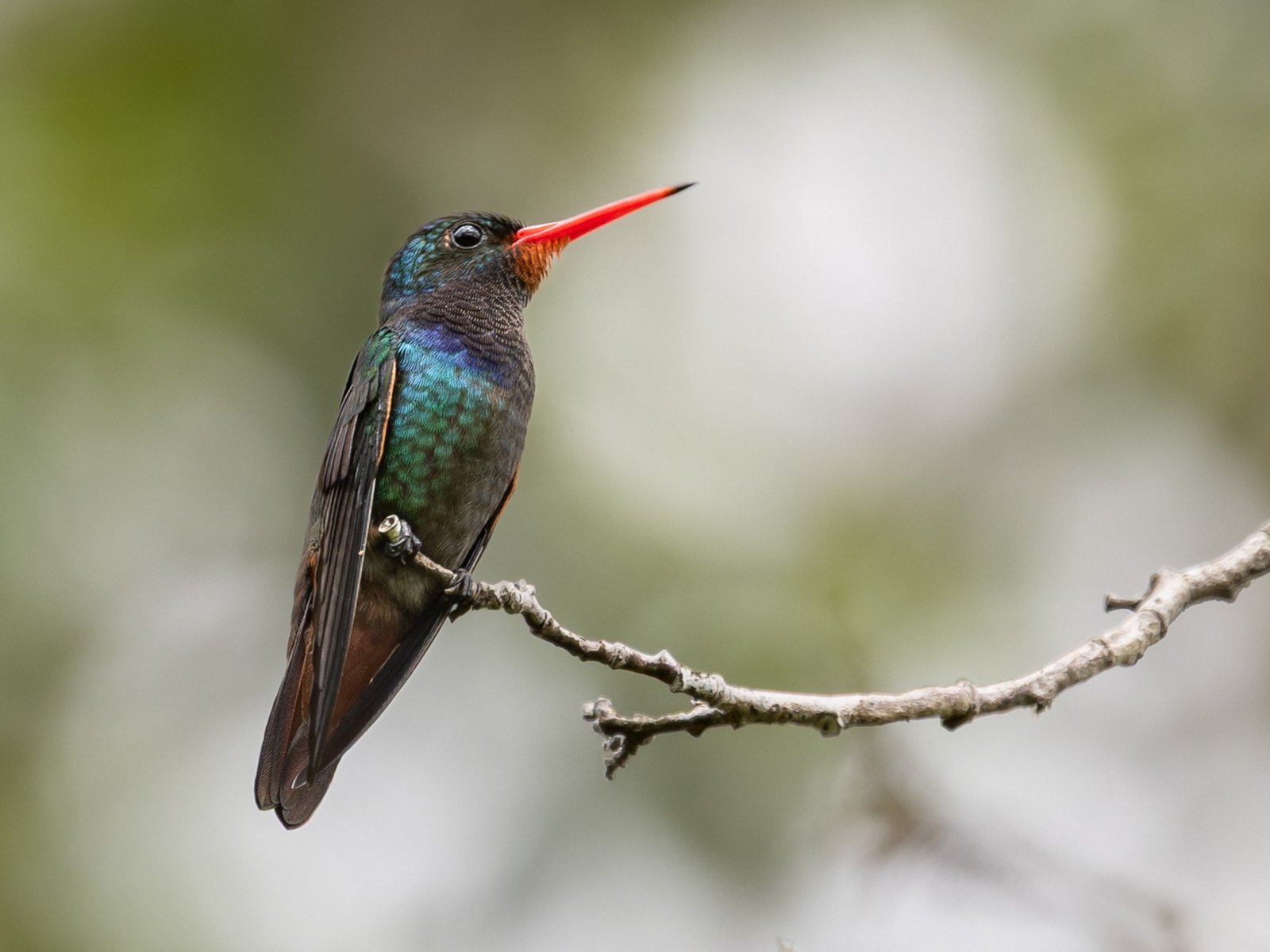
9–10 cm, with a straight, red bill with a black tip. The male is green above, with a rufous chin, a violet-blue throat and upper breast, a green belly and chestnut undertail coverts. The tail is coppery rufous. The female has a small rufous chin, greyish-white underparts with blue-green spots on the throat and breast, and a rufous tail with a dark band. Young birds resemble the female.
Confusion species
Gilded Sapphire Hylocharis chrysura lacks a blue throat, is golden green below and in the guide area occurs only in Bolivia. White-chinned Sapphire Chlorestes cyanus has a white chin, a blue head in the male, and a dark tail. Golden-tailed Sapphire Chrysuronia oenone has a green throat, a golden-copper tail and, in the male, a blue head. Red-billed hummingbirds with a dark tail, such as Glittering-bellied Emerald Chlorostilbon lucidus, lack the rufous chin and tail.
Habitat
Canopy and edges of humid forest, forest on sandy soils, gallery forest, savanna with woodland patches and gardens in the lowlands, mostly below 500 m. It takes nectar from flowering trees and epiphytes, often high in the crowns, and catches small insects. The cup nest is placed on a branch or twig.
Where the bird is most at home, classified by the vegetation units of the Andes and the west coast.


Range and movements
In the guide area only in the lowlands east of the Andes, everywhere scarce and local. In Colombia in the east, in the llanos and Amazonia. In Ecuador scattered in the eastern lowlands. In Peru with scattered records from the east. In Bolivia in the lowlands of the north and east. Absent from the Galápagos. Outside the guide area in Venezuela, the Guianas, Brazil, Paraguay and north-eastern Argentina.
- Resident
- dark = core range, pale = thinly spread
How and when to look
Check flowering trees along forest edges and rivers in the lowlands; the birds often forage high in the crowns. In red-billed hummingbirds, look for the rufous chin and tail.
Conservation status
Least Concern. The species has a large range in eastern South America; in the guide area the population is small and local.
Scientific name
Hylocharis sapphirina | (Gmelin, 1788)
Gmelin described the species in 1788 as Trochilus sapphirinus; because it was later moved to another genus, the author and year stand in brackets. The genus Hylocharis was introduced in 1831 by Boie. The genus name combines Greek hulē, 'woodland', with kharis, 'beauty'. The species name is Latin sapphirinus, 'sapphire-coloured'. The specimen the first description was based on came from the Guianas.