All species › Passerines › Tanagers and allies › Great-billed Seed Finch
Great-billed Seed Finch | Sporophila maximiliani
Grootsnavelzaadkraker | Semillero picón | Bicudo
Great-billed Seed Finch is the largest seed finch, with a very heavy bill. In the guide area it is known only from Bolivia, where recent data are scarce. Through trapping for its song the species has disappeared from large parts of its range.
Voice
The song is a series of clear, melodious whistles, slower and fuller than that of the smaller seed finches. The call is a short chek.
Recording: Jacob Wijpkema — CC BY-NC-SA 4.0 · xeno-canto
Identification
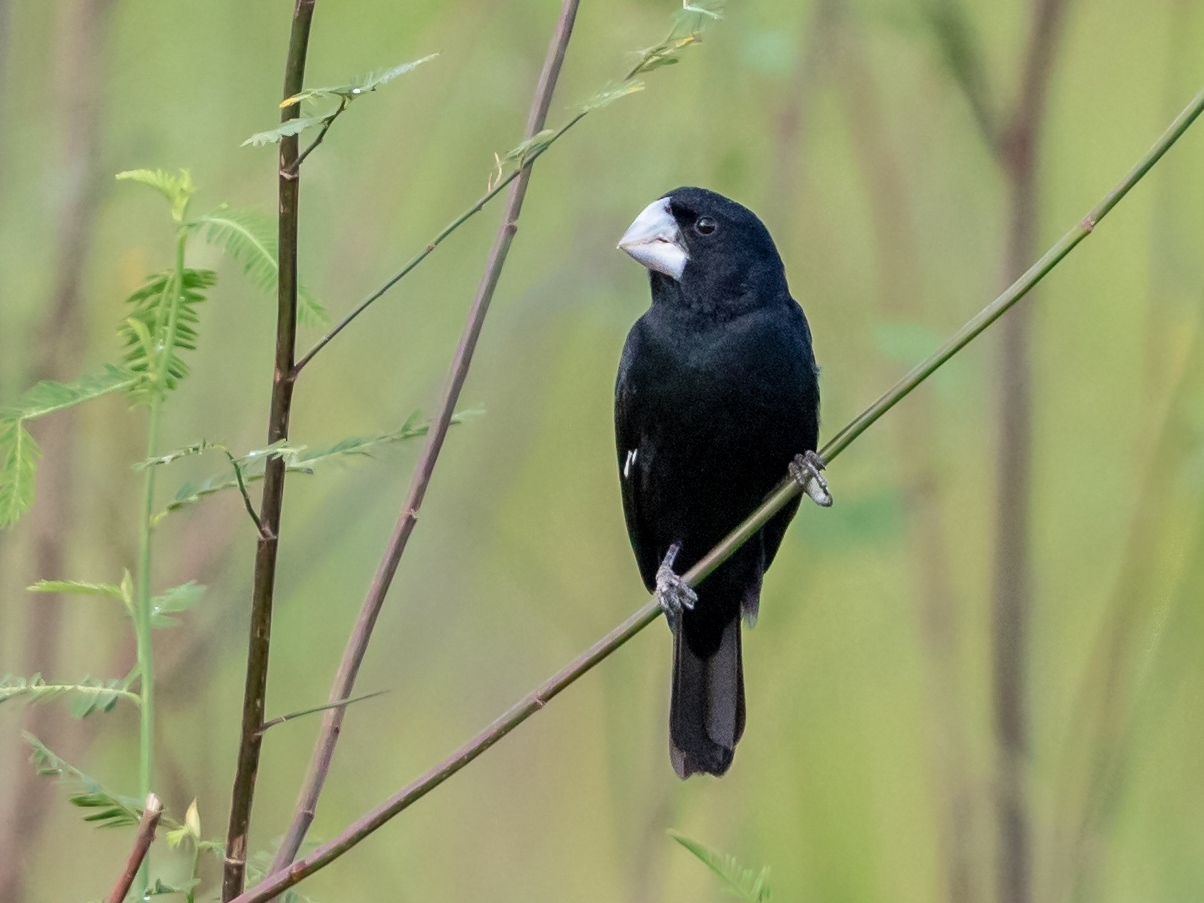
15–16 cm, with a very heavy, deep bill that is ivory to horn-coloured in the male. The male is glossy black, with a white wing speculum and white underwing coverts. The female is warm brown, slightly paler below, with a darker bill. Young males at first resemble the female.
Confusion species
Chestnut-bellied Seed Finch Sporophila angolensis is smaller, has a black bill and, in the male, a chestnut belly. Male Black-billed Seed Finch Sporophila atrirostris has a black bill. Large-billed Seed Finch Sporophila crassirostris is slightly smaller, with a less heavy bill; in the guide area the two species hardly overlap. Females of the large seed finches are identified in the field mainly by bill size.
Habitat
Marshes, wet grassland with bushes, gallery forest edges and swamp forest with moriche palms, in the lowlands. It eats mainly seeds of sedges and grasses, which it cracks with its heavy bill. The nest is a small cup in a bush or tall grass.
Where the bird is most at home, classified by the vegetation units of the Andes and the west coast.


Range and movements
In Bolivia reported from the north and east, including Beni and Santa Cruz; there are very few recent confirmed records. Absent from Colombia, Ecuador, Peru and the Galápagos. Outside the guide area locally in eastern Venezuela, Guyana, northern Brazil and the cerrado of central and eastern Brazil.
How and when to look
In the guide area the species is extremely rare. Any record in the wild, especially in marshy grassland in eastern Bolivia, is worth documenting with a photo or sound recording; keep escaped cage birds in mind.
Conservation status
Endangered. Numbers have declined steeply through trapping for the cage-bird trade, in which its song is in high demand, and through drainage and conversion of marshes and grasslands. The wild population is estimated at a few thousand birds at most.
Scientific name
Sporophila maximiliani | (Cabanis, 1851)
Cabanis described the species in 1851 as Oryzoborus maximiliani; because it was later moved to another genus, the author and year stand in brackets. The genus Sporophila was introduced in 1844 by Cabanis. The genus name combines Greek sporos, 'seed', and philos, 'fond of'. The species name honours Prince Maximilian of Wied-Neuwied (1782–1867), a German naturalist and explorer who collected in eastern Brazil in 1815–1817. The specimen the first description was based on came from east coast of Brazil.