All species › Woodpeckers and allies › Toucans › Green Aracari
Green Aracari | Pteroglossus viridis
Groene arassari | Arasarí verde | Araçari-miudinho
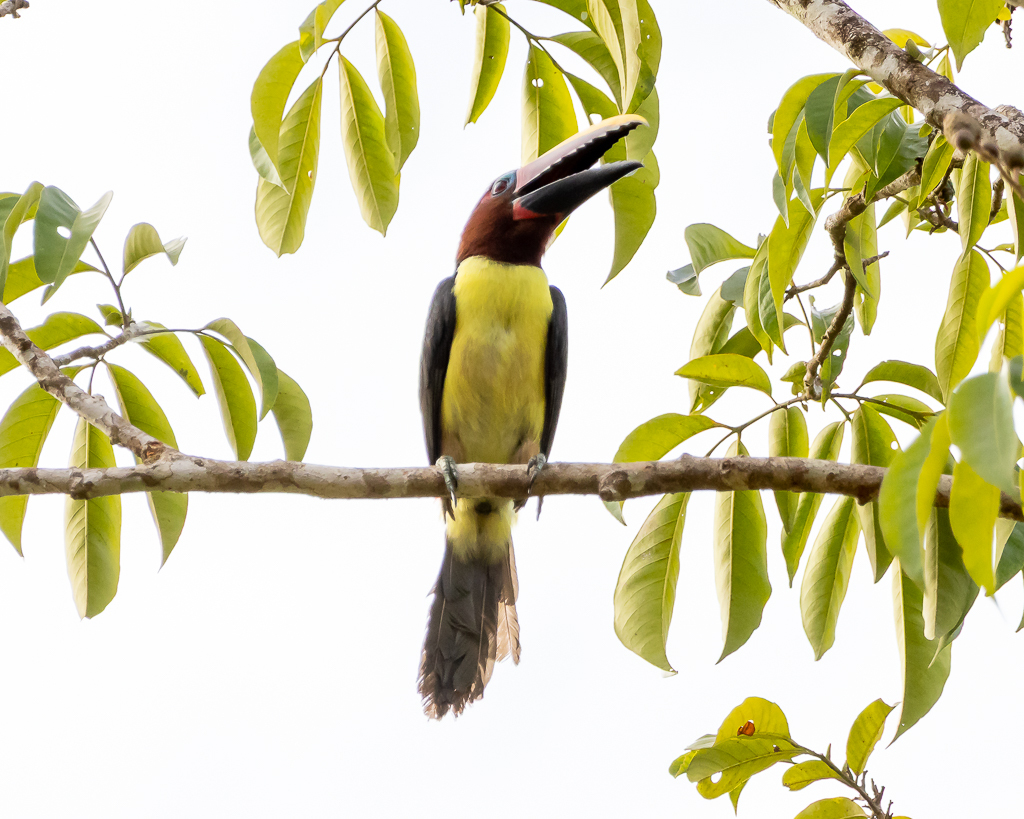
The Green Aracari is the smallest aracari, a species of north-eastern South America. It has not been recorded in the guide area itself, Colombia, Ecuador, Peru and Bolivia; the nearest birds live in southern and eastern Venezuela and in the Guianas. It lives in small groups in the canopy of humid lowland forest.
Voice
Short, rapidly repeated croaking or grating notes, and soft rattling calls within the group.
Recording: Phil Stouffer — CC BY-NC-SA 4.0 · xeno-canto
Identification
30–35 cm, slim, with a long, graduated tail. The back, wings and tail are dark green, the rump is red and the underparts are plain yellow, without bands. The male has a black head and throat, the female a chestnut head and throat. The upper mandible is mainly yellow to orange, with red at the base, the lower mandible largely black. Bare coloured skin surrounds the eye.
Confusion species
Lettered Aracari Pteroglossus inscriptus also has plain yellow underparts, but has black marks along the cutting edge of the bill and lives in Amazonia, far from Green Aracari. Black-necked Aracari Pteroglossus aracari is larger, with a red-and-black band across the yellow belly. Many-banded Aracari Pteroglossus pluricinctus has two black bands across the underparts.
Habitat
Humid lowland forest, forest edges, savanna woodland and secondary forest, mainly in the canopy. It lives in pairs or small groups. It eats mainly fruit, also insects. It nests and roosts in tree cavities, including old woodpecker holes.
Where the bird is most at home, classified by the vegetation units of the Andes and the west coast.


Range and movements
Not recorded in Colombia, Ecuador, Peru, Bolivia or the Galápagos. Outside the guide area in southern and eastern Venezuela south of the Orinoco, in the Guianas and in northern Brazil north of the Amazon.
- Resident
- dark = core range, pale = thinly spread
How and when to look
To see the species, visit the Guianas or southern Venezuela, where groups forage along forest edges and clearings in the lowlands.
Conservation status
Least Concern. The range is large and the forest there is still largely intact.
Scientific name
Pteroglossus viridis | (Linnaeus, 1766)
Linnaeus described the species in 1766 as Ramphastos viridis; because it was later moved to another genus, the author and year stand in brackets. The genus Pteroglossus was introduced in 1811 by Illiger. The genus name comes from Greek pteron, 'feather', and glōssa, 'tongue', after the frayed, feather-like tongue of these birds. The species name viridis is Latin for 'green'. The specimen the first description was based on came from Cayenne, French Guiana.