All species › Woodpeckers and allies › Toucans › Lettered Aracari
Lettered Aracari | Pteroglossus inscriptus
Letterarassari | Arasarí letrado | Araçari-de-bico-riscado
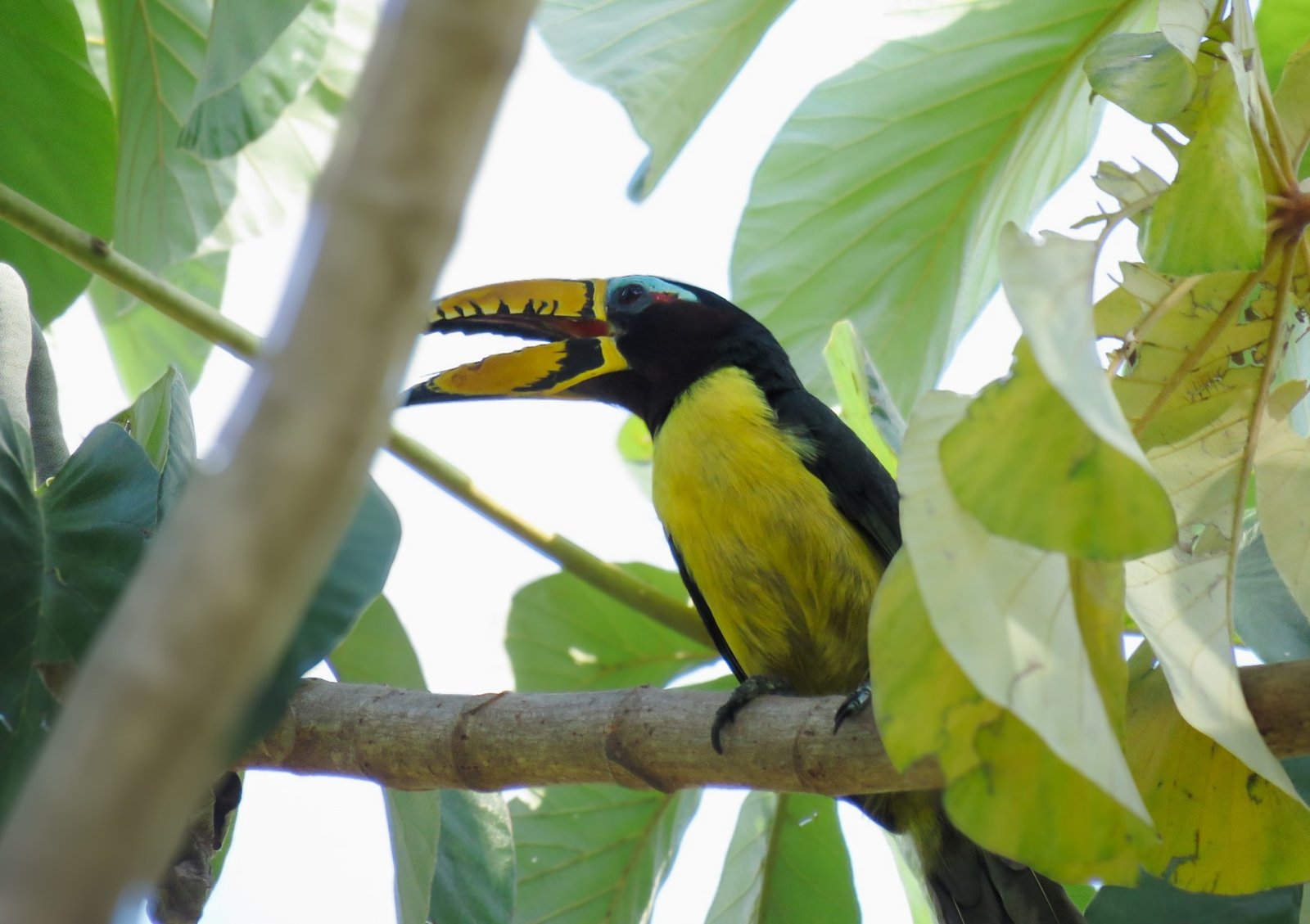
The Lettered Aracari is a small aracari of Amazonia, named after the black marks along the cutting edge of the bill, which recall writing. Unlike the other Pteroglossus aracaris of the guide area it has plain yellow underparts without a breast band. In western Amazonia the form humboldti occurs, which is sometimes treated as a separate species.
Voice
A series of short, dry, somewhat croaking notes, like a rapid chek-chek-chek, and clicking sounds.
Recording: Mauricio Cuellar Ramirez (@Birding.travel) — CC BY-NC-SA 4.0 · xeno-canto
Identification
33–37 cm, slim, with a long tail. The back, wings and tail are dark green, the rump is red and the underparts are plain yellow. The male has a black head and throat; in the female the sides of the head and the throat are chestnut. The upper mandible is yellowish to ivory, with a black tip and a series of black marks along the cutting edge; in the western form humboldti the lower mandible is largely black, in the nominate form yellowish. Bare bluish skin surrounds the eye.
Confusion species
Chestnut-eared Aracari Pteroglossus castanotis is larger, with chestnut sides to the head and a red band across the belly. Many-banded Aracari Pteroglossus pluricinctus has two black bands across the underparts. Ivory-billed Aracari Pteroglossus azara has a red throat, an ivory bill and a red breast band. Curl-crested Aracari Pteroglossus beauharnaisii has curled, glossy head feathers. All these species have one or more bands across the underparts; Lettered Aracari has none.
Habitat
Humid lowland forest, especially forest edges, várzea, riverine forest, clearings and secondary forest, less in the interior of terra firme; usually below 1000 m. It lives in pairs or small groups. It eats mainly fruit, also insects. It nests and roosts in tree cavities, often old woodpecker holes.
Where the bird is most at home, classified by the vegetation units of the Andes and the west coast.


Range and movements
In Colombia in the Amazonian lowlands of the south-east. In Ecuador in the eastern lowlands. In Peru in the Amazonian lowlands. In Bolivia in the northern lowlands. Absent west of the Andes and from the Galápagos. Outside the guide area in Amazonian Brazil, with the nominate form south of the Amazon east to north-eastern Brazil.
- Resident
- dark = core range, pale = thinly spread
How and when to look
Search riverbanks, forest edges and clearings at lodges in the Amazonian lowlands, where groups forage in fruiting trees. The plain yellow underparts without a band separate it from the other Pteroglossus aracaris.
Conservation status
Not Evaluated in this species limit. The species is widespread and tolerates secondary forest, but suffers locally from deforestation.
Scientific name
Pteroglossus inscriptus | Swainson, 1822
Swainson described the species in 1822 and placed it straight away in the genus where it still stands. The genus Pteroglossus was introduced in 1811 by Illiger. The genus name comes from Greek pteron, 'feather', and glōssa, 'tongue', after the frayed, feather-like tongue of these birds. The species name inscriptus is Latin for 'inscribed, lettered', after the letter-like black markings on the bill. The specimen the first description was based on came from Pará, Brazil.