All species › Woodpeckers and allies › Toucans › Collared Aracari
Collared Aracari | Pteroglossus torquatus
Halsbandarassari | Tucancillo collarejo | Araçari-de-colar
The Collared Aracari is the aracari of Central America and north-western South America. In the guide area it occurs in northern Colombia and, as the form sanguineus, often treated as a separate species, on the Pacific side of Colombia and in north-western Ecuador. Groups move noisily through the canopy and roost together in a tree cavity.
Voice
A high, sharp, squeaky pseek or two-syllabled pi-tseek, often repeated by the members of a group.
Recording: Johan Chaves — CC BY-NC-SA 4.0 · xeno-canto
Identification
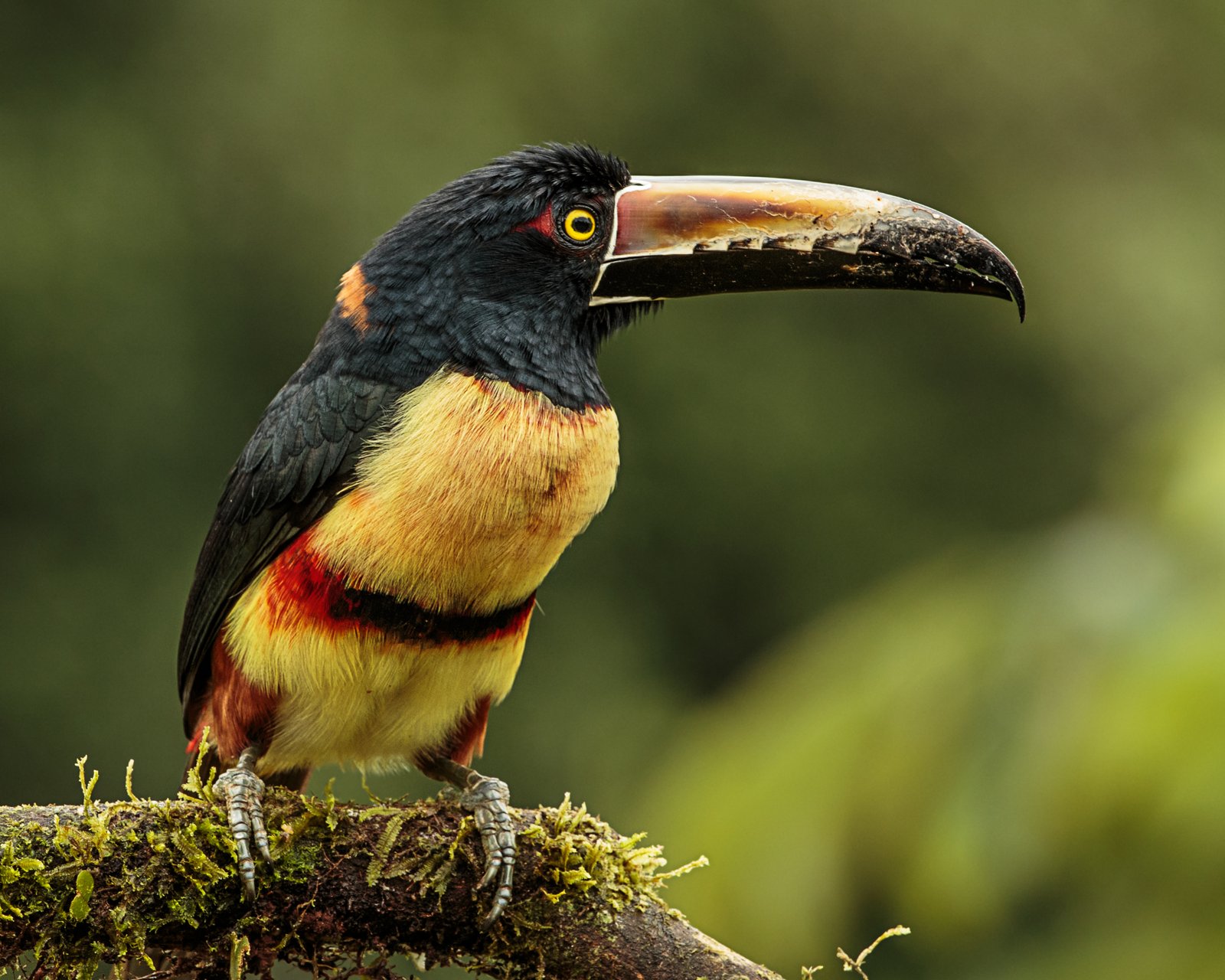
39–43 cm. The head, throat and neck are black, with a faint chestnut collar on the nape. The back and wings are dark green, the rump is red and the long tail dark greenish black. The underparts are yellow washed red, with a round black spot in the centre of the breast and a broad red-and-black band across the belly; the thighs are chestnut. The iris is yellow, the bare skin around the eye red. In the form of northern Colombia the upper mandible is ivory to dirty yellow with blackish marks along the cutting edge and the lower mandible is black; in the western form sanguineus a long black stripe runs along the upper mandible. The sexes are alike.
Confusion species
Pale-mandibled Aracari Pteroglossus erythropygius in western Ecuador has a largely pale, yellowish bill without a black lower mandible or black stripe; the two meet in north-western Ecuador, where hybrids occur. Keel-billed Toucan Ramphastos sulfuratus and Choco Toucan Ramphastos brevis are much larger, with a black belly and a yellow throat and breast.
Habitat
Humid and semi-humid lowland forest, forest edges, secondary forest, riverine forest and semi-open country with tall trees, also plantations; usually below 1000 m. It lives in groups that fly one after another from tree to tree. It eats mainly fruit, but also insects, eggs and nestlings. It nests and roosts in tree cavities, often old woodpecker holes; several birds roost together in one cavity.
Where the bird is most at home, classified by the vegetation units of the Andes and the west coast.


Range and movements
In Colombia in the north, in the Caribbean lowlands and the Magdalena valley, and along the whole Pacific side (form sanguineus). In Ecuador only in the north-west, mainly in Esmeraldas, where it intergrades with Pale-mandibled Aracari. Absent from Peru, Bolivia and the Galápagos. Outside the guide area from southern Mexico through Central America to Panama and in north-western Venezuela.
- Resident
- dark = core range, pale = thinly spread
How and when to look
Search forest edges and semi-open country with fruiting trees in the Pacific lowlands of Colombia or in Esmeraldas; groups fly in single file across open stretches, giving their squeaky call.
Conservation status
Least Concern. The species tolerates secondary forest and semi-open country, but is declining locally through deforestation.
Scientific name
Pteroglossus torquatus | (Gmelin, 1788)
Gmelin described the species in 1788 as Ramphastos torquatus; because it was later moved to another genus, the author and year stand in brackets. The genus Pteroglossus was introduced in 1811 by Illiger. The genus name comes from Greek pteron, 'feather', and glōssa, 'tongue', after the frayed, feather-like tongue of these birds. The species name torquatus is Latin for 'collared'. The specimen the first description was based on came from Veracruz, Mexico.