All species › Woodpeckers and allies › Toucans › Pale-mandibled Aracari
Pale-mandibled Aracari | Pteroglossus erythropygius
Bleeksnavelarassari | Arasarí piquipálido | Araçari-de-bico-pálido
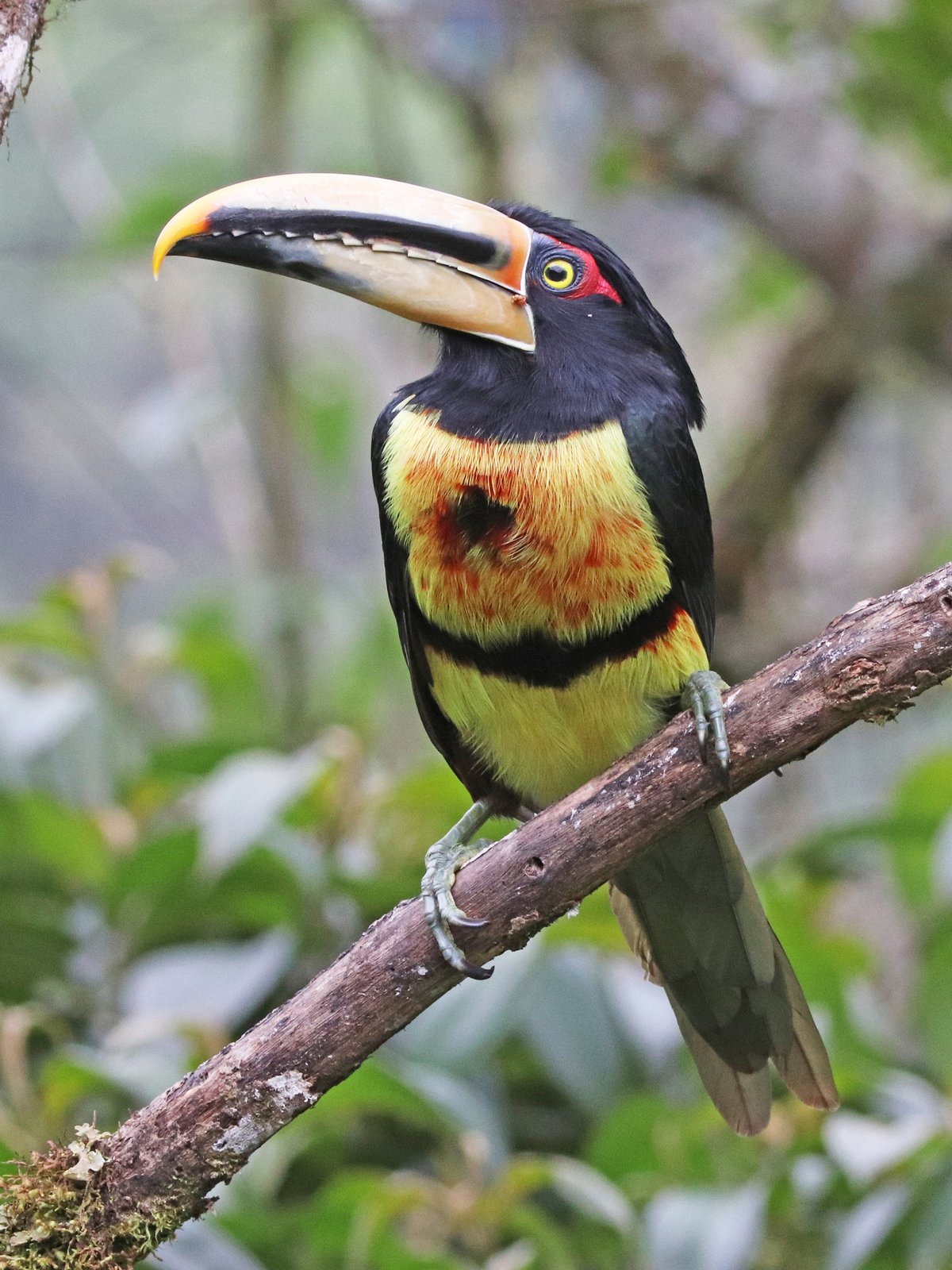
The Pale-mandibled Aracari is the aracari of western Ecuador and extreme north-western Peru, and one of the characteristic birds of the Tumbesian region. It is closely related to Collared Aracari and is sometimes treated as a form of it; where the two meet, hybrids occur. The pale bill is the clearest feature.
Voice
A high, sharp, squeaky pseek or pi-tseek, often repeated by the members of a group, similar to the call of Collared Aracari.
Recording: José María Loaiza B. — CC BY-NC-SA 4.0 · xeno-canto
Identification
41–45 cm. The head, throat and neck are black, with a chestnut tinge on the nape. The back and wings are dark green, the rump is red and the long tail dark. The underparts are yellow washed red, with a black spot in the centre of the breast and a red-and-black band across the belly. The bill is pale yellow to ivory, with at most some dark marking near the tip. Bare red skin surrounds the eye. The sexes are alike.
Confusion species
Collared Aracari Pteroglossus torquatus in north-western Ecuador has a black lower mandible or a long black stripe along the upper mandible; in the contact zone in Esmeraldas birds with intermediate bill patterns occur. Choco Toucan Ramphastos brevis is much larger, with a black belly and a yellow throat and breast.
Habitat
Humid and semi-deciduous forest, dry forest with tall trees, forest edges, secondary forest and plantations with shade trees, from the lowlands into the foothills. It lives in groups that fly one after another from tree to tree. It eats mainly fruit, also insects, eggs and nestlings. It nests and roosts in tree cavities.
Where the bird is most at home, classified by the vegetation units of the Andes and the west coast.


Range and movements
In Ecuador in the western lowlands and foothills, from Esmeraldas, where it intergrades with Collared Aracari, south to El Oro and Loja. In Peru only in the extreme north-west, in Tumbes. Absent from Colombia, Bolivia and the Galápagos. Endemic to the guide area.
- Resident
- dark = core range, pale = thinly spread
How and when to look
In forest reserves in western Ecuador, such as Cerro Blanco near Guayaquil and Buenaventura in El Oro, or in the forests of Tumbes in Peru. Groups visit fruiting trees at forest edges and give themselves away by their squeaky call.
Conservation status
Not Evaluated in this species limit. The range is small and much of the forest of western Ecuador has been cleared; the species now lives mainly in forest remnants and reserves.
Scientific name
Pteroglossus erythropygius | Gould, 1843
Gould described the species in 1843 and placed it straight away in the genus where it still stands. The genus Pteroglossus was introduced in 1811 by Illiger. The genus name comes from Greek pteron, 'feather', and glōssa, 'tongue', after the frayed, feather-like tongue of these birds. The species name erythropygius comes from Greek eruthros, 'red', and pugē, 'rump', after the red rump. The specimen the first description was based on came from Ecuador.