All species › Woodpeckers and allies › Toucans › Chestnut-eared Aracari
Chestnut-eared Aracari | Pteroglossus castanotis
Bruinoorarassari | Arasarí orejicastaño | Araçari-castanho
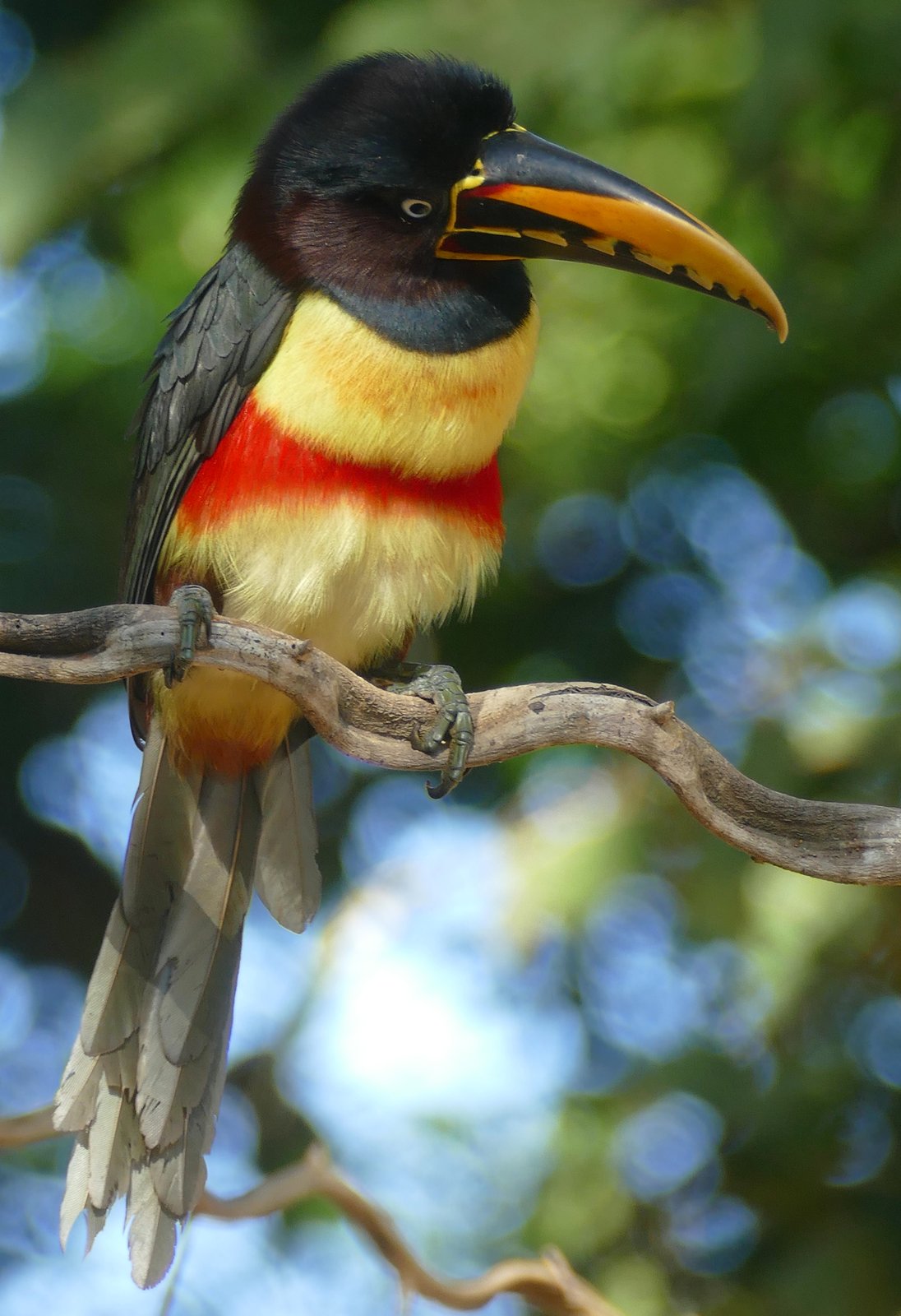
The Chestnut-eared Aracari is the most widespread aracari of the Amazonian lowlands in the guide area. It stands out by its chestnut sides to the head and a single red band across the yellow belly. It often lives in noisy small groups along forest edges and rivers and also enters secondary forest and semi-open country.
Voice
A sharp, high, somewhat hoarse call, like kseek or psheek, often repeated and answered by members of the group.
Recording: Jose Martin — CC BY-NC-SA 4.0 · xeno-canto
Identification
41–46 cm, with a long tail and a large bill. The crown is black; the sides of the head and the throat are chestnut. The back, wings and tail are dark green, the rump is red. The underparts are yellow, with a broad red band across the belly, often with some black along it. The bill is largely dark, with a pale, yellowish stripe along the upper mandible and pale marks along the cutting edge. Bare blue-green skin surrounds the eye. The sexes are nearly alike; the female has a slightly shorter bill.
Confusion species
Many-banded Aracari Pteroglossus pluricinctus has a black head and throat and two bands across the underparts, the upper one black. Ivory-billed Aracari Pteroglossus azara is smaller, with a pale, ivory bill and a red breast band. Lettered Aracari Pteroglossus inscriptus is smaller, with plain yellow underparts without a band. Curl-crested Aracari Pteroglossus beauharnaisii has curled, glossy head feathers and pale, spotted sides to the head.
Habitat
Forest edges, várzea, riverine forest, secondary forest, clearings with tall trees and plantations, also terra firme, from the lowlands into the foothills, locally to about 1500 m. It lives in pairs or groups of a few birds. It eats fruit, also insects, eggs and nestlings. It nests in tree cavities, often old woodpecker holes; groups roost together in a cavity.
Where the bird is most at home, classified by the vegetation units of the Andes and the west coast.


Range and movements
In Colombia in the eastern lowlands and foothills east of the Andes, from southern Meta southwards. In Ecuador in the eastern lowlands. In Peru in the Amazonian lowlands and foothills. In Bolivia in the northern and central lowlands. Absent west of the Andes and from the Galápagos. Outside the guide area in western and southern Amazonian Brazil, south to Paraguay and north-eastern Argentina.
- Resident
- dark = core range, pale = thinly spread
How and when to look
Watch along riverbanks, forest edges and clearings at lodges for groups flying one after another from tree to tree. Fruiting trees often attract several birds at once.
Conservation status
Least Concern. The species is widespread and tolerates secondary forest and semi-open landscapes, but suffers locally from deforestation.
Scientific name
Pteroglossus castanotis | Gould, 1834
Gould described the species in 1834 and placed it straight away in the genus where it still stands. The genus Pteroglossus was introduced in 1811 by Illiger. The genus name comes from Greek pteron, 'feather', and glōssa, 'tongue', after the frayed, feather-like tongue of these birds. The species name castanotis comes from Latin castaneus, 'chestnut', and Greek ous, ōtos, 'ear', after the chestnut ear coverts. The specimen the first description was based on came from Rio Solimões, Brazil.