All species › Woodpeckers and allies › Toucans › Many-banded Aracari
Many-banded Aracari | Pteroglossus pluricinctus
Dubbelbandarassari | Arasarí bifajeado | Araçari-de-cinta-dupla
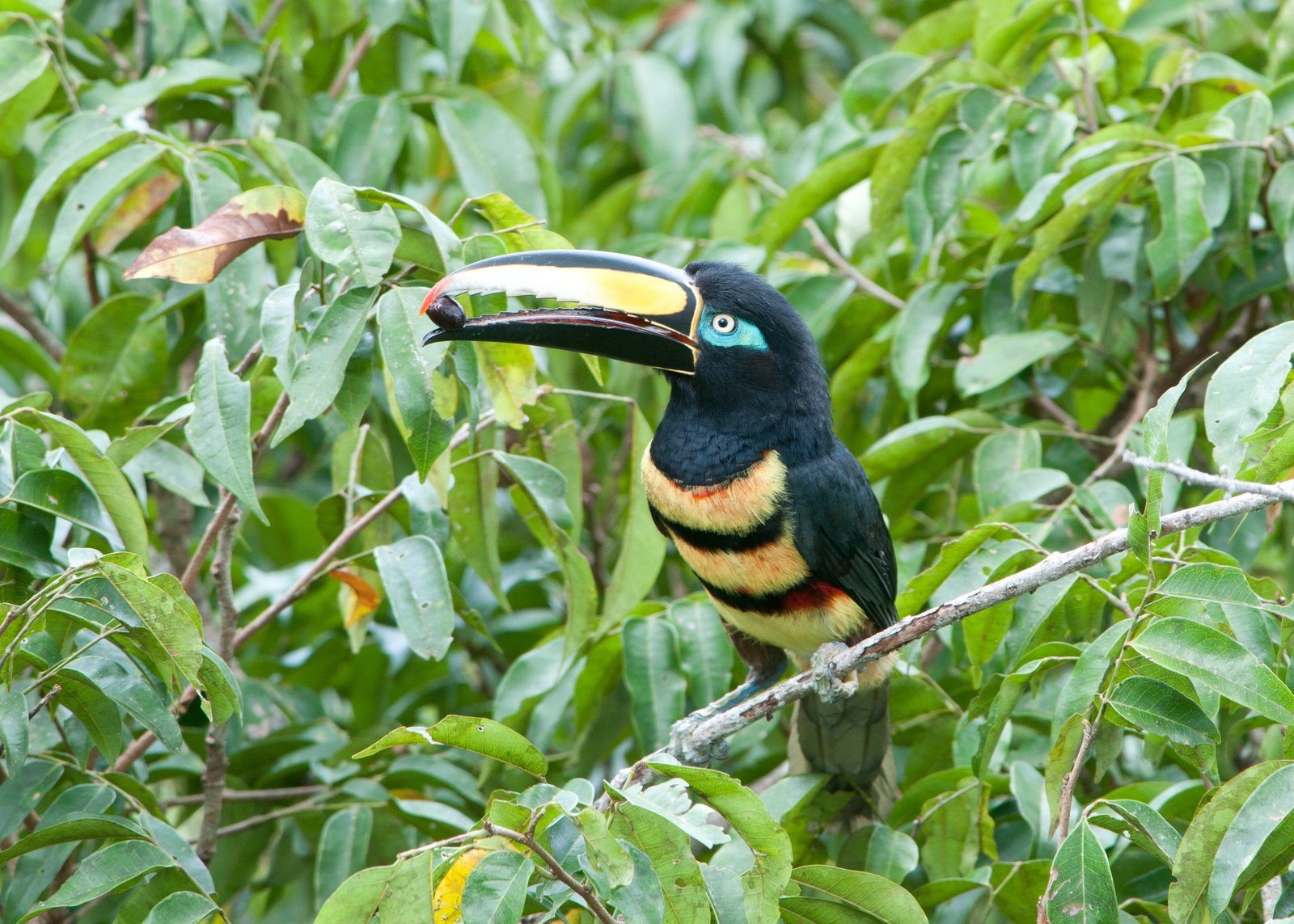
The Many-banded Aracari is an aracari of north-western Amazonia, recognisable by two bands across the yellow underparts. More than Chestnut-eared Aracari it keeps to the canopy of tall, continuous forest. In the guide area it lives mainly north of the Amazon and the Marañón.
Voice
A high, sharp call, like pseek or ksee-eek, repeated in series; also rattling and clicking sounds.
Recording: Mauricio Cuellar Ramirez (@Birding.travel) — CC BY-NC-SA 4.0 · xeno-canto
Identification
43–46 cm, slim, with a long tail. The head, neck and throat are black, with bare blue-green skin around the eye. The back, wings and tail are dark green, the rump is red. The underparts are yellow, with a black band across the breast and, lower down, a broad band of black and red across the belly. The upper mandible is yellow-orange with a dark ridge, the lower mandible black. The sexes are nearly alike.
Confusion species
Chestnut-eared Aracari Pteroglossus castanotis has chestnut sides to the head and throat and only one, red band across the belly. Ivory-billed Aracari Pteroglossus azara is smaller, with a red throat and an ivory bill. Lettered Aracari Pteroglossus inscriptus is smaller, with plain yellow underparts without a band. Black-necked Aracari Pteroglossus aracari, outside the guide area, has only one band.
Habitat
Tall humid lowland forest on terra firme, also várzea, forest edges and tall secondary forest, from the lowlands into the foothills, usually below 1000 m. It lives in pairs or small groups, usually high in the canopy. It eats mainly fruit, also insects and eggs. It nests in tree cavities.
Where the bird is most at home, classified by the vegetation units of the Andes and the west coast.


Range and movements
In Colombia in the eastern lowlands east of the Andes, from Meta and Vichada southwards. In Ecuador in the eastern lowlands. In Peru in the north-east, mainly north of the Amazon and the Marañón. Absent from Bolivia, west of the Andes and from the Galápagos. Outside the guide area in southern Venezuela and north-western Brazil.
- Resident
- dark = core range, pale = thinly spread
How and when to look
Search from canopy towers and clearings in tall forest, where small groups move along the treetops. In fruiting trees it sometimes joins other aracaris.
Conservation status
Least Concern. The species lives in large, still largely intact forest areas, but is more sensitive to the felling of tall forest than Chestnut-eared Aracari.
Scientific name
Pteroglossus pluricinctus | Gould, 1835
Gould described the species in 1835 and placed it straight away in the genus where it still stands. The genus Pteroglossus was introduced in 1811 by Illiger. The genus name comes from Greek pteron, 'feather', and glōssa, 'tongue', after the frayed, feather-like tongue of these birds. The species name pluricinctus comes from Latin plus, pluris, 'more, many', and cinctus, 'girdled, banded', after the two breast bands. The specimen the first description was based on came from Rio Solimões, Brazil.