All species › Passerines › New World sparrows › Green-backed Sparrow
Green-backed Sparrow | Arremonops chloronotus
Groenruggors | Rascador dorso verde | Tico-tico-de-dorso-verde
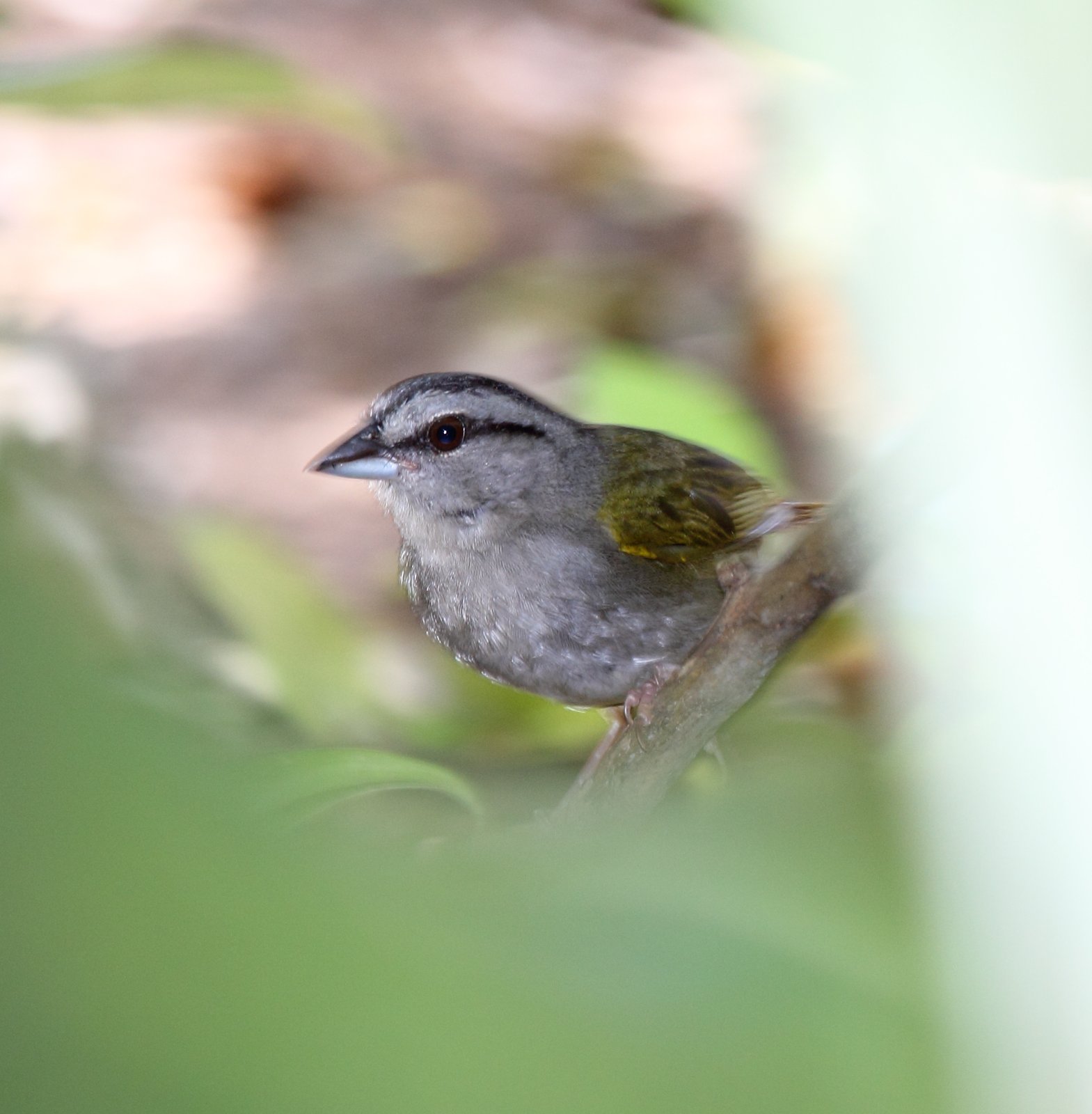
The Green-backed Sparrow is an olive-green sparrow with a grey, striped head, living in scrub and forest edge in south-eastern Mexico and northern Central America. It is a resident that does not migrate. In the guide area it is at most a very rare vagrant: no documented records are known, and reports may be based on confusion with Black-striped Sparrow.
Voice
The song is a series of clear notes accelerating into a rolling trill, similar to that of Black-striped Sparrow. The call is a dry chip.
Recording: Manuel Grosselet - Benoit Larrouquis — CC BY-NC-SA 4.0 · xeno-canto
Identification
14–15 cm, with a heavy, conical bill. The head is grey, with broad blackish-brown lateral crown stripes and a dark eyestripe. The upperparts are olive-green. The throat and belly are whitish, the breast and flanks grey to buff. There is yellow at the bend of the wing. The sexes are alike. Juveniles are duller, with a browner head.
Confusion species
Black-striped Sparrow Arremonops conirostris is larger, with black rather than blackish-brown head stripes and greyer underparts; it is the only Arremonops in the west of the guide area. Tocuyo Sparrow Arremonops tocuyensis is smaller and paler, with brown head stripes, and lives in dry scrub in north-eastern Colombia.
Habitat
Scrub, forest edge, overgrown clearings and the understorey of open forest in the lowlands, up to about 1000 m. It feeds on the ground on seeds and insects. The nest is a domed structure with a side entrance, low in a shrub.
Where the bird is most at home, classified by the vegetation units of the Andes and the west coast.


Range and movements
Not established with certainty in the guide area; a record in Colombia, Ecuador, Peru or Bolivia would lie far outside the known range. Absent from the Galápagos. The range extends from the Yucatán Peninsula in Mexico through Belize and Guatemala to northern Honduras.
How and when to look
Examine any Arremonops with blackish-brown rather than black head stripes closely and document a possible record with photographs and a sound recording; confusion with Black-striped Sparrow is likely.
Conservation status
Least Concern. A resident of Central America that could occur in the guide area at most as an exceptional vagrant.
Scientific name
Arremonops chloronotus | (Salvin, 1861)
Salvin described the species in 1861 as Embernagra chloronota; because it was later moved to another genus, the author and year stand in brackets. The genus Arremonops was introduced in 1896 by Ridgway. The genus name combines the genus Arremon with Greek ōps, 'appearance': 'resembling Arremon'. The species name comes from Greek khlōros, 'green', and nōtos, 'back': 'green-backed'. The specimen the first description was based on came from Choctum, Alta Verapaz, Guatemala.