All species › Passerines › New World sparrows › White-crowned Sparrow
White-crowned Sparrow | Zonotrichia leucophrys
Witkruingors | Chingolo coroniblanco | Tico-tico-de-coroa-branca
The White-crowned Sparrow is a large, long-tailed sparrow of North America, breeding from Alaska and Canada to the mountains of the western United States and wintering south into Mexico. In the guide area it is an exceptional vagrant: a bird that stayed in Bogotá in 2019 was the first documented record for South America.
Voice
The song is a series of clear whistles, followed by buzzy notes and a trill. The call is a sharp, metallic pink or chip.
Recording: Don Profota — CC BY-NC-SA 4.0 · xeno-canto
Identification
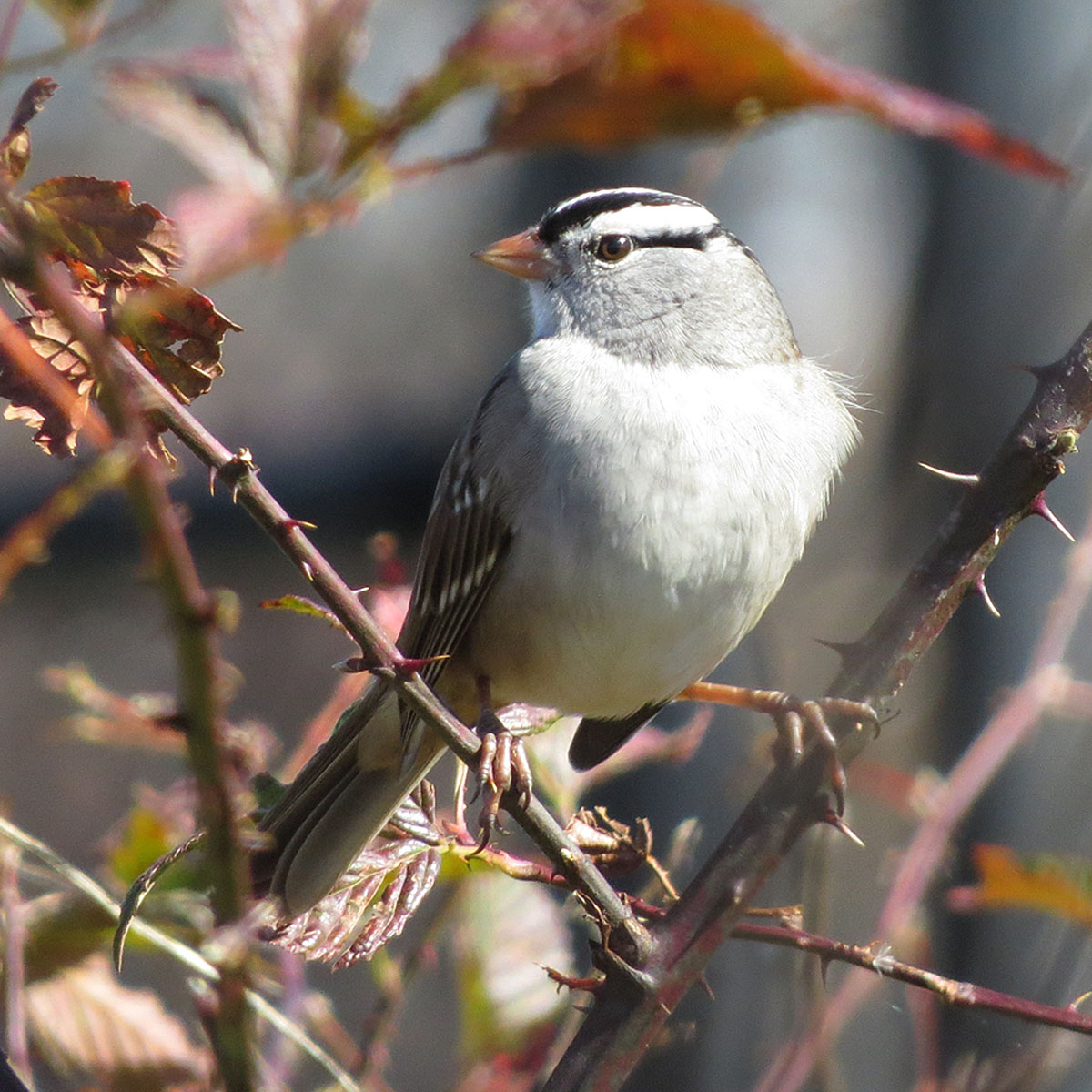
16–18 cm, with a fairly long tail and a pink to orange-yellow bill. The adult has a black-and-white striped crown: a white median stripe, black lateral crown stripes, a white supercilium and a black eyestripe. The face, throat and underparts are plain grey, the flanks brownish. The back is brown with dark streaks, with two white wingbars. The sexes are alike. Immatures have rufous-brown and buff head stripes instead of black and white.
Confusion species
Rufous-collared Sparrow Zonotrichia capensis, the only other Zonotrichia of the guide area, is smaller, with a grey head striped black, a rufous collar and a black patch on the side of the breast. Song Sparrow Melospiza melodia, also an exceptional vagrant, has a densely streaked breast with a central spot.
Habitat
In the breeding range scrub, forest edges, shrubby tundra and mountain meadows; in winter hedgerows, fields, gardens and parks. In the guide area it was seen on a vegetated university campus in the city. Forages on the ground for seeds and insects.
Where the bird is most at home, classified by the vegetation units of the Andes and the west coast.


Range and movements
In Colombia one record: a bird that stayed on the campus of the Universidad Nacional in Bogotá in May and June 2019. No records from Ecuador, Peru, Bolivia or the Galápagos. The range extends from Alaska and Canada to the western United States; the species winters south to central Mexico.
How and when to look
Check sparrows in parks, gardens and pastures in the Andes and on the Caribbean coast of Colombia carefully; a Zonotrichia without a rufous collar and with a grey breast deserves attention. Document a sighting with photographs and report it to the national records committee.
Conservation status
Least Concern. A numerous North American species, recorded in the guide area only exceptionally as a vagrant.
Scientific name
Zonotrichia leucophrys | (Forster, 1772)
Forster described the species in 1772 as Emberiza leucophrys; because it was later moved to another genus, the author and year stand in brackets. The genus Zonotrichia was introduced in 1832 by Swainson. The genus name comes from Greek zōnē, 'band', and thrix, 'hair', referring to the striped head. The species name comes from Greek leukos, 'white', and ophrus, 'eyebrow', referring to the white head stripes. The specimen the first description was based on came from Severn River, Hudson Bay, Ontario, Canada.