All species › Passerines › New World sparrows › Song Sparrow
Song Sparrow | Melospiza melodia
Zanggors | Chingolo cantor | Tico-tico-cantor
The Song Sparrow is one of the most widespread sparrows of North America, with dozens of subspecies ranging from pale grey to dark rufous-brown. Northern birds migrate in winter to the southern United States and Mexico. In the guide area it is at most an exceptional vagrant.
Voice
The song is a varied series of three or four clear introductory notes, followed by a trill and a rapid jumble. The call is a heavy chep.
Recording: Lars Mogensen — CC BY-NC-SA 4.0 · xeno-canto
Identification
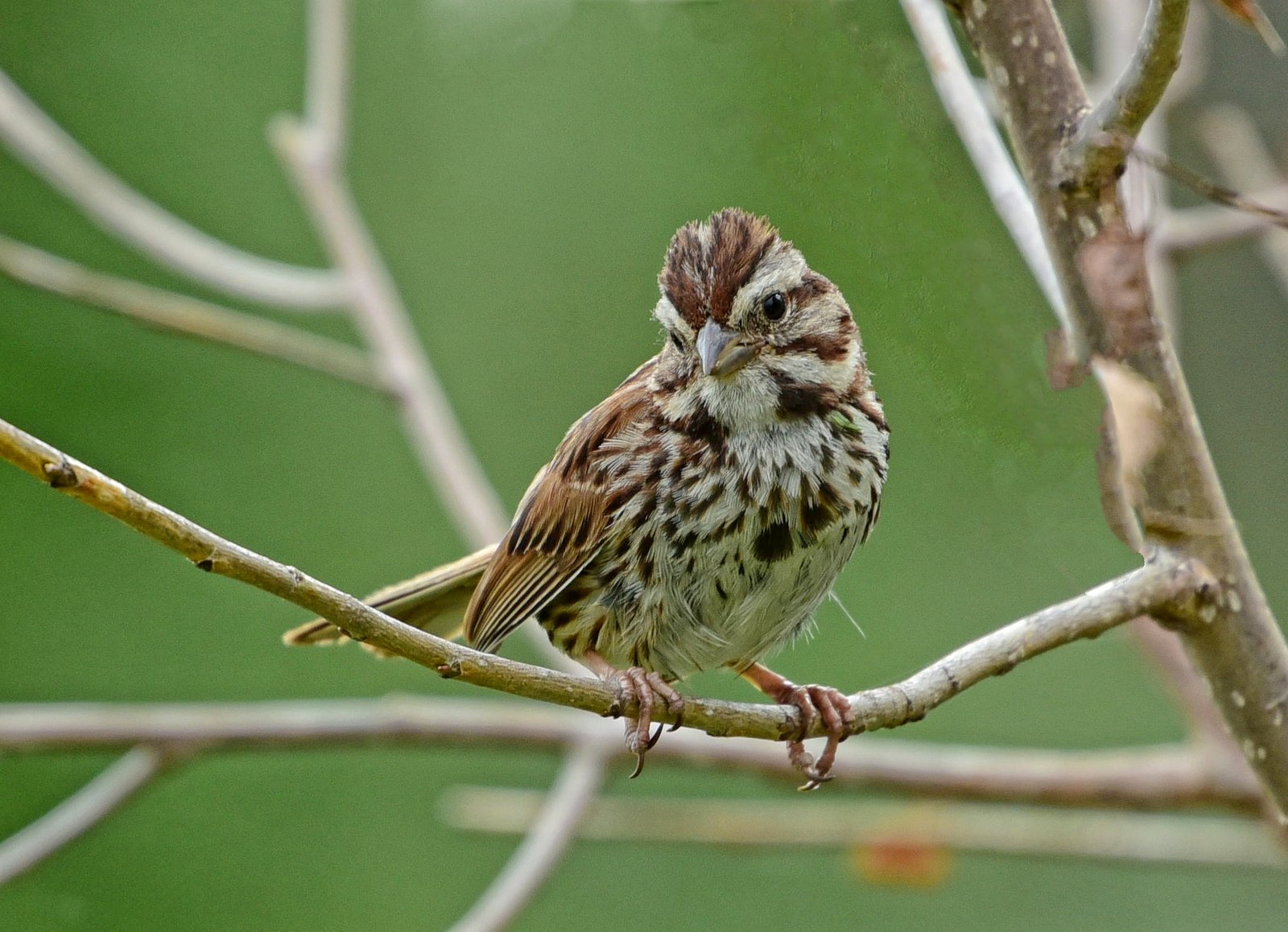
15–17 cm, with a fairly long, rounded tail that is pumped up and down in flight. The head is grey, with a brown crown with a grey median stripe, a brown eyestripe and a dark malar stripe beside a white throat. The breast and flanks are white with dense brown streaks that merge into a dark spot in the centre of the breast. The upperparts are brown with dark streaks. The sexes are alike. Juveniles are buffier, with finer streaks.
Confusion species
Lincoln's Sparrow Melospiza lincolnii, another vagrant from North America, is smaller, with a buffy breast band with fine black streaks and a grey face. Juvenile Rufous-collared Sparrows Zonotrichia capensis are also streaked, but more finely and without a central breast spot, and already show a trace of the adult head pattern. White-crowned Sparrow Zonotrichia leucophrys has a plain grey breast.
Habitat
Scrub, hedgerows, waterside vegetation, marsh edges, gardens and shrubby pastures, often near water. Forages on the ground and in low vegetation for insects and seeds. The nest is a grass cup on the ground or low in a shrub.
Where the bird is most at home, classified by the vegetation units of the Andes and the west coast.


Range and movements
Not reliably recorded in the guide area; reports from Colombia or Ecuador are not well documented. No records from Peru, Bolivia or the Galápagos. The range extends from Alaska and Canada to central Mexico; northern birds winter south to northern Mexico.
How and when to look
Check any heavily streaked sparrow with a central breast spot in scrub or marsh edges carefully, and rule out juvenile Rufous-collared Sparrow and Lincoln's Sparrow. Document a possible sighting with photographs and a sound recording.
Conservation status
Least Concern. A numerous North American species, occurring in the guide area at most exceptionally as a vagrant.
Scientific name
Melospiza melodia | (Wilson, 1810)
Wilson described the species in 1810 as Fringilla melodia; because it was later moved to another genus, the author and year stand in brackets. The genus Melospiza was introduced in 1858 by Baird. The genus name comes from Greek melos, 'song', and spiza, 'finch': a singing finch. The species name is Latin melodia (from Greek), 'melody, song', referring to the song. The specimen the first description was based on came from Philadelphia, Pennsylvania, United States.