All species › Passerines › New World sparrows › Lincoln's Sparrow
Lincoln's Sparrow | Melospiza lincolnii
Lincolns gors | Chingolo de Lincoln | Tico-tico-de-lincoln
Lincoln's Sparrow is a small, finely streaked sparrow that breeds in wet thickets and bogs in Canada, Alaska and the western United States and winters from the southern United States to Central America. In the guide area it is a very rare vagrant, with only a few records in northern Colombia.
Voice
The call is a sharp chip and a thin, buzzy zeet. The song, not to be expected in the guide area, is a rapid, bubbling series of trills recalling a wren.
Recording: Stanislas Wroza — CC BY-NC-SA 4.0 · xeno-canto
Identification
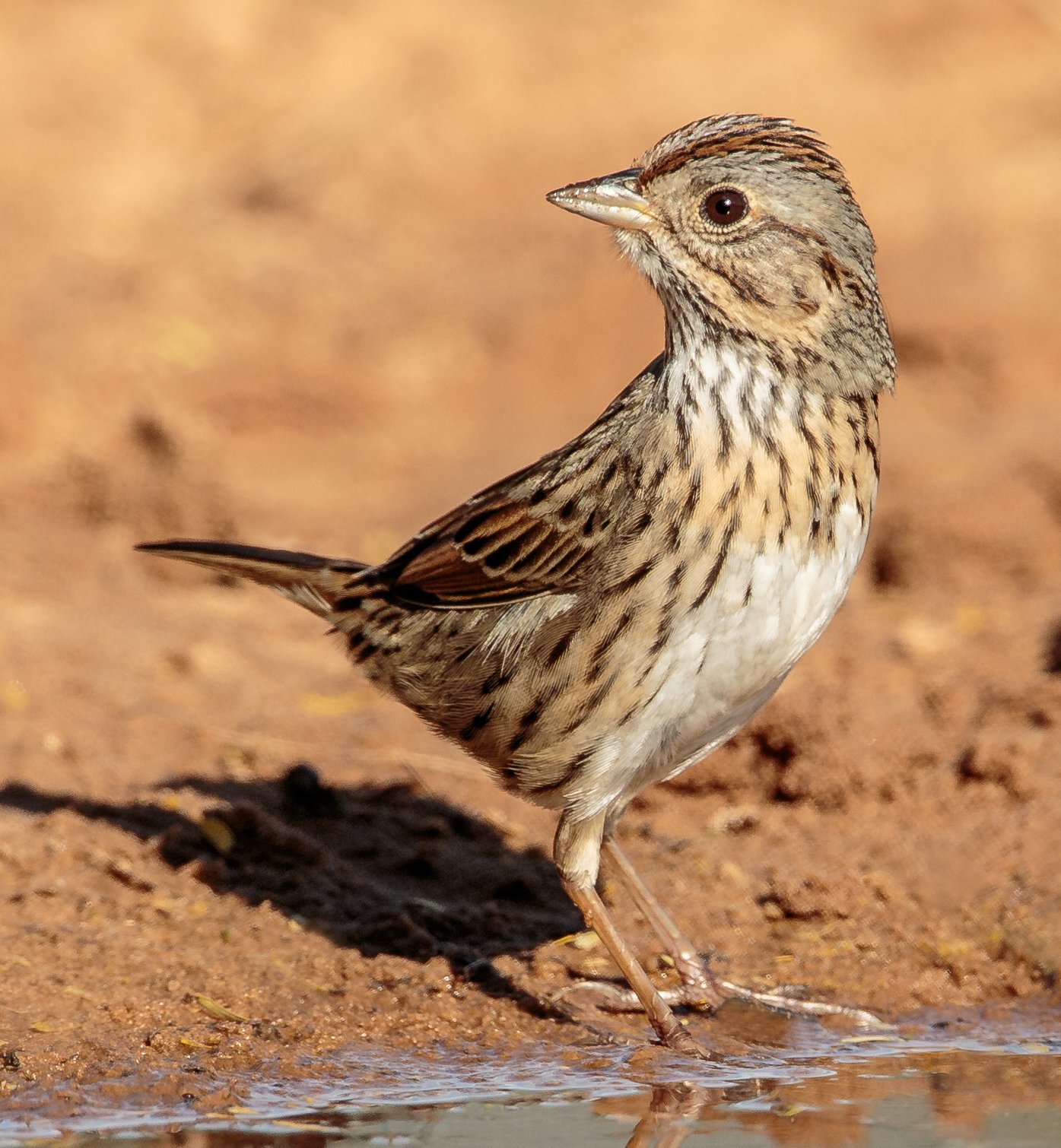
13–15 cm, with a small, pointed bill, a slight crest and a fairly short tail. The crown is rufous-brown with a grey median stripe; the supercilium and cheeks are grey, with a narrow brown eye-stripe and a pale eye-ring. A warm buff breast band and flanks are finely and sharply streaked black; the belly is white and unstreaked. The upperparts are brown with black streaks. The sexes are alike; juveniles are paler and more heavily streaked.
Confusion species
Song Sparrow Melospiza melodia, also a vagrant, is larger, with coarser brown streaks, a dark central breast spot and no buff breast band. Rufous-collared Sparrow Zonotrichia capensis has a rufous collar, a black patch on the side of the breast and an unstreaked breast. Grasshopper Sparrow Ammodramus savannarum has a flat head, an unstreaked buffy breast and a shorter tail.
Habitat
In winter dense, often damp thickets, rank growth along forest edges, overgrown fields and marsh edges. It feeds on or near the ground on seeds and insects and usually stays hidden in cover. The nest is on the ground in wet vegetation, on the breeding grounds far outside the guide area.
Where the bird is most at home, classified by the vegetation units of the Andes and the west coast.


Range and movements
In the guide area only a few records in northern Colombia. Not known from Ecuador, Peru, Bolivia or the Galápagos. Outside the guide area it breeds in Alaska, Canada and the western United States and winters from the southern United States to Central America, rarely to Panama.
How and when to look
A bird in the guide area is most likely between October and April in rank scrub in northern Colombia. Look for a small, streaked sparrow with a buff breast band briefly leaving cover, and listen for the sharp chip.
Conservation status
Least Concern. The species is numerous and widespread in North America.
Scientific name
Melospiza lincolnii | (Audubon, 1834)
Audubon described the species in 1834 as Fringilla Lincolnii; because it was later moved to another genus, the author and year stand in brackets. The genus Melospiza was introduced in 1858 by Baird. The genus name comes from Greek melos, 'song', and spiza, 'finch': a singing finch. The species name honours Thomas Lincoln (1812–1883) of Dennysville, Maine, a travelling companion of John James Audubon who shot the first specimen. The specimen the first description was based on came from Mouth of the Natashquan River, Quebec, Canada.