All species › Passerines › New World blackbirds, troupials and allies › Bobolink
Bobolink | Dolichonyx oryzivorus
Bobolink | Tordo arrocero | Triste-pia
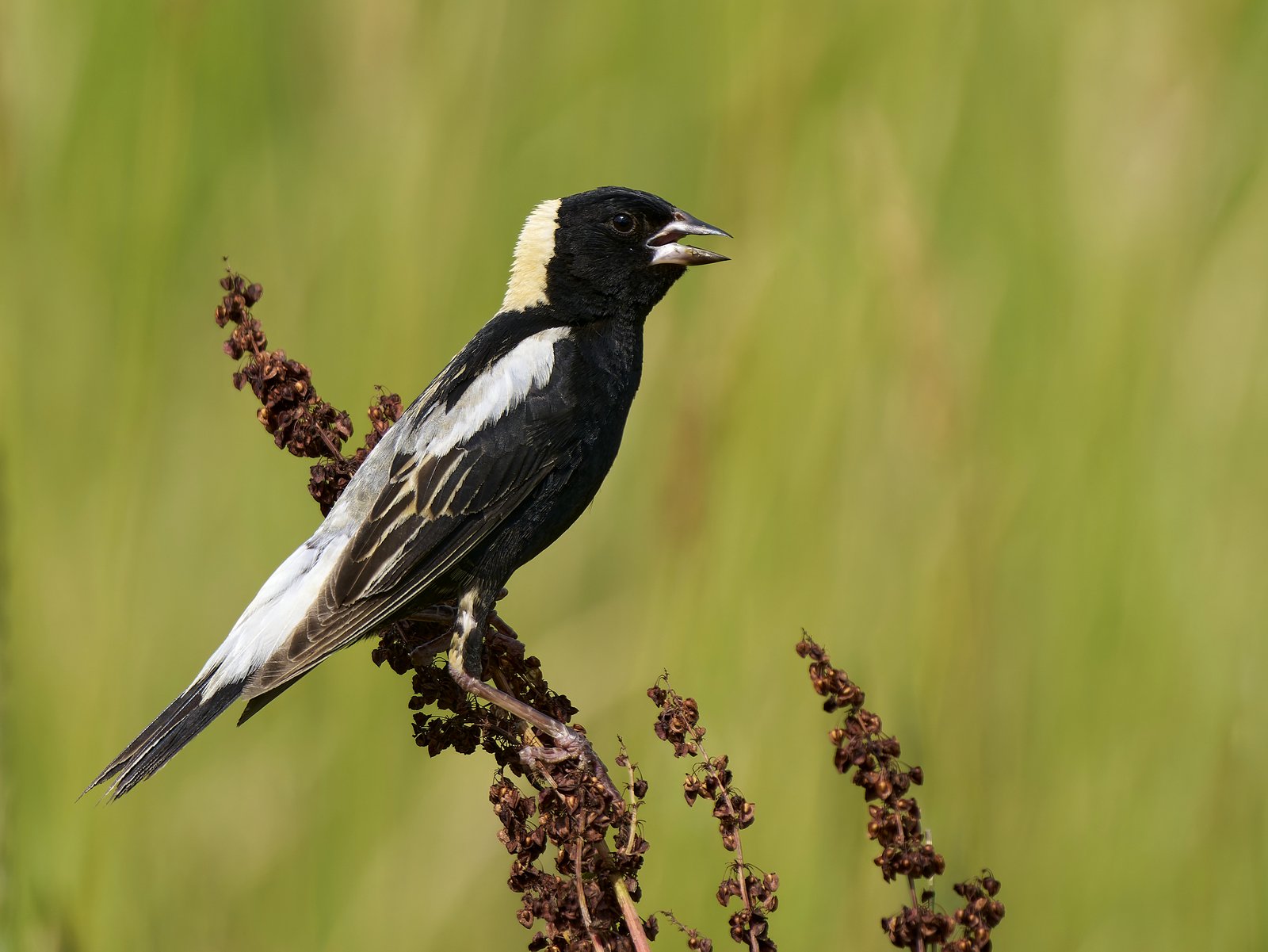
The Bobolink is a small, sparrow-like blackbird that makes one of the longest migrations of any songbird: from the grasslands of North America to the pampas and savannas south of Amazonia. The breeding male is black with a straw-coloured nape and white shoulders and rump; outside the breeding season both sexes resemble a large, buffy sparrow. In the guide area it is mainly a passage migrant, also on the Galápagos.
Voice
On migration mainly the call, a metallic, rising pink, often heard from flocks flying high overhead. The song, a rapid bubbling jumble, is rarely heard in the guide area.
Recording: Stanislas Wroza — CC BY-NC-SA 4.0 · xeno-canto
Identification
16–18 cm, with a short, conical bill and spiky tail feathers. Outside the breeding season, the plumage most often seen in the guide area, both sexes are buffy, with dark streaks on the crown and back, a pale central crown stripe, a dark eyestripe and fine streaks on the flanks; the underparts are warm buff. The breeding male (sometimes already on spring passage) is black with a creamy yellow nape and white shoulders and rump. The breeding female resembles the non-breeding plumage.
Confusion species
Dickcissel Spiza americana, another Nearctic migrant, has a grey head, a thicker grey bill and a yellow breast. Female Red-breasted Meadowlarks Leistes militaris are larger, with a longer, pointed bill and a pinkish wash on the belly. Grassland Sparrow Ammodramus humeralis is smaller and greyer, with a yellow spot in front of the eye. Wedge-tailed Grass Finch Emberizoides herbicola has a long, graduated tail.
Habitat
On migration and in winter in open country: rice fields, wet grassland, savannas, pastures and fields with tall grass, from the lowlands up to the Andean plateaus. Feeds mainly on seeds of grasses and grain, especially rice. Breeds in hayfields and prairies in North America; the nest is on the ground.
Where the bird is most at home, classified by the vegetation units of the Andes and the west coast.


Range and movements
In Colombia a passage migrant in the lowlands on both sides of the Andes and locally in the Andes. In Ecuador and Peru a scarce passage migrant, mainly in the eastern lowlands, with scattered records in the west and in the Andes. In Bolivia a passage migrant and winter visitor in the savannas and grasslands of the eastern lowlands. On the Galápagos a fairly regular passage migrant in small numbers, mainly in the northern autumn. Breeds in southern Canada and the northern United States; winters mainly in Paraguay, northern Argentina and adjacent parts of Brazil and Bolivia.
- Winter visitor (c. Oct–Mar)
- Passage (Mar–Apr, Oct–Nov)
- dark = core range, pale = thinly spread
How and when to look
In September–November and March–May watch for small groups of buffy birds flying over with a metallic pink or sitting in rice fields and wet grassland. In Bolivia they can be found in the austral summer in the savannas of the east.
Conservation status
Near Threatened. The species is declining because of early mowing of hayfields on the breeding grounds, control as a pest in rice fields and trapping for the cage-bird trade in the wintering area.
Scientific name
Dolichonyx oryzivorus | (Linnaeus, 1758)
Linnaeus described the species in 1758 as Fringilla oryzivora; because it was later moved to another genus, the author and year stand in brackets. The genus Dolichonyx was introduced in 1827 by Swainson. The genus name comes from Ancient Greek dolikhos, 'long', and onux, 'claw' or 'nail'. The species name comes from Latin oryza, 'rice', and -vorus, 'eating'. The specimen the first description was based on came from South Carolina, United States.