All species › Passerines › New World blackbirds, troupials and allies › Eastern Meadowlark
Eastern Meadowlark | Sturnella magna
Witkaakweidespreeuw | Sabanero | Pedro-ceroulo
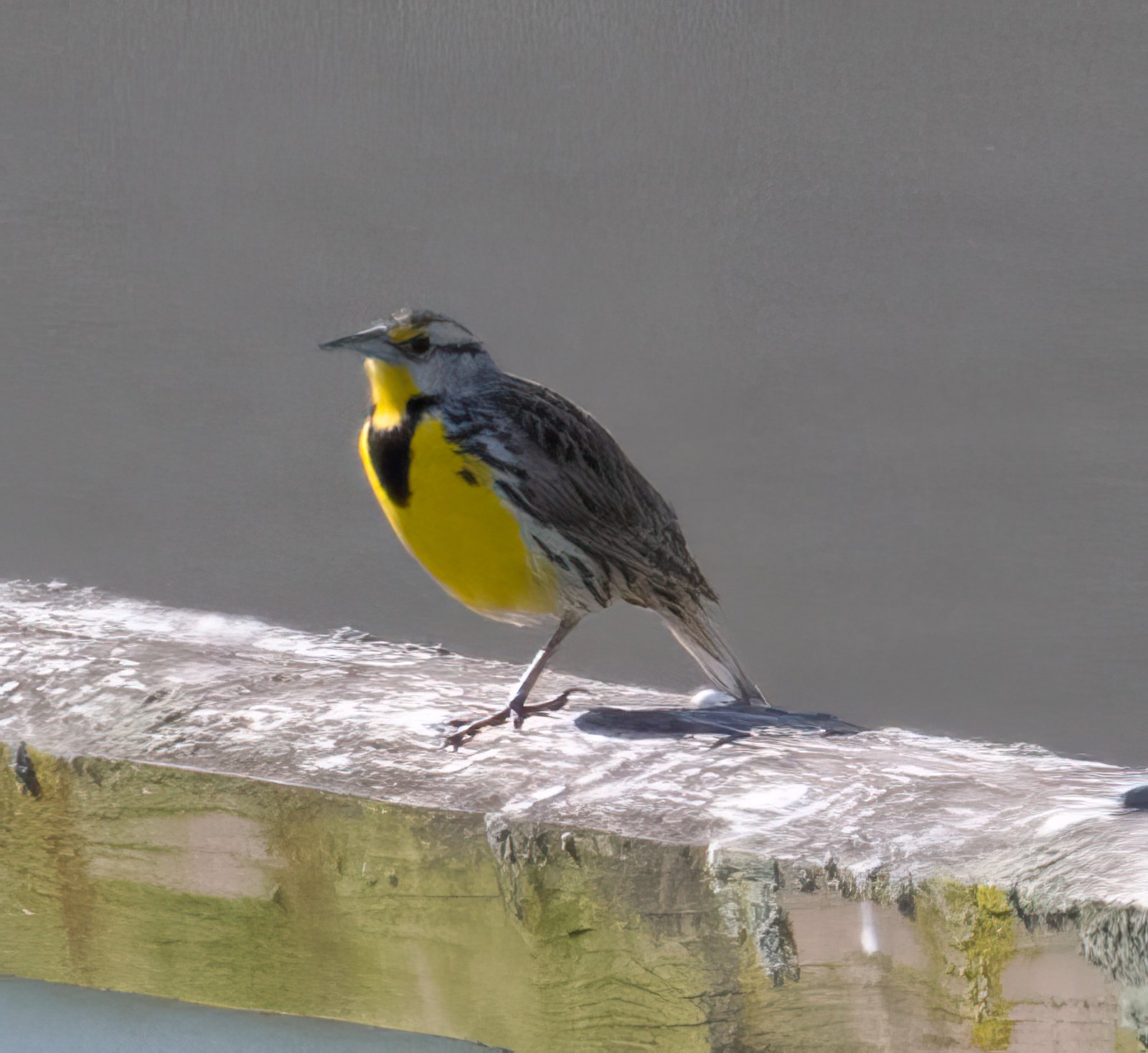
The Eastern Meadowlark is a stocky, short-tailed blackbird of open grassland, with yellow underparts and a black V on the breast. It sings from posts, shrubs and wires with clear, whistled phrases. In the guide area it occurs only in Colombia, both in the lowlands and on the plateaus of the Andes.
Voice
The song is a series of two to five clear, drawn-out whistles, often descending in pitch, delivered from a raised perch. The call is a buzzy dzert and a dry, rattling chatter.
Recording: Manuel Grosselet — CC BY-NC-SA 4.0 · xeno-canto
Identification
21–24 cm, with a long, pointed bill, a flat head and a short tail with white outer feathers, conspicuous when the bird flushes. The upperparts are brown with black and buff streaks and spots. The head has a pale crown stripe, a dark eyestripe and an eyebrow that is yellow in front of the eye and white behind it. The throat, breast and belly are bright yellow, with a broad black V on the breast; the flanks are white with dark spots. The sexes are alike; the female is slightly smaller and duller. Juveniles are paler, with a spotted breast instead of the V.
Confusion species
Red-breasted Meadowlark Leistes militaris is smaller; the male is black with a red throat and breast, and the female is streaked buff with a pinkish wash on the belly, without yellow and without a black V. Grassland Yellow Finch Sicalis luteola also has yellow underparts, but is much smaller, with a short, conical bill and no breast band.
Habitat
Open grassland, savannas, pastures and field edges, from the lowlands of the llanos and the Caribbean region up to the Andean plateaus, locally to about 3000 m. Forages on foot on the ground for insects, especially grasshoppers and beetles, and seeds. The nest is a cup on the ground in a grass tussock, often with a roof of grass.
Where the bird is most at home, classified by the vegetation units of the Andes and the west coast.


Range and movements
In Colombia in the Caribbean lowlands, in the llanos east of the Andes and locally in the valleys and on the plateaus of the Andes, including the Bogotá savanna. Absent from Ecuador, Peru, Bolivia and the Galápagos. Outside the guide area from eastern North America through Central America to Venezuela, the Guianas and northern Brazil.
- Resident
- dark = core range, pale = thinly spread
How and when to look
Look in pastures and savannas for birds singing from posts or small shrubs. In flight short series of rapid wingbeats alternate with glides, and the white outer tail feathers stand out.
Conservation status
Not evaluated in its current species limits. The species is declining steeply in North America through loss of grassland; in the guide area it locally benefits from deforestation and the creation of pastures.
Scientific name
Sturnella magna | (Linnaeus, 1758)
Linnaeus described the species in 1758 as A[lauda] magna; because it was later moved to another genus, the author and year stand in brackets. The genus Sturnella was introduced in 1816 by Vieillot. The genus name is a diminutive of Latin sturnus, 'starling'. The species name is Latin magnus, 'large'. The specimen the first description was based on came from South Carolina, United States.