All species › Passerines › New World blackbirds, troupials and allies › Red-breasted Meadowlark
Red-breasted Meadowlark | Leistes militaris
Zwartkopsoldatenspreeuw | Pastorero pechirrojo | Polícia-inglesa-do-norte
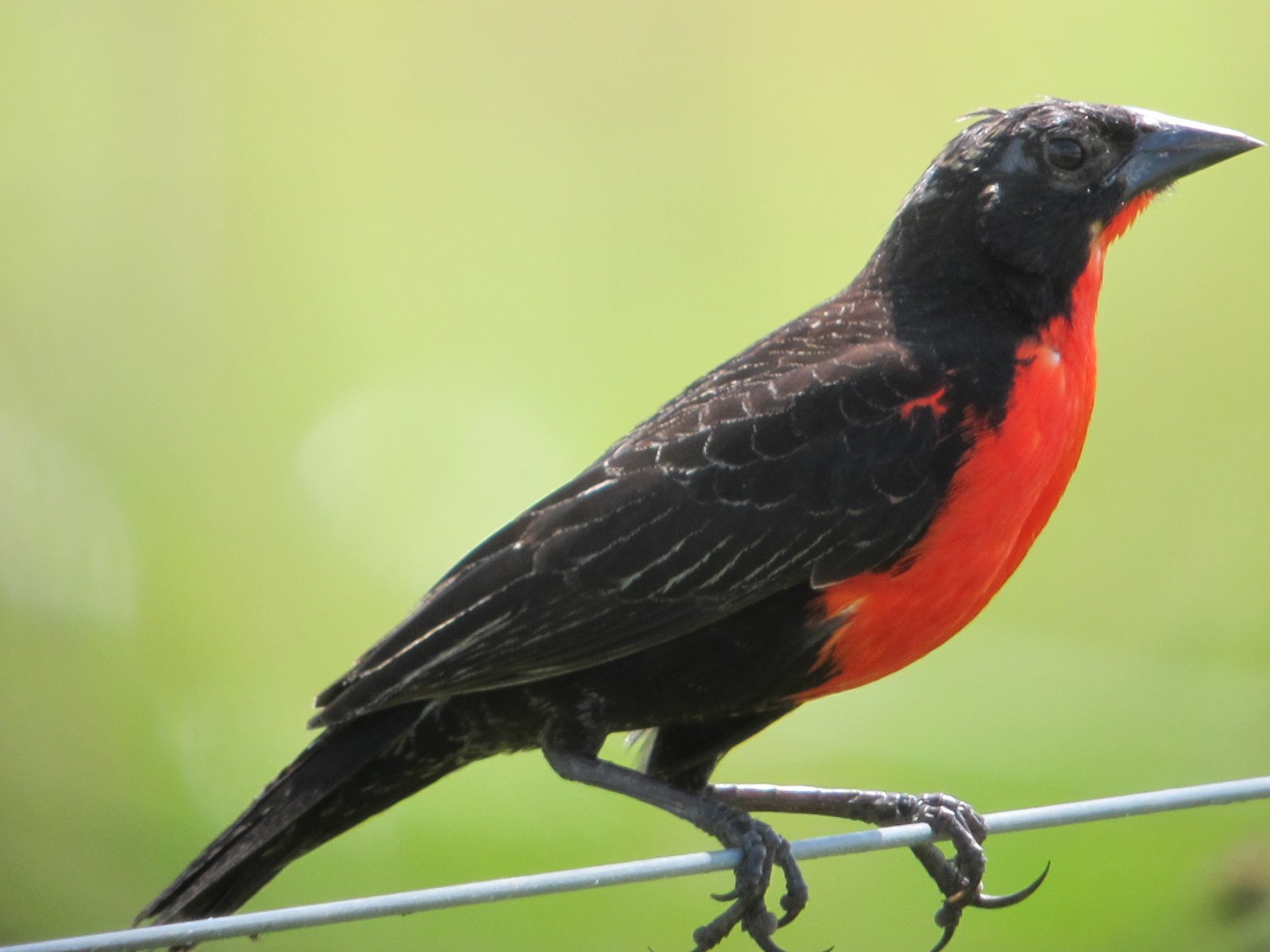
The Red-breasted Meadowlark is a small blackbird of wet grassland and pastures in the lowlands. The male is black with a scarlet throat and breast and sings in a short display flight over the grass. The species is spreading with deforestation and colonises newly created pastures.
Voice
The male sings from a post or during a short flight upwards, after which it descends with spread wings: a short, dry introduction followed by a buzzy, drawn-out tzeeeee. The call is a dry chek.
Recording: JAYRSON ARAUJO DE OLIVEIRA — CC BY-NC-SA 4.0 · xeno-canto
Identification
17–19 cm, with a pointed, fairly long bill and a short tail. The breeding male is black, with a scarlet throat, breast and upper belly and a red bend of the wing; freshly moulted males have brown feather edges that make the black parts look streaked and partly cover the red breast. The female is buffy with black streaks on the head and upperparts, a pale crown stripe and eyebrow, and pale underparts with a pinkish wash on the breast and belly. Juveniles resemble the female.
Confusion species
In White-browed Meadowlark Leistes superciliaris of eastern Bolivia the male has a white eyebrow behind the eye; females of the two species are very similar. Peruvian Meadowlark Leistes bellicosus lives west of the Andes and is larger, with a longer bill and a white eyebrow. Female Bobolinks Dolichonyx oryzivorus are smaller, with a short, conical bill and warm buff underparts without red.
Habitat
Wet and dry grassland, pastures, savannas, rice fields and rank vegetation in cleared areas in the lowlands, locally to about 1500 m in the valleys. Forages on the ground for insects and seeds. The nest is a grass cup on the ground, hidden in a grass tussock.
Where the bird is most at home, classified by the vegetation units of the Andes and the west coast.


Range and movements
In Colombia in the northern lowlands and in the llanos east of the Andes, and locally in the Magdalena valley and west of the Andes, where it is spreading. In Ecuador in the eastern lowlands, where it is spreading along roads and into new pastures. In Peru in the eastern lowlands, locally in savannas and cleared areas. In Bolivia in the savannas and grasslands of the north and east. Absent from the Galápagos. Outside the guide area from Costa Rica and Panama to Venezuela, the Guianas and Amazonian Brazil.
- Resident
- dark = core range, pale = thinly spread
How and when to look
Look in wet pastures and savannas for males singing from posts or flying up above the grass; the red of the breast contrasts with the green grass.
Conservation status
Least Concern. The species is spreading as forest is converted into pasture.
Scientific name
Leistes militaris | (Linnaeus, 1758) (GBIF: Sturnella militaris)
Linnaeus described the species in 1758 as E[mberiza] militaris; because it was later moved to another genus, the author and year stand in brackets. The genus Leistes was introduced in 1825 by Vigors. The genus name comes from Greek lēistēs, 'robber' or 'plunderer'. The species name is Latin militaris, 'military, soldier-', from miles, 'soldier'. The specimen the first description was based on came from Suriname.