All species › Swifts › Hummingbirds › Green-bearded Helmetcrest
Green-bearded Helmetcrest | Oxypogon guerinii
Groenbaardhelmkolibrie | Chivito de los páramos | Capacete-de-barba-verde
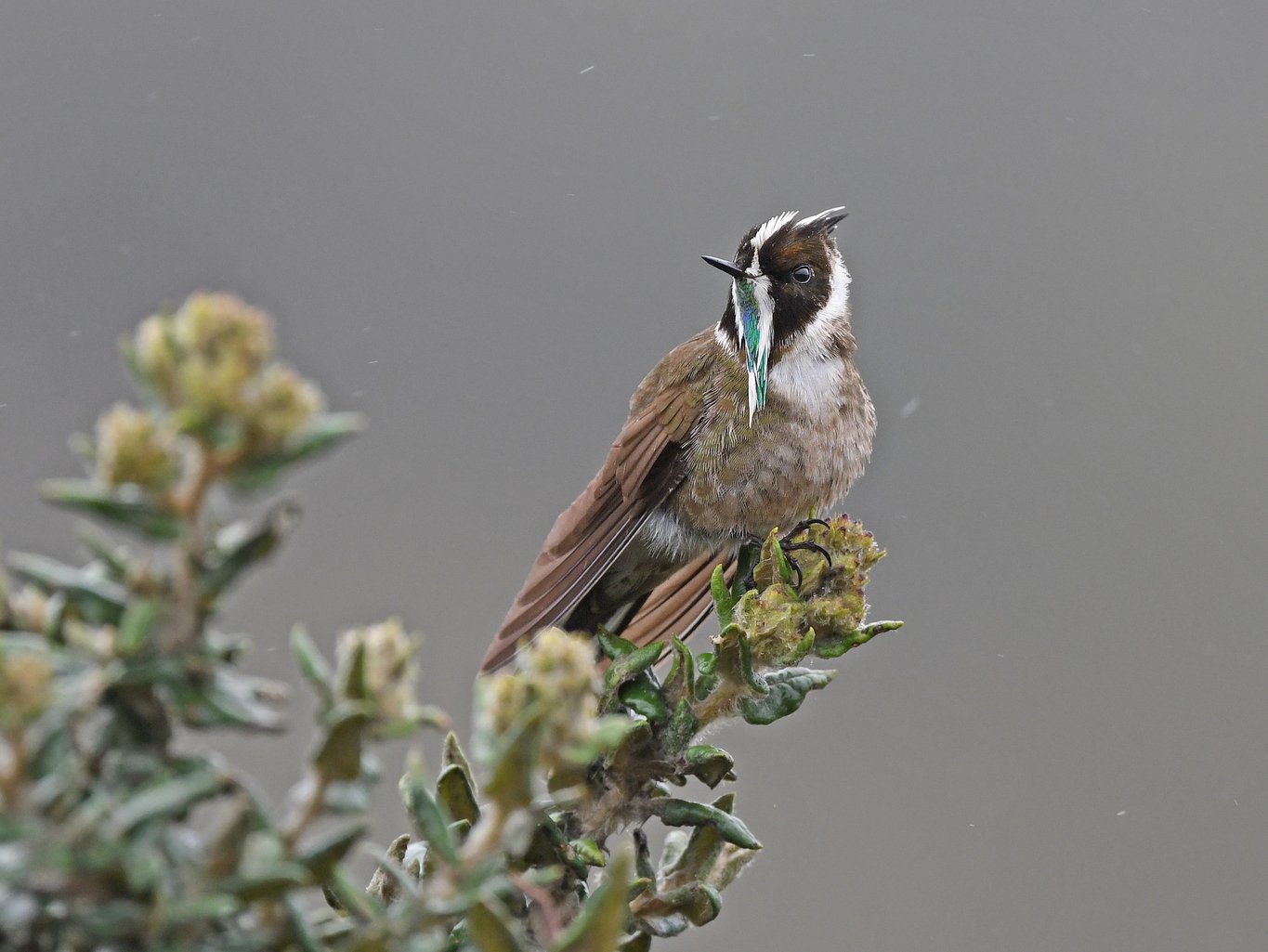
The Green-bearded Helmetcrest is a hummingbird of the páramo of the Eastern Cordillera of Colombia. The male has a long, pointed crest and a narrow beard with a green central stripe. It often feeds low down, clinging to the flowers of frailejones.
Voice
A dry, soft tsik, sometimes repeated; in chases a short twitter.
Recording: Diana Carolina Macana — CC BY-NC-SA 4.0 · xeno-canto
Identification
11–12 cm, with a short, straight black bill. The male has a long, pointed crest of black and white feathers, a black face bordered with white and an elongated beard, white at the sides and glittering green in the centre. The upperparts are dull bronze-green, the underparts greyish olive-brown with paler spots. The forked tail is bronzy, with white in the outer feathers. The female has no crest and no beard, and a white throat with small dark spots. Young males have a short crest and a short beard.
Confusion species
Bronze-tailed Thornbill Chalcostigma heteropogon lives in the same mountains, but has no crest and no black-and-white face, and has a coppery-red rump and a narrow green beard turning pink at the bottom. Tyrian Metaltail Metallura tyrianthina is smaller, plain green and without crest or beard. The other helmetcrests live elsewhere: Buffy Helmetcrest Oxypogon stuebelii in the Central Cordillera and Blue-bearded Helmetcrest Oxypogon cyanolaemus in the Sierra Nevada de Santa Marta.
Habitat
Humid páramo with frailejones, grass tussocks, low shrubs and bogs, roughly between 3000 and 5000 m, mainly above 3200 m; outside the breeding season sometimes lower, down to the treeline. It takes nectar from frailejones (Espeletia) and other low flowers, often perching or clinging, and catches insects close to the ground. It breeds in the rainy season; the nest is made of plant down and placed among the leaves of a frailejón or against a rock face or bank.
Where the bird is most at home, classified by the vegetation units of the Andes and the west coast.


Range and movements
Only in Colombia, in the páramo of the Eastern Cordillera, from Santander and Boyacá south into Cundinamarca. Absent from Ecuador, Peru, Bolivia and the Galápagos. Does not occur outside the guide area; a related helmetcrest lives in the Andes of Venezuela.
- Resident
- dark = core range, pale = thinly spread
How and when to look
In Chingaza National Park and in the Sumapaz páramo, a few hours' drive from Bogotá, at flowering frailejones. Males often perch on a rock or on the flower stalk of a frailejón.
Conservation status
Least Concern. The páramo is locally degraded by fires, cattle ranching and potato farming.
Scientific name
Oxypogon guerinii | (Boissonneau, 1840)
Boissonneau described the species in 1840 as Ornismia Guerinii; because it was later moved to another genus, the author and year stand in brackets. The genus Oxypogon was introduced in 1848 by Gould. The genus name combines Greek oxus, 'sharp, pointed', with pōgōn, 'beard'. The species name honours Félix Édouard Guérin-Méneville (1799–1874), a French entomologist and naturalist. The specimen the first description was based on came from Bogotá, Colombia.