All species › Swifts › Hummingbirds › Buffy Helmetcrest
Buffy Helmetcrest | Oxypogon stuebelii
Purperbaardhelmkolibrie | Chivito del Ruiz | Capacete-amarelado
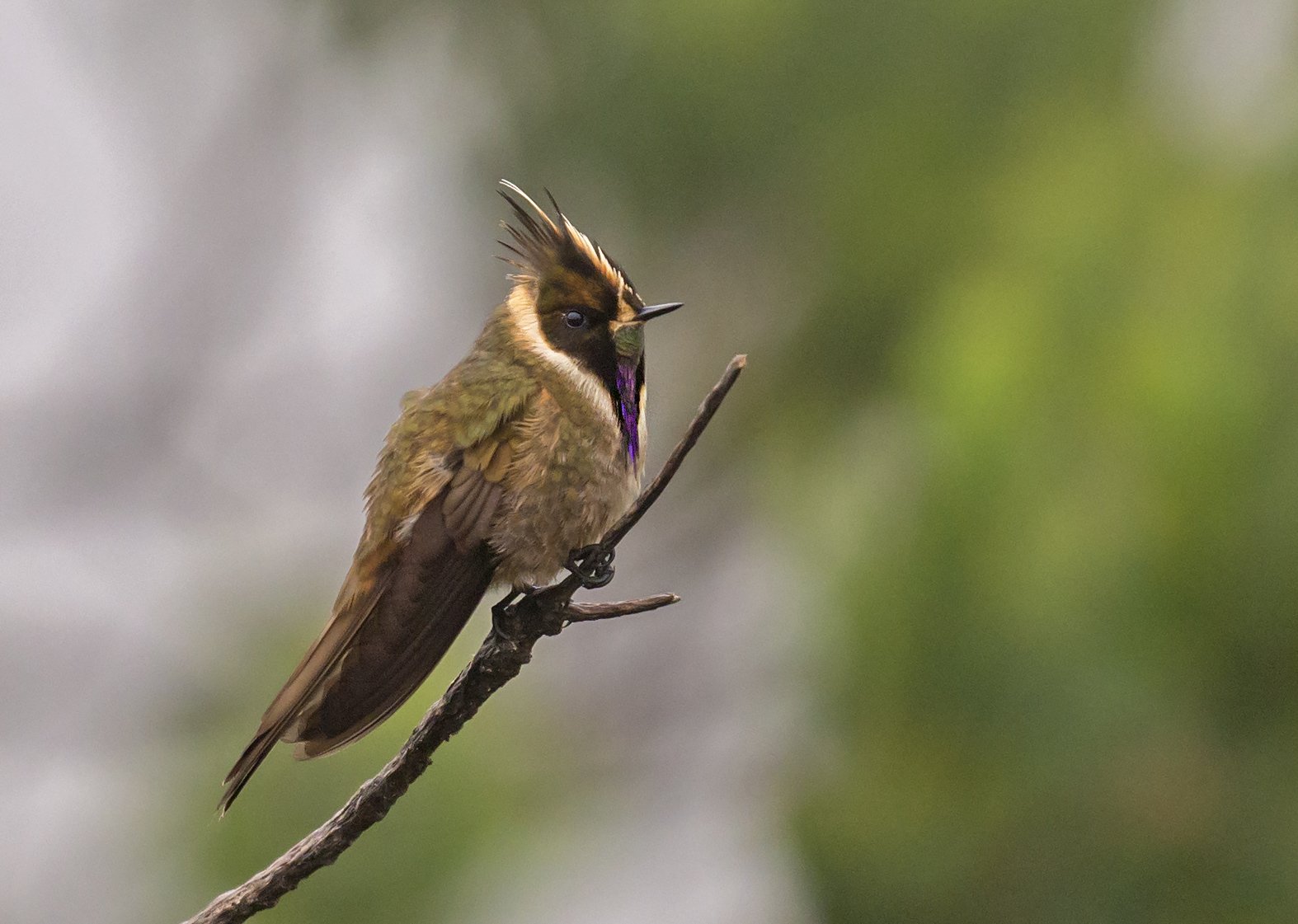
The Buffy Helmetcrest lives only in the high mountains around the Nevado del Ruiz volcano in the Central Cordillera of Colombia. It is the least white and most buffy of the helmetcrests, with a long crest of buffy and black feathers. It is closely tied to the frailejones of the high páramo.
Voice
Poorly documented; a soft, dry tsit.
Recording: JULIAN ANDRES ZULETA MARIN — CC BY-NC-SA 3.0 · xeno-canto
Identification
11–13 cm, with a short, straight black bill. The male has a long crest of buffy and black feathers, a mostly black face with a buffy collar and a narrow, elongated beard of glittering green and blue. The upperparts are bronze-green, the underparts greyish bronze, becoming cinnamon-buff towards the undertail coverts. The slightly forked tail is coppery to bronze-green, with white in the outer feathers. The female has no crest and no beard and is rufous-buff below with small green spots. Young males have a short crest and a short beard.
Confusion species
Rainbow-bearded Thornbill Chalcostigma herrani lives on nearby Nevado del Tolima, but has no crest, and has a rufous crown, a multicoloured beard and white tail tips. Tyrian Metaltail Metallura tyrianthina is smaller, plain green and without crest or beard. Shining Sunbeam Aglaeactis cupripennis is larger and largely cinnamon, without crest or beard, and lives lower, at the treeline. Green-bearded Helmetcrest Oxypogon guerinii of the Eastern Cordillera is whiter, with a white collar and a green beard.
Habitat
Open, humid páramo with frailejones, up into the superpáramo, roughly between 3800 and 4800 m; in the dry season possibly somewhat lower. It takes nectar while clinging to the flowers, especially of frailejones (Espeletia), rather than hovering. It catches insects and larvae on the ground, with short jumps or in the air, or picks them from plants. Little is known about its breeding.
Where the bird is most at home, classified by the vegetation units of the Andes and the west coast.


Range and movements
Only in Colombia, in the Central Cordillera around Nevado del Ruiz and the adjacent mountains in Caldas, Tolima, Risaralda and Quindío, largely within Los Nevados National Park. Absent from Ecuador, Peru, Bolivia and the Galápagos. Does not occur outside the guide area.
- Resident
- dark = core range, pale = thinly spread
How and when to look
In the páramo along the road to Nevado del Ruiz, at flowering frailejones, especially in the morning. The volcano is active and access to the park is sometimes closed during periods of increased activity.
Conservation status
Vulnerable. The range is very small; outside the national park the páramo is deteriorating rapidly through cattle ranching, farming and fires. The population is estimated at fewer than 1000 mature birds and is probably declining.
Scientific name
Oxypogon stuebelii | Meyer, 1884
Meyer described the species in 1884 and placed it straight away in the genus where it still stands. The genus Oxypogon was introduced in 1848 by Gould. The genus name combines Greek oxus, 'sharp, pointed', with pōgōn, 'beard'. The species name honours Alphons Stübel (1835–1904), a German geologist and volcanologist who travelled in the Andes. The specimen the first description was based on came from Nevado del Tolima, Colombia.