All species › Swifts › Hummingbirds › Rufous-capped Thornbill
Rufous-capped Thornbill | Chalcostigma ruficeps
Roodkruindoornsnavel | Picoespina gorrirrufo | Bico-de-espinho-de-coroa-ruiva
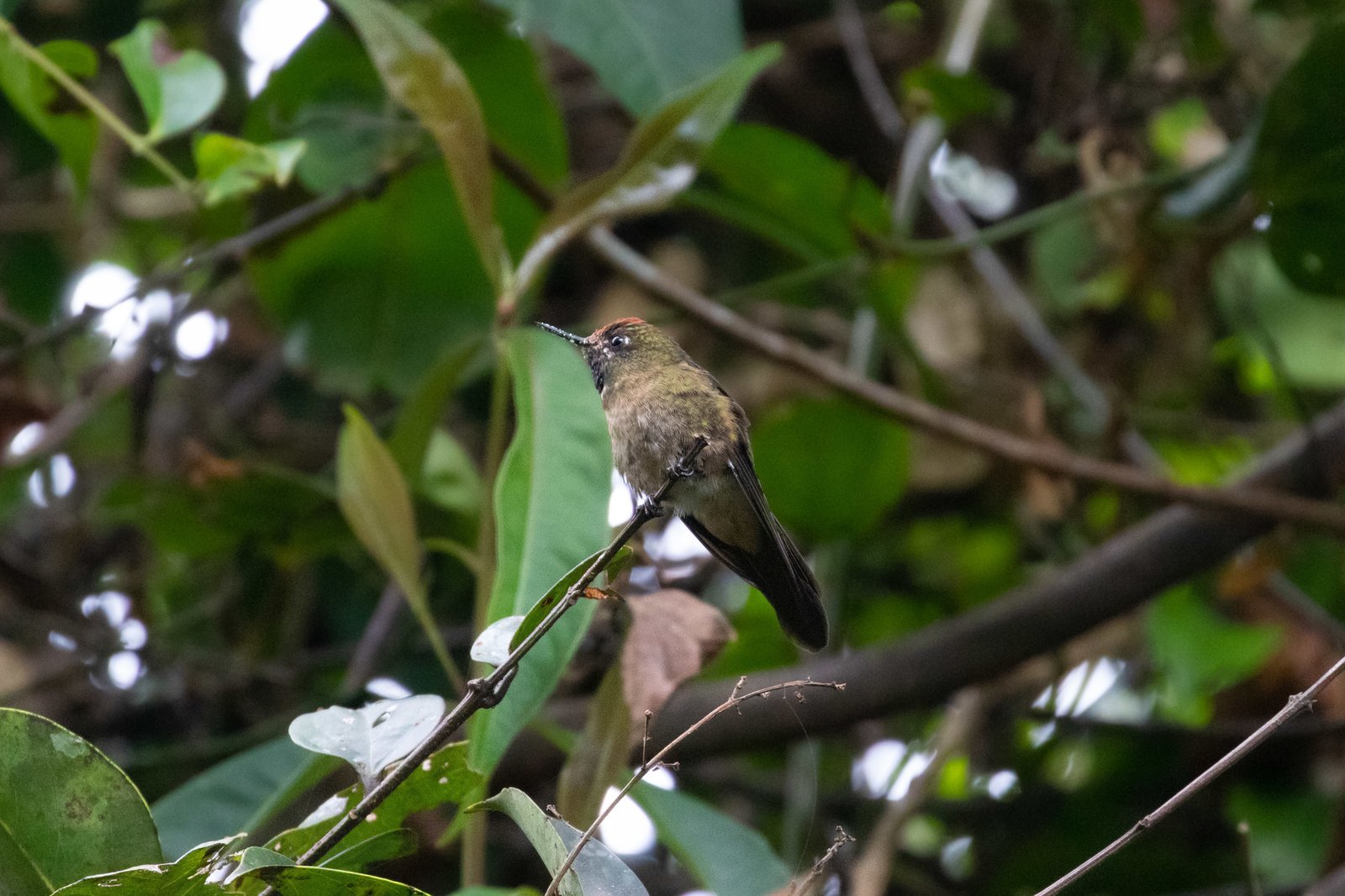
The Rufous-capped Thornbill is the smallest thornbill and the only one that lives mainly in montane forest, lower than its relatives of the páramo and puna. It has a very short bill; the male has a rufous crown. Males defend flowering shrubs as feeding territories.
Voice
Little studied. A short, dry double rattle and a rising and falling twitter.
Recording: Lelis Navarrete — CC BY-NC-SA 4.0 · xeno-canto
Identification
10 cm, with a very short, straight black bill. The male has a rufous crown, bottle-green upperparts and rufous underparts mottled with green, especially on the flanks; on the throat is a narrow, glittering green beard edged with yellow. The tail is dull olive-green. The female has a green crown, an ochre-orange throat and breast with olive-green dots, and pale tips to the outer tail feathers.
Confusion species
Rainbow-bearded Thornbill Chalcostigma herrani also has a rufous crown, but is larger, with white tail tips and a multicoloured beard, and lives higher, in páramo and scrub above the treeline. Purple-backed Thornbill Ramphomicron microrhynchum has an even shorter bill; the male is purple above and lacks a rufous crown. Tyrian Metaltail Metallura tyrianthina has a slightly longer bill, a reddish tail and no rufous crown; the female has a cinnamon throat without dots.
Habitat
Humid montane forest, cloud forest, forest edges and secondary forest on the eastern slope of the Andes, mostly between 1400 and 3500 m, commonest around 2500 m; it may move up and down the slope with the seasons. It takes nectar at low to middle heights, especially from flowers of Melastomataceae, usually clinging to the flower. It also steals nectar through holes at the base of flowers, including those made by flowerpiercers (Diglossa). It also catches insects.
Where the bird is most at home, classified by the vegetation units of the Andes and the west coast.


Range and movements
In Ecuador on the eastern slope in the south-east, mainly in Zamora-Chinchipe. In Peru on the eastern slope of the Andes along almost the whole length of the country. In Bolivia on the eastern slope in La Paz and Cochabamba. In Colombia only as a rare vagrant; absent from the Galápagos. Does not occur outside the guide area.
- Resident
- dark = core range, pale = thinly spread
How and when to look
At flowering shrubs along forest edges beside the roads over the eastern slope, such as the Manu road in Cusco. Males often return to the same flowering shrubs.
Conservation status
Least Concern. The species also occurs in secondary forest; deforestation on the eastern slope locally reduces its habitat.
Scientific name
Chalcostigma ruficeps | (Gould, 1846)
Gould described the species in 1846 as Trochilus (--?) ruficeps; because it was later moved to another genus, the author and year stand in brackets. The genus Chalcostigma was introduced in 1854 by Reichenbach. The genus name combines Greek khalkos, 'bronze', with stigmē, 'spot' or 'mark', referring to the beard of the Bronze-tailed Thornbill. The species name combines Latin rufus, 'red', with -ceps, '-headed', referring to the rufous crown. The specimen the first description was based on came from Bolivia.